The deadline registerInternational student · since 1 August 2026
French student residence permit: resources, work and renewal in 2026
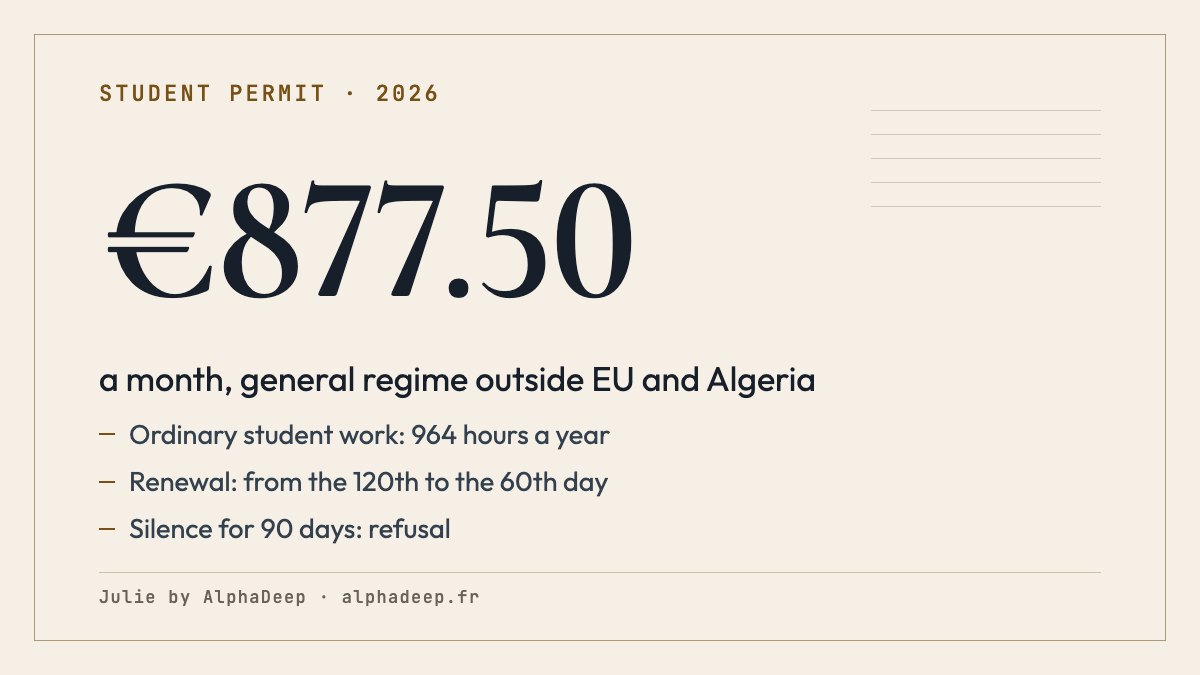
Outside EU/EEA/Switzerland and Algeria, a student card or validated VLS-TS follows the general regime: 47% of the gross monthly SMIC since 1 August 2026, €877.50; ordinary student employment up to 964 hours a year without authorisation; renewal from the 120th to the 60th day before expiry (CESEDA R422-2, R431-5; Labour Code R5221-26). Short visas and work forming part of studies require separate checks.
Go to the tool: the deadline register
Julie by AlphaDeep is an AI legal assistant for French law: it researches official references to help answer your questions (Légifrance, case law, service-public), analyses your documents and drafts your letters, for individuals and professionals alike.
General legal information with official references and dated checks. It is not personalised advice: for a decision that commits you, have your situation checked by a qualified professional.

Let’s look at your situation
Give your nationality, document, duration and work type, then the expiry date, resources and study situation.
Example questions
Your question carries over after signup. Maximum 400 characters. Avoid health data and names.
When should you renew your student permit, and are your resources enough?
First check nationality, document, duration and work type. In the annual general regime, confirm the filing-date threshold and the counted 12-month period, then enter the permit expiry date, the start of that period, your resources and hours worked: the register places the filing window and counts the hours left. The example: a card issued on 20 January 2026, €900 a month and 520 hours already worked.
Fictional example · student permit register
File the renewal application online between 21 September 2026 and 20 November 2026.
- Resources required
- €877.50 a month
- Your resources
- At least equal to the threshold
- Hours of work left
- 444 of 964
Days left: to be calculated
Start of the 964-hour work year: card issue, VLS-TS validation or annual anniversary
Online filing of the renewal application opens (120th day before expiry)
Last day to file the application on time; after that, a €180 regularisation visa fee, except in case of force majeure or presentation of a valid visa
End of validity of the current permit or visa
End of the work year: the 964-hour count then starts again
Threshold worked out on the gross monthly SMIC of €1,867.02 in force since 1 June 2026: it follows the SMIC on the day the application is filed.
Do these rules cover your nationality and residence document?
The register applies the general student-card or validated student VLS-TS regime, for an annual stay and ordinary salaried student work, outside EU, EEA, Switzerland and Algeria. Also confirm that the resources threshold applies to your application, without a competitive-exam exemption. It stops when the applicable threshold, counted annual period, document, duration or work type differs or is unknown: general calculations then confirm none of your rights.
For an Algerian student, ordinary employment needs authorisation obtained by the employer and is limited to 50% of annual working time in the branch or profession, with no universal hourly number. A six-month visa requires authorisation and work time proportional to the studies; apprenticeship, professional training and work forming part of a course have specific rules (F2713). European students have a distinct regime (F13519).
Sources: Service-public F2231 · Service-public F2713 · Service-public F13519
Which resources must you show for a French student residence permit?
In the general regime outside EU/EEA/Switzerland and Algeria, at least 47% of the full-time gross monthly SMIC in force on the day of the application (CESEDA, article R422-2, created by decree no. 2026-526 of 22 June 2026). With the gross monthly SMIC of €1,867.02 in force since 1 June 2026, that makes €877.50 a month, the amount shown by service-public. The threshold applies to applications filed since 1 August 2026.
Accepted proofs include a grant certificate, the last 3 payslips, support from a third party with regular transfers, or a sufficient bank balance, with one proof per resource, according to service-public. A student admitted by competitive exam to a school linked to the State by an agreement does not have to show resources on first admission (article L422-2).
Sources: CESEDA R422-2 · Decree no. 2026-526 · Service-public F2231 · CESEDA L422-2
How many hours can a foreign student work in France?
For ordinary student employment under the general regime outside EU/EEA/Switzerland and Algeria, with a student card or validated student VLS-TS: 964 hours a year, 60% of the legal annual working time, without a work authorisation (CESEDA, article L422-1, and Labour Code, article R5221-26). The year runs from the issue of the card or the validation of the long-stay visa (VLS-TS), according to service-public: a permit issued on 1 September 2025 opens 964 hours until 31 August 2026.
The employer declares the hiring to the prefecture at least 2 working days before it starts (Labour Code, articles L5221-9 and R5221-27). Going over the limit exposes you to withdrawal and refusal to renew the permit; a validated apprenticeship contract allows work beyond it, according to service-public.
Sources: CESEDA L422-1 · C. trav. R5221-26 · Service-public F2713
When and how do you apply to renew the student permit?
For a student card or VLS-TS under the general regime, between the 120th and the 60th day before the permit expires (CESEDA, article R431-5), online only; the filing certificate is issued immediately. A late temporary-card application adds a €180 regularisation visa fee to the €100 tax, except in case of force majeure or presentation of a valid visa, according to service-public.
The prefecture decides within 90 days of the complete application; silence beyond that counts as refusal (CESEDA, article R422-5), which can be challenged within 2 months. After a year in France, renewal can give a multi-year card covering the years left in the course of study, according to service-public.
Sources: CESEDA R431-5 · CESEDA R422-5 · Service-public F2231
How does the prefecture judge whether your studies are genuine?
On the whole course since arriving in France: attendance, exam results, diplomas obtained and explanations given for any change of direction, according to service-public. Repeating one year per cycle of study does not, on its own, call into question the genuine nature of the studies.
The renewal file therefore attaches the transcripts for the past year, the certificate of success and the last diploma obtained in France, with the enrolment or pre-enrolment for the coming year.
Source: Service-public F2231
Which documents should you attach to the renewal application?
The general regime outside EU/EEA/Switzerland and Algeria, published by service-public; other documents follow their own procedure.
- Document 1
Long-stay visa or residence permit still valid
The document you are asking to renew.
- Document 2
Proof of address and e-photo
A proof dated less than 6 months ago and the code of the digital identity photo.
- Document 3
Enrolment or pre-enrolment
Issued by the higher education institution, public or private.
- Document 4
Transcripts, certificate of success, last diploma
They are used to assess whether the studies are real and serious.
- Document 5
Proof of resources
Grant, payslips, transfers from a third party or bank balance, for at least €877.50 a month.
- Document 6
Commitment to respect the principles of the Republic
A signed copy.
Which amounts and time limits apply to the student permit?
General regime outside EU/EEA/Switzerland and Algeria, student card or validated VLS-TS; ordinary salaried student work.
| Rule | Figure | Text |
|---|---|---|
| Minimum resources | 47% of the gross monthly SMIC, that is €877.50 a month | CESEDA R422-2 |
| Work without authorisation | 964 hours a year | C. trav. R5221-26 |
| Employer’s declaration | 2 working days before hiring | C. trav. R5221-27 |
| Validating the VLS-TS | Within 3 months after arrival, €100 tax | Service-public F2231 |
| Renewal application | From the 120th to the 60th day before expiry | CESEDA R431-5 |
| Late application | €180 regularisation visa fee, except force majeure or a valid visa | Service-public F2231 |
| Prefecture’s answer | 90 days after a complete application; silence counts as refusal | CESEDA R422-5 |
| After a master’s degree | One-year card subject to conditions: degree, previous permit, health insurance and project | CESEDA L422-10 |
For other nationalities, short visas or work forming part of studies, check the specific rules before calculating. The resources threshold follows the SMIC in force on the day of filing: it rises with each increase.
Sources: CESEDA R422-2 · C. trav. R5221-26 · CESEDA R431-5 · CESEDA R422-5 · Service-public F2231 · CESEDA L422-10
What changed for foreign students in France in 2026?
Two decrees of June 2026 changed the required resources and housing aid.
For foreign holders of a student visa or permit covered by article L822-2, housing aid requires eligibility for a higher-education means-tested grant, alongside the general aid conditions; apprentices, holders of a professional training contract and students carrying out professional activity are deemed to meet this eligibility condition (Construction and Housing Code, article L822-2, decree no. 2026-552 of 27 June 2026).
Source: CCH L822-2
The resources threshold moves from €615 a month, the amount of the French Government grant unchanged since 2002, to 47% of the gross monthly SMIC, that is €877.50 (decree no. 2026-526 of 22 June 2026).
Sources: Decree no. 2026-526 · CESEDA R422-2
What does article R422-2 of the CESEDA provide on resources?
Article R422-2 is the text of the resources threshold, created by the decree of 22 June 2026.
Pour l’application des articles L. 422-1, L. 422-4, L. 422-5 et L. 422-6, l’étranger justifie disposer de moyens d’existence mensuels correspondant au moins à 47 % du montant brut du salaire minimum de croissance mensuel en vigueur au jour du dépôt de sa demande pour une activité à temps plein.
In English, briefly (our summary, not an official translation): For articles L422-1, L422-4, L422-5 and L422-6, the foreign national shows monthly means of subsistence of at least 47% of the gross monthly minimum wage (SMIC) for full-time work in force on the day the application is filed. According to the notes to the decree, 47% of the gross SMIC equals 60% of the net SMIC; the rule applies to applications filed since 1 August 2026.
What do foreign students ask before their permit expires?
Can a foreign student be self-employed (auto-entrepreneur)?
No. The student residence card does not allow work as a micro-entrepreneur, according to service-public; the 964-hour cap covers ordinary student employment in the general regime outside EU/EEA/Switzerland and Algeria; other cases follow F2713.
What if the prefecture does not answer the application?
For the general student-card regime, with no decision 90 days after the complete application, silence counts as an implicit refusal (CESEDA, article R422-5). This refusal is challenged within 2 months by an appeal to the prefect or the minister, or before the administrative court, where a lawyer is not compulsory, according to service-public.
How much does the student residence permit cost?
In the general regime outside EU/EEA/Switzerland and Algeria, validating the VLS-TS costs €100, as does the temporary student residence card (tax and stamp duty). A multi-year student card costs €150. A renewal application filed late adds a €180 regularisation visa fee, except in case of force majeure or presentation of a valid visa (service-public, fiche F2231).
Can you get a student card for several years?
In the general regime outside EU/EEA/Switzerland and Algeria, yes, after a year on a VLS-TS or a student card: subject to resources and real, serious studies, the multi-year card covers the years left in the course of study, for example 2 years after a successful first year of a bachelor’s degree (licence), according to service-public.
What happens to the permit after a master’s degree?
In the general CESEDA regime outside EU/EEA/Switzerland and Algeria, the one-year "job search or business creation" card requires health insurance, a previous student card covered by article L422-10 and a degree at least equivalent to a master’s (or on the regulatory list), obtained from a nationally authorised higher-education institution. The purpose must be a first professional experience or a business project in a field matching the course. At the end of the year, a job or job offer related to the course and paid above the regulatory threshold allows the employee, temporary-worker or talent card covered by article L422-11, subject to those provisions.
Which texts set the student permit and its thresholds?
- CESEDA, article R422-2 (resources: 47% of the gross monthly SMIC)Légifrance, in French
- Decree no. 2026-526 of 22 June 2026 updating and indexing the level of students’ resourcesLégifrance, Journal officiel, in French
- CESEDA, article L422-1 (student card, work at 60% of the annual working time)Légifrance, in French
- Labour Code, articles R5221-26 and R5221-27 (964 hours, employer’s declaration)Légifrance, in French
- CESEDA, article R431-5 (time limit for filing the renewal application)Légifrance, in French
- CESEDA, article R422-5 (decision within 90 days, silence counting as refusal)Légifrance, in French
- "Student" visa or residence card (fiche F2231)Service-public.fr, in French · checked by the publisher on 1 August 2026
- Can a non-European student work in France? (fiche F2713)Service-public.fr, in French · checked by the publisher on 7 October 2025
- CESEDA, articles L422-10 and L422-11 ("job search or business creation" card)Légifrance, in French
- Labour Code, article L5221-9 (prior named declaration)Légifrance, in French
- CESEDA, article L422-2 (admission by competitive exam, without a resources condition)Légifrance, in French
- Can a European student work in France? (F13519, in French)Service-public.fr
- Construction and Housing Code, article L822-2, and decree no. 2026-552 of 27 June 2026 (housing aid)Légifrance, in French
Texts cited last checked: 30 September 2026