The filing deskUndocumented foreign workers
Regularisation through work in France in 2026: exceptional admission and shortage occupations
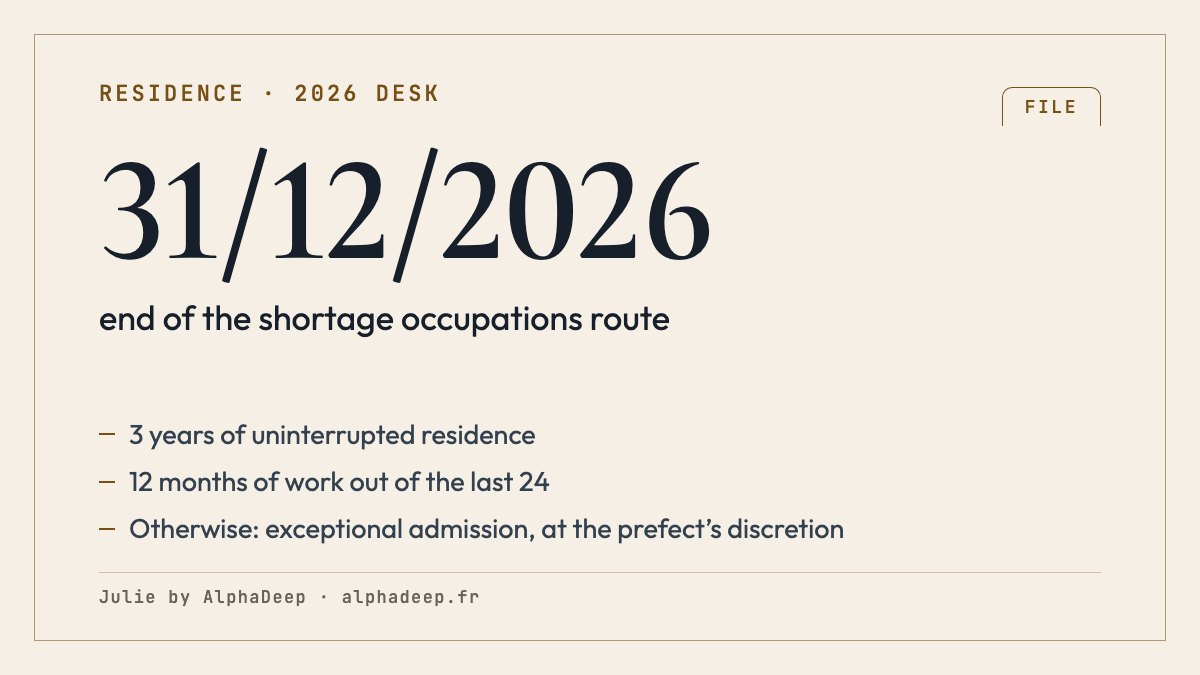
A foreign national without a permit can apply for work-based regularisation. Until 31 December 2026, CESEDA article L435-4 requires 3 years’ continuous residence, 12 months’ salaried work in 24 in a listed occupation and region, and a matching current job. Residence and work under student cards, seasonal worker cards or asylum attestations are excluded. Article L435-1 provides exceptional admission at the prefect’s discretion, possibly requiring 7 years’ presence.
Go to the tool: the filing desk
Julie by AlphaDeep is an AI legal assistant for French law: it researches official references to help answer your questions (Légifrance, case law, service-public), analyses your documents and drafts your letters, for individuals and professionals alike.
General legal information with official references and dated checks. It is not personalised advice: for a decision that commits you, have your situation checked by a qualified professional.

Let’s look at your situation
Give your years in France, your occupation and your months of work, without names.
Example questions
Your question carries over after signup. Maximum 400 characters. Avoid health data and names.
Which route to regularisation through work is open to you?
Enter your presence in France, your months of work and your occupation: the desk ticks off the conditions of the "shortage occupations" route and otherwise points you to exceptional admission. The example is 4 years of presence and 14 months of work in a construction occupation on the regional list.
Fictional example · eligibility desk
The date of application must be checked before assessing this temporary scheme.
Conditions of article L435-4
- At least 3 years of uninterrupted residence in France
- At least 12 months of salaried work, consecutive or not, in the last 24 months
- An occupation on your region’s shortage list
- A job held today in that occupation
- No conviction, legal incapacity or disqualification recorded on bulletin no. 2 of the criminal record
None of these routes is an automatic right: the prefect also weighs integration, social inclusion and public order.
Which documents should you gather for the prefecture file?
Service-public.fr lists the documents for each route; the work authorisation form depends on the route chosen.
- Document 1
Passport
Civil-status pages, validity dates, entry stamps and visas; otherwise, a nationality certificate less than 6 months old with a photo.
- Document 2
Full copy of the birth certificate
With the most recent annotations and, if needed, the decision ordering its transcription.
- Document 3
Proof of address and 3 photos
The proof must be less than 6 months old.
- Document 4
Proof of presence in France
Dated documents covering each period relied on, without gaps, for the 3 years of the "shortage occupations" route.
- Document 5
Proof of salaried work
Payslips, bank statements or transfers, a certificate of employment, a France Travail statement, a tax notice covering the periods worked.
- Document 6
Work authorisation form
Shortage occupations: the application you fill in yourself, without the employer. Exceptional admission: form Cerfa no. 15186, completed and signed by the employer.
- Document 7
Employment contract
A permanent contract or the current contract, proving the job held today.
Shortage occupations or exceptional admission: what are the differences?
The shortage occupations route sets precise conditions but stops on 31 December 2026; exceptional admission has no end date but depends entirely on the prefect’s discretion.
| Point | Shortage occupations | Exceptional admission |
|---|---|---|
| Text | CESEDA, art. L435-4 | CESEDA, art. L435-1 |
| Presence in France | 3 years of uninterrupted residence | Case by case; 7 years may be required, according to service-public.fr |
| Work | 12 months out of the last 24 in a shortage occupation, and a current job in that occupation | Humanitarian considerations or exceptional grounds, often an established job |
| Work form | Application filled in yourself, without the employer | Cerfa no. 15186 signed by the employer |
| Card obtained | One-year "employee" or "temporary worker" card | "Employee", "temporary worker" or "private and family life" card |
| Criminal record | A conviction, legal incapacity or disqualification recorded on bulletin no. 2 rules out this route | Weighed with public order |
| End of the scheme | 31 December 2026 | No end date |
Periods spent on a seasonal worker card, a student card or an asylum application attestation do not count for the shortage occupations route (article L435-4). Beyond 10 years of habitual residence, the prefect must consult the residence permit commission before refusing exceptional admission (article L435-1).
Sources: CESEDA L435-4 · CESEDA L435-1 · Service-public F16053
What has changed for regularisation through work?
The shortage occupations route is temporary: created in January 2024, it stops at the end of 2026, and fees rose on 1 May 2026.
Article L435-4 of the CESEDA creates the shortage occupations route, until 31 December 2026 (article 27 of law no. 2024-42 of 26 January 2024).
Source: CESEDA L435-4
A circular sets the guidelines for examining applications for exceptional admission to residence, according to service-public.fr.
Source: Service-public F16053
A ministerial order sets the new list of occupations and geographical areas with recruitment difficulties, by region.
Source: Order of 21 May 2025
The fee for a first permit rises to €300, and the regularisation visa fee to €300, of which €100 is non-refundable and paid when the application is filed (articles L436-1 and L436-4, law no. 2026-103 of 19 February 2026).
Sources: CESEDA L436-1 · CESEDA L436-4
End of the period during which article L435-4 applies under article 27 of the law of 26 January 2024. Article L435-1 remains a route to work-related exceptional admission to residence.
Source: CESEDA L435-4
What will happen to the shortage occupations route after 31 December 2026?
The verified version of article 27 of the law of 26 January 2024 provides for article L435-4 to apply until 31 December 2026. Article L435-1 remains a route to work-related exceptional admission to residence.
The article does not say how applications filed before that date and examined after it will be handled. The safest course is to file a complete application as early as possible, with all the proof of presence and work.
Sources: CESEDA L435-4 · CESEDA L435-1
What does the prefecture’s silence on your application mean?
Silence for 4 months on a residence permit application counts as an implicit refusal (CESEDA, articles R*432-1 and R432-2). You then have 2 months to bring an administrative appeal or go to the administrative court, according to service-public.fr.
In the shortage occupations route, a complete application gives a receipt (récépissé) that allows you to work. If the receipt expires with no answer, ask the prefecture to renew it.
Sources: CESEDA R432-2 · Service-public F16053
What can make the application fail?
A threat to public order bars the card (CESEDA, article L412-5), and a conviction, legal incapacity or disqualification recorded on bulletin no. 2 of the criminal record closes the shortage occupations route. Service-public.fr also cites polygamy.
The prefect also weighs the reality of the work, social and family integration, and adherence to the principles of the Republic, which you undertake to respect by a commitment contract (articles L435-4 and L412-7).
Sources: CESEDA L435-4 · CESEDA L412-5 · Service-public F16053
What does article L435-4 of the CESEDA say about shortage occupations?
Here is the first paragraph, which sets the three conditions of presence and work; the text remains in force until 31 December 2026.
A titre exceptionnel, et sans que les conditions définies au présent article soient opposables à l’autorité administrative, l’étranger qui a exercé une activité professionnelle salariée figurant dans la liste des métiers et zones géographiques caractérisés par des difficultés de recrutement définie à l’article L. 414-13 durant au moins douze mois, consécutifs ou non, au cours des vingt-quatre derniers mois, qui occupe un emploi relevant de ces métiers et zones et qui justifie d’une période de résidence ininterrompue d’au moins trois années en France peut se voir délivrer une carte de séjour temporaire portant la mention « travailleur temporaire » ou « salarié » d’une durée d’un an.
In English, briefly (our summary, not an official translation): Exceptionally, and without the conditions in the article being binding on the administration, a foreign national who has worked as an employee in an occupation on the list of occupations and areas with recruitment difficulties (article L414-13) for at least twelve months, consecutive or not, in the last twenty-four months, who holds a job in those occupations and areas and who shows at least three years of uninterrupted residence in France may be issued a one-year temporary residence card marked "temporary worker" or "employee". The words "exceptionally" and "without the conditions being binding" mean that meeting the conditions opens the possibility of a card, without guaranteeing it.
Which questions come up during the procedure?
Do you need the employer’s agreement for regularisation through work?
Not for the shortage occupations route: according to service-public.fr, you fill in the work authorisation application yourself, without the employer. For exceptional admission, form Cerfa no. 15186 must be completed and signed by the employer.
How many payslips must you provide?
For shortage occupations, enough to prove at least 12 months of work out of the last 24, consecutive or not. For exceptional admission, no text sets a number: the prefecture weighs the whole working history.
Can you work while the application is examined?
In the shortage occupations route, yes, once a complete application has given a receipt allowing you to work, according to service-public.fr. For exceptional admission, check the wording on your receipt.
What should you do after a refusal of regularisation?
An express refusal usually comes with an obligation to leave France (OQTF), with short appeal time limits; it is challenged before the administrative court, where a lawyer is not compulsory. After an implicit refusal, the time limit is 2 months. Read the decision and its means of appeal without delay.
Which texts is this regularisation desk based on?
- CESEDA, article L435-4 (shortage occupations, in force until 31 December 2026)Légifrance, in French
- CESEDA, articles L435-1 and L432-14 (exceptional admission, residence permit commission)Légifrance, in French
- CESEDA, articles L412-5, L412-7 and L432-1 (public order, commitment contract)Légifrance, in French
- CESEDA, articles R*432-1 and R432-2 (implicit refusal after 4 months)Légifrance, in French
- CESEDA, article L436-4 (regularisation visa fee, version of 1 May 2026)Légifrance, in French
- CESEDA, article L436-1 (first-issue tax, version of 1 May 2026)Légifrance, in French
- Order of 21 May 2025 setting the list of occupations and geographical areas with recruitment difficultiesLégifrance, Journal officiel, in French
- What is regularisation of a foreign national through work? (fiche F16053)Service-public.fr, in French
Texts cited last checked: 24 September 2026