The letterAdministration · Letter of appeal
Administrative appeal in France: the recours gracieux, its deadline, the administration’s silence and the letter to send
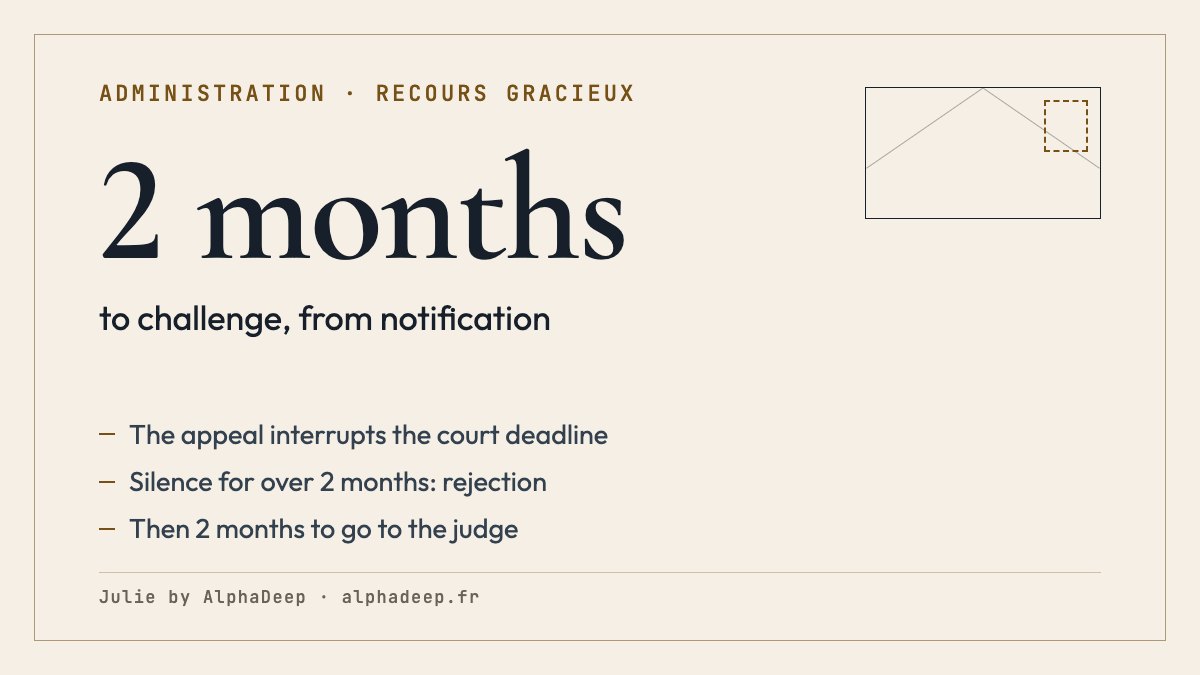
For an ordinary individual decision, a recours gracieux or hiérarchique lodged within the court deadline, generally 2 months, interrupts it (CRPA L411-2). Outside special regimes, silence for over 2 months is a rejection. The new court deadline depends notably on a compliant acknowledgment and any express response (L112-6, R421-2). A compulsory prior appeal follows its own text: check the notification before applying this calendar.
Julie by AlphaDeep is an AI legal assistant for French law: it researches official references to help answer your questions (Légifrance, case law, service-public), analyses your documents and drafts your letters, for individuals and professionals alike.
General legal information with official references and dated checks. It is not personalised advice: for a decision that commits you, have your situation checked by a qualified professional.

Let’s look at your situation
Give the administration, the decision you received and its date, what it says about appeals, and what you are challenging.
Example questions
Your question carries over after signup. Maximum 400 characters. Avoid health data and names.
Recours gracieux, hiérarchique or RAPO: which one should you send?
The recours gracieux goes to the administration that took the decision; the recours hiérarchique, to the authority above it. The compulsory prior administrative appeal, or RAPO, is the one a text requires before any court case (Code of Relations between the Public and the Administration, article L410-1).
Outside a RAPO, the first two are optional and can be filed together: the court deadline then restarts only once both are rejected (article L411-2). When a RAPO applies, the notification must say so, with the authority to write to and the deadline (article L412-3).
This guide prepares an optional appeal against an ordinary decision, outside special regimes. For a residence-permit refusal guide (in French) or an AAH disability-benefit compulsory appeal, follow the dedicated procedure; do not transfer this calendar.
Sources: CRPA L410-1 · CRPA L411-2 · CRPA L412-3
What is the deadline for a recours gracieux?
The deadline for going to the administrative court: 2 months from the notification or publication of the decision (Code of Administrative Justice, article R421-1). Service-public.fr gives 3 months overseas and 4 months for someone living abroad, the distance extensions of article R421-7.
The deadline binds you only if the notification stated the remedies and deadlines (article R421-5). Otherwise, the Conseil d’État as a general rule allows a challenge within a reasonable time of one year from notification (13 July 2016, no. 387763).
Sources: CJA R421-1 · CJA R421-5 · CJA R421-7 · CE, Ass., 13 juill. 2016, n° 387763 · Service-public F2474
What happens if the administration does not answer?
Silence for more than 2 months on an administrative appeal counts as a rejection (Code of Relations between the Public and the Administration, articles L411-7 and L231-4), unless a text sets another period (article L231-6).
A new 2-month deadline to go to court then runs from that implied rejection; an express rejection arriving before it ends starts it again (Code of Administrative Justice, article R421-2). Enforceability depends notably on a compliant acknowledgment; its absence or missing information falls under L112-6. Prove the filing date: keep sending and receipt evidence.
Sources: CRPA L411-7 · CRPA L231-4 · CRPA L231-6 · CJA R421-2 · CRPA L112-6
Must the administration acknowledge receipt of the appeal?
In principle yes, including an appeal by the decision’s addressee; L112-3 nevertheless excludes abusive requests and certain requests with a short response period or limited to a service or document (Code of Relations between the Public and the Administration, articles L112-3 and L411-3).
If no acknowledgment reached you, or it lacks the required information, the deadlines do not bind you, unless an express decision was properly notified to you before the implied rejection arose (article L112-6).
Sources: CRPA L411-3 · CRPA L112-3 · CRPA L112-6
What does article L411-2 of the French Code of Relations between the Public and the Administration say?
The text that lets a recours gracieux buy time without losing the court.
Toute décision administrative peut faire l’objet, dans le délai imparti pour l’introduction d’un recours contentieux, d’un recours gracieux ou hiérarchique qui interrompt le cours de ce délai.
Lorsque dans le délai initial du recours contentieux ouvert à l’encontre de la décision, sont exercés contre cette décision un recours gracieux et un recours hiérarchique, le délai du recours contentieux, prorogé par l’exercice de ces recours administratifs, ne recommence à courir à l’égard de la décision initiale que lorsqu’ils ont été l’un et l’autre rejetés.
In English, briefly (our summary, not an official translation): Any administrative decision may, within the time allowed for bringing a court action, be the subject of a recours gracieux or hiérarchique, which interrupts that time. When both a recours gracieux and a recours hiérarchique are brought within the initial court deadline, the court deadline, extended by those appeals, starts running again against the initial decision only once both have been rejected. Our note: interrupting means starting from zero, so, outside special regimes, the full 2 months after rejection remain subject to the enforceability conditions of L112-6 and R421-5; an appeal sent after the initial deadline interrupts nothing.
Until when can you send the appeal, and when must you go to court?
The calendar covers an ordinary decision, an optional appeal and residence in metropolitan France; it does not cover residence permits, public-service employment relations or special deadlines. A RAPO produces a letter without calculating its deadline. Give the date of the decision, the date it was notified, whether it stated the remedies and deadlines, whether a RAPO applies, and the date your appeal was received if it has gone, a compliant acknowledgment and no express rejection. Also confirm that no other appeal is pending: the letter dates each step and drafts the appeal, in French, for the French authority. The example: a decision of 2 January 2026, notified on 5 January, appeal received on 16 February, compliant acknowledgment, no answer or other appeal.
Fictional example · the appeal to the administration
Deadline interrupted: with no answer, implied rejection on 16 April 2026, then the 2-month court reference is 16 June 2026, subject to the conditions confirmed below.
- Initial 2-month reference
- 5 March 2026
- Implied rejection, with no answer
- 16 April 2026
- 2-month court reference
- 16 June 2026
Lettre recommandée avec accusé de réception, ou formulaire en ligne de l’administration
[Vos nom et prénom][Votre adresse]
[Service ou autorité qui a pris la décision][Adresse]
À [ville], le [date]
ObjetRecours gracieux contre la décision du 2 janvier 2026
Madame, Monsieur,
Par une décision du 2 janvier 2026, qui m’a été notifiée le 5 janvier 2026 (référence [référence du dossier]), vous avez [ce que la décision a fait : refusé, retiré, suspendu…].
Je forme contre cette décision un recours gracieux, en application des articles L410-1 et L411-2 du Code des relations entre le public et l’administration.
Cette décision doit être réexaminée pour les motifs suivants : [les faits et les raisons, pièce par pièce].
Je vous demande en conséquence de retirer cette décision et de [ce que vous demandez à la place].
Je vous remercie de m’adresser un accusé de réception de ce recours (article L112-3 du même code).
Je vous prie d’agréer, Madame, Monsieur, l’expression de ma considération distinguée.[Signature]
Pièces jointes : la copie de la décision contestée ; la preuve de sa date de notification ; les pièces qui appuient mes motifs
Indicative result: months are counted date to date, with no carry-over from a Saturday, Sunday or public holiday; distance extensions (overseas, abroad) and special texts are left out. Send without waiting for the last day. The appeal is in French because the French authority works in French.
Which deadline applies, depending on your situation?
The deadlines of the administrative appeal and of the court follow one another; a special text may set others. Enforceability after silence depends on article L112-6 conditions, notably a compliant acknowledgment.
| Situation | Deadline | Starting point | Text |
|---|---|---|---|
| Recours gracieux or hiérarchique | 2 months | Notification of the decision | Articles L411-2 and R421-1 |
| Administration silent on the appeal | More than 2 months counts as a rejection | Receipt of the appeal | Article L411-7 |
| Court after an implied rejection | 2 months | The date the rejection arises | Article R421-2 |
| Notification without remedies or deadlines | Reasonable time of one year, as a general rule | Notification or knowledge of the decision | Article R421-5; CE, 13 July 2016 |
| Living overseas | 1 more month | The 2-month deadline | Article R421-7 |
| Living abroad | 2 more months | The 2-month deadline | Article R421-7 |
| Compulsory prior appeal | The one in the text, stated in the notification | Notification | Article L412-3 |
The distance extensions apply before an administrative court in metropolitan France (article R421-7).
Sources: CRPA L411-2 · CJA R421-1 · CRPA L411-7 · CJA R421-2 · CJA R421-5 · CE, Ass., 13 juill. 2016, n° 387763 · CJA R421-7 · CRPA L412-3
Which documents should go with the recours gracieux?
The appeal should let the administration review the decision without asking you for anything.
- Document 1
A copy of the decision challenged
With its date, its reference and the page stating the remedies and deadlines, or showing they are missing.
- Document 2
Proof of the notification date
The registered-mail receipt, the email or the date it was posted to your online account: that date starts the 2 months.
- Document 3
The documents behind each ground
For a refusal, the administration looks at the situation on the date it rules on the appeal, so a new document counts (article L411-4).
- Document 4
Proof of sending and receipt
The registered-mail or online-form receipt: the filing date will have to be proved before the court (Code of Administrative Justice, article R421-2).
- Document 5
The administration’s acknowledgment of receipt
Keep it, or ask for it: missing or incomplete information makes the deadlines unenforceable, except where an express decision was properly notified before the implied rejection (article L112-6).
What do people ask when they challenge a French administration’s decision?
Do I need a lawyer for a recours gracieux?
No: it is a plain letter to the administration, with no set form, giving your details, the subject, the grounds and an explicit request (fiche F2474).
Does a recours gracieux suspend the decision?
No: it keeps applying during the review. In an emergency and with serious doubt about its legality, the urgent applications judge can suspend it if you also ask the court to annul it (Code of Administrative Justice, article L521-1).
Can I bring new facts in the appeal?
Yes for a decision that creates no rights, a refusal in particular: the administration rules on the situation on the date it decides the appeal (article L411-4).
After a rejected RAPO, what do I challenge in court?
The decision taken on the RAPO, which replaces the initial decision (article L412-7).
To obtain a sum of money, must I write first?
Yes: a court claim for payment of a sum is admissible only after the administration has decided on a prior request (Code of Administrative Justice, article R421-1).
Which texts is the recours gracieux based on?
- Code of Relations between the Public and the Administration, article L410-1 (definitions)Légifrance
- Code of Relations between the Public and the Administration, article L411-2 (interrupting the deadline)Légifrance
- Code of Relations between the Public and the Administration, article L411-3 (acknowledgment of receipt)Légifrance
- Code of Relations between the Public and the Administration, article L112-3 (acknowledgment of receipt)Légifrance
- Code of Relations between the Public and the Administration, article L112-6 (deadlines not binding)Légifrance
- Code of Relations between the Public and the Administration, article L411-7 (2 months of silence)Légifrance
- Code of Relations between the Public and the Administration, article L412-3 (RAPO)Légifrance
- Code of Relations between the Public and the Administration, article L231-6 (another period by decree)Légifrance
- Code of Administrative Justice, article R421-1 (2 months to go to court)Légifrance
- Code of Administrative Justice, article R421-2 (implied rejection)Légifrance
- Code of Administrative Justice, article R421-5 (stating remedies and deadlines)Légifrance
- Code of Administrative Justice, article R421-7 (distance extensions)Légifrance
- Conseil d’État, full bench, 13 July 2016, no. 387763 (reasonable time of one year)Légifrance
- Recours gracieux, hiérarchique and RAPO (fiche F2474, in French)Service-public.fr · checked on 11 May 2026
- Code of Administrative Justice, article L521-1 (urgent suspension)Légifrance
- Code of Relations between the Public and the Administration, article L231-4 (silence as a rejection)Légifrance
- Code of Relations between the Public and the Administration, article L411-4 (date of the situation reviewed)Légifrance
- Code of Relations between the Public and the Administration, article L412-7 (decision on a RAPO)Légifrance
Texts cited last checked: 27 September 2026