The filing deskSeriously ill foreign nationals and parents of ill minors
Residence permit for medical care in France: conditions, the OFII medical opinion and time limits
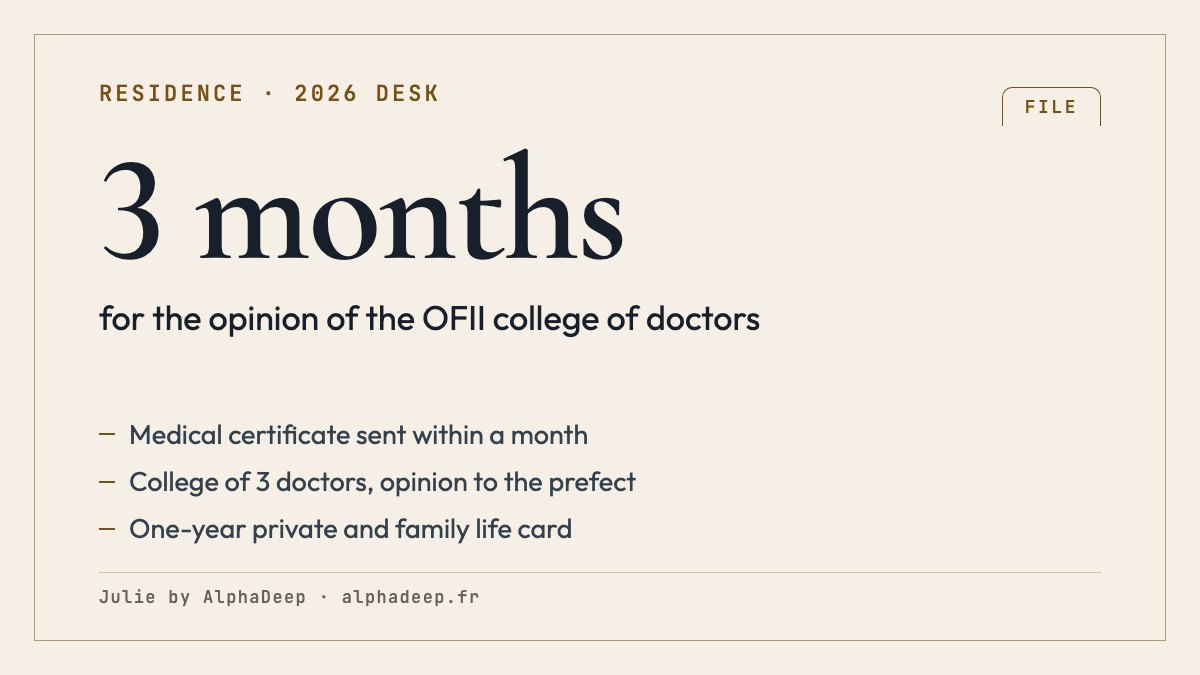
A foreign national habitually resident in France whose health requires care, without which the consequences would be exceptionally serious, can obtain a one-year "private and family life" card if they cannot effectively receive appropriate treatment in their home country (article L425-9), subject to general residence conditions. The prefect decides after the opinion of a college of 3 OFII doctors, given within 3 months of the medical certificate being sent.
Go to the tool: the filing desk
Julie by AlphaDeep is an AI legal assistant for French law: it researches official references to help answer your questions (Légifrance, case law, service-public), analyses your documents and drafts your letters, for individuals and professionals alike.
General legal information with official references and dated checks. It is not personalised advice: for a decision that commits you, have your situation checked by a qualified professional.

Let’s look at your situation
Describe the steps and dates of your procedure, without your diagnosis.
Example questions
Your question carries over after signup. Maximum 400 characters. Avoid health data and names.
Who can obtain a residence permit for medical care?
Three health and residence conditions apply together: habitual residence in France, a state of health whose lack of care would have exceptionally serious consequences, and no effective access to appropriate treatment in the home country (CESEDA, article L425-9). Subject to general residence conditions, including no threat to public order, the private and family life card is issued for one year, without a long-stay visa.
According to service-public.fr, habitual residence is shown over at least one year. A foreign national who does not meet this condition can receive a temporary residence authorisation, renewable during treatment (article R425-14).
Sources: CESEDA L425-9 · CESEDA R425-14 · Service-public F17164
How does the OFII medical opinion work?
Article R425-12 counts one month from prefecture registration; Service Public describes one month from ANEF availability. Have the starting point confirmed for your file. For the parent of an ill child, Service Public describes one month from prefecture delivery of the certificate: also confirm registration. For an asylum seeker, the 3 months start at asylum registration. The treating or hospital doctor completes the certificate for OFII; its doctor writes a report, may request further information within 15 days or summon you.
A college of 3 doctors, which does not include the author of the report, gives its opinion within 3 months of the certificate being sent (article R425-13). The prefect then decides; if the college considers the conditions met, a refusal must give specific reasons (article L425-9).
Sources: CESEDA R425-12 · CESEDA R425-11 · CESEDA R425-13 · CESEDA L425-9 · Service-public F17164 · Service-public F17336
What if it is your minor child who is ill?
The parents of a foreign-national minor child who meets these health conditions receive a temporary residence authorisation of up to 6 months, if they habitually reside in France with the child and contribute to the child’s upkeep and education (CESEDA, article L425-10).
This authorisation allows work and is renewed throughout the child’s medical care if the conditions remain met, after the opinion of the OFII college of doctors. According to service-public.fr, it can be issued to both parents.
Sources: CESEDA L425-10 · Service-public F17336
Which deadlines should you watch between the medical certificate and the decision?
Identify the certificate starting point, then enter the transmission and application dates: the calendar calculates the transmission time limit only when its origin is confirmed, then the expected OFII opinion and implicit refusal. The example is prefecture registration on 1 October 2026.
Fictional example · procedure calendar
Here are your deadlines: the certificate first, then the OFII opinion, then the prefect’s decision.
Residence permit application filed
Application registered at the prefecture: article R425-12 starting point
Medical certificate sent to the OFII
Prudent last day to send the completed certificate to the OFII: 1 month
Indicative implicit-refusal date, normally after 4 months without an answer
Expected opinion of the OFII college of 3 doctors: 3 months after it is sent
Prudent last day to challenge this implicit refusal: 2 months to appeal
Article R425-12 counts one month from prefecture registration; Service Public describes one month from ANEF availability or, for an ill child, prefecture delivery. These dates alone do not prove that an earlier statutory time limit remains open. Check the registration and the instructions received; the tool only calculates the prudent article R425-12 date when that origin is identified.
Do not send any medical document to the prefecture: the certificate goes to the OFII, which gives an opinion to the prefect. Prudent dates, worked out from the ones you enter.
What does article L425-9 of the CESEDA say about the permit for medical care?
Here are the first two paragraphs, which set the conditions and the role of the OFII college of doctors.
L’étranger, résidant habituellement en France, dont l’état de santé nécessite une prise en charge médicale dont le défaut pourrait avoir pour lui des conséquences d’une exceptionnelle gravité et qui, eu égard à l’offre de soins et aux caractéristiques du système de santé dans le pays dont il est originaire, ne pourrait pas y bénéficier effectivement d’un traitement approprié, se voit délivrer une carte de séjour temporaire portant la mention « vie privée et familiale » d’une durée d’un an. La condition prévue à l’article L. 412-1 n’est pas opposable.
La décision de délivrer cette carte de séjour est prise par l’autorité administrative après avis d’un collège de médecins du service médical de l’Office français de l’immigration et de l’intégration, dans des conditions définies par décret en Conseil d’Etat.
In English, briefly (our summary, not an official translation): A foreign national habitually resident in France whose state of health requires medical care, the lack of which could have exceptionally serious consequences, and who, given the care available and the health system in their country of origin, could not effectively receive appropriate treatment there, is issued a one-year temporary residence card marked "private and family life"; the long-stay visa condition of article L412-1 does not apply. The decision is taken by the administration after the opinion of a college of doctors of the OFII medical service. The text lists no diseases: what counts is how serious the consequences of a lack of care would be, and effective access to treatment in the home country.
Which documents should you attach, and to whom should you send them?
The administrative documents go to the prefecture; the medical certificate goes to the OFII alone, which gives an opinion to the prefect without passing on your medical file.
- Document 1
Proof of nationality
Passport, civil-status, validity, entry and visa pages, or another proof with a photo.
- Document 2
Proof of habitual residence
Documents covering at least one year of residence in France, according to service-public.fr.
- Document 3
Proof of address
It must be less than 6 months old.
- Document 4
Medical certificate filled in by your doctor
Downloaded from ANEF and sent to OFII; confirm the one-month starting point, with the three-month asylum exception. Never to the prefecture.
- Document 5
Stamp duty and, where relevant, regularisation visa fee
For the medical-care card: €50 stamp duty. The €300 regularisation visa fee, including €100 non-refundable on filing, applies to entry without legally required documents or visas, or an adult staying without a card beyond 3 months (or the longer regulatory period), subject to statutory exceptions. For a parent’s temporary authorisation: €100 tax on issue.
What has changed recently in this procedure?
Two dates frame the current procedure: its codification in the CESEDA in 2021 and the rise in fees in 2026.
The procedure is set out in articles R425-11 to R425-14 of the CESEDA: report by an OFII doctor, opinion of a college of 3 doctors within 3 months, temporary authorisation for those not habitually resident in France.
Sources: CESEDA R425-12 · CESEDA R425-11 · CESEDA R425-13 · CESEDA R425-14
The stamp duty rises from €25 to €50 and the regularisation visa fee from €200 to €300, of which €100 is non-refundable and paid on filing; the first card for medical care is exempt from the €300 tax (articles L436-1, L436-4 and L436-7, law no. 2026-103 of 19 February 2026).
Sources: CESEDA L436-7 · CESEDA L436-1 · CESEDA L436-4
Which questions come up during the examination?
Does the residence permit for medical care allow you to work?
Yes. In mainland France, the private and family life card gives the right to work (CESEDA, article L414-10). The temporary authorisation of the parent of a sick child also gives the right to work (article L425-10).
Which illnesses give a right to this permit?
Article L425-9 does not list diseases. The OFII college assesses whether a lack of care would have exceptionally serious consequences and whether appropriate treatment is effectively accessible in the home country, following guidelines set by the health minister (CESEDA, article R425-11).
To whom should you send the medical documents?
To the OFII only, through the route shown in your ANEF account, or in the envelope provided for the authorisation of the parent of a sick child. The prefecture receives the college’s opinion, not your medical file.
What if the OFII opinion is unfavourable?
The opinion is only one element of the prefect’s decision. A refusal, written or arising from 4 months of silence, is challenged before the administrative court within 2 months, according to service-public.fr. If it comes with an obligation to leave France, the time limits are shorter: read the decision without delay.
Which texts is this procedure based on?
- CESEDA, article L425-9 (seriously ill foreign national)Légifrance, in French
- CESEDA, articles R425-11, R425-12 and R425-13 (medical report, OFII college, 3-month time limit)Légifrance, in French
- CESEDA, article R425-14 (temporary authorisation without habitual residence)Légifrance, in French
- CESEDA, article L425-10 (parent of a sick minor child)Légifrance, in French
- CESEDA, article L436-7 (€50 stamp duty, version of 1 May 2026)Légifrance, in French
- How can a seriously ill foreign national living in France obtain a residence permit? (fiche F17164)Service-public.fr, in French
- Temporary residence authorisation for a foreign parent of a sick child (fiche F17336)Service-public.fr, in French
- CESEDA, article R425-11 (medical opinion and health guidelines)Légifrance, in French
- CESEDA, article R425-13 (3-doctor college and opinion within 3 months)Légifrance, in French
- CESEDA, article L436-1 (first medical-care card exemption and temporary-authorisation tax)Légifrance, in French
- CESEDA, article L436-4 (regularisation visa conditions, version of 1 May 2026)Légifrance, in French
- CESEDA, articles R*432-1 and R432-2 (implicit refusal after 4 months)Légifrance, in French
Texts cited last checked: 24 September 2026