Consumer and banking · Vehicles · France and Switzerland
Importing a car from Switzerland to France: customs duty, VAT, the 846 A and the malus
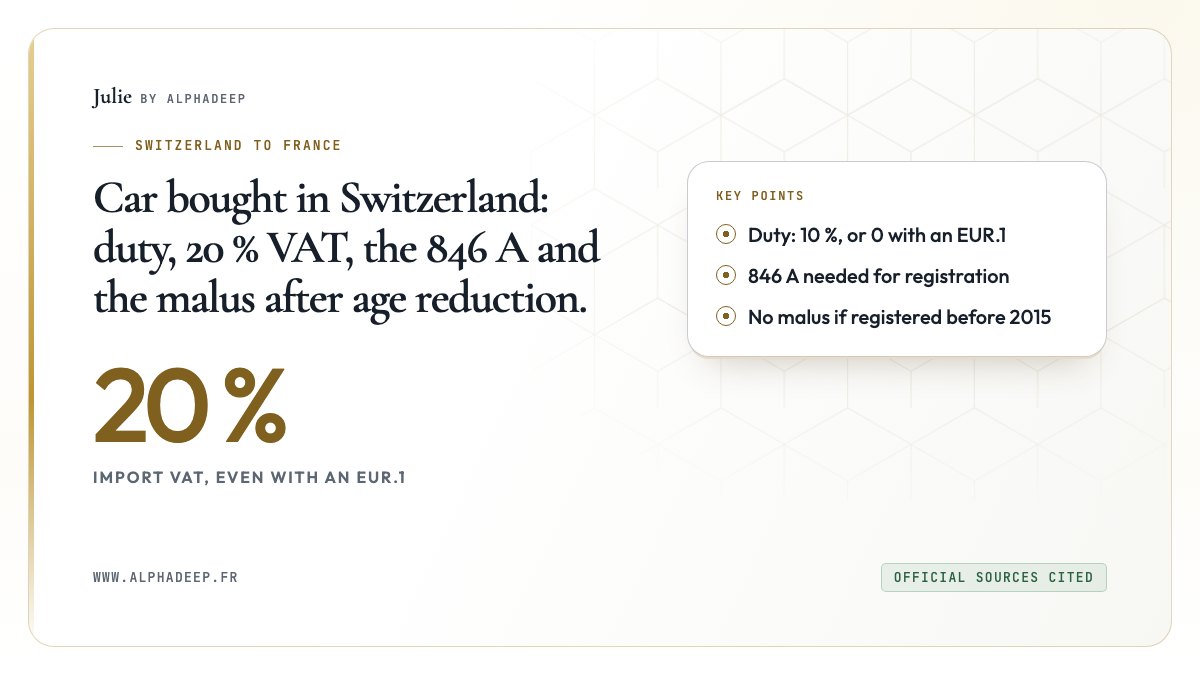
A car bought in Switzerland must clear French customs when it enters France. The 10 % customs duty is reduced or nil if you hold an EUR.1 proof of preferential origin, but 20 % import VAT is still due on the value, the duty and the costs. Customs then issues the 846 A certificate, which registration requires. The CO2 malus and the weight malus of the CIBS also apply, reduced according to the car’s age.
- Official texts cited
- Sources checked on
- Drafted with AI assistance, our method
General legal information with official references and dated checks. It is not personalised advice: for a decision that commits you, have your situation checked by a qualified professional.
Julie by AlphaDeep
You have found a car in Switzerland: I can work out the French duty, import VAT and malus with you, and list the papers for the 846 A and the registration.
3 free questions at signup. Avoid names and sensitive information.
Which customs duty and VAT do you pay on a car bought in Switzerland?
On a car bought in Switzerland you pay French customs a 10 % duty on its value, reduced or nil if you hold an EUR.1 proof of preferential origin, then 20 % import VAT. Switzerland is not in the European Union, so bringing the car into France is an import, subject to VAT under article 291 of the French tax code (Code général des impôts, CGI) at the standard 20 % rate of article 278.
According to French customs (guidance updated 5 February 2021), VAT is charged on the value of the car plus the customs duty plus ancillary costs such as transport to the border. A used car therefore pays French VAT, even when bought from a private seller.
- Price €20,000, transport €500, no EUR.1: duty of €2,050.
- VAT: 20 % of €22,550, which is €4,510.
- The malus comes on top, at registration.
Customs: buying a vehicle abroad (in French)Code général des impôts (CGI): article 291Code général des impôts (CGI): article 278
How does an EUR.1 origin proof remove the 10 % duty?
An EUR.1 origin proof removes or reduces the 10 % duty because it shows the car originates in a country linked to the European Union by a trade agreement, as Switzerland is. According to French customs, the rate then becomes reduced or nil depending on the agreement.
The proof is about the car’s preferential origin under the rules of origin, not about the country where you buy it. Ask the seller, or the forwarding agent who files the Swiss export declaration, before you cross the border. Without it, French customs charge 10 %. The 20 % VAT is due in every case: the EUR.1 only affects the duty.
Customs: buying a vehicle abroad (in French)Swiss customs (FOCBS): vehicle clearance FAQ (in French)
What will your Swiss car cost once registered in France?
Enter the price, costs, duty rate and the malus tariffs read from the CIBS scales: the worksheet computes duty, 20 % VAT and the malus after the age reduction. It does not set the value customs will use.
Fictional example · Cost of importing into France
Indicative amount: duty on price and costs, 20 % VAT on price, costs and duty (articles 291 and 278 of the CGI), then the CO2 and weight malus, capped and reduced for age (articles L421-60, L421-73 and L421-74 of the CIBS). With a valid EUR.1, run it again at the reduced rate or at 0.
- Value and costs
- €24,450.00
- Customs duty
- €2,445.00
- Import VAT (20 %)
- €5,379.00
- CO2 and weight malus after reduction
- €1,510.00
- Total before the registration fee
- €33,784.00
- Ask the seller for the invoice, the Swiss registration document and, if possible, the EUR.1 origin proof.
- Declare the car to French customs and pay €2,445.00 duty and €5,379.00 VAT: customs issue the 846 A certificate.
- Get the European certificate of conformity from the manufacturer, or plan an individual approval.
- Apply for registration on the ANTS site with the 846 A: the malus, here €1,510.00, is paid at that point.
Uses only the figures you enter: no exchange rate or market value is assumed. Customs may use a different value from the price paid.
What does article L421-60 of the CIBS say about the malus on an imported used car?
Le montant de la taxe est réduit à hauteur du coefficient forfaitaire de décote régi par le paragraphe 2 bis de la sous-section unique de la section 1 du présent chapitre.
[…]
Toutefois, le montant de la taxe est nul pour les véhicules dont la première immatriculation, au sens de l'article L. 421-5, est antérieure au 1er janvier 2015.
In plain English: For an imported used car, the CO2 malus from the scale is reduced by a flat-rate age coefficient. It is nil if the car was first registered, in Switzerland or elsewhere, before 1 January 2015.
Article L421-73 applies the same rule to the weight malus.
Where do you get the 846 A certificate and what does ANTS ask for?
French customs issue the 846 A certificate once the car has cleared customs (dédouanement) and duty and VAT are paid: it is the proof of clearance that the national vehicle agency (ANTS) asks for before issuing the registration certificate (carte grise). Keep the original with the invoice.
For a first registration in France, article R322-1 of the Highway Code (Code de la route) requires proof of identity, of address, of insurance, a driving licence and proof that the car conforms to a European (EC) or national type, or has an individual approval. Customs also point out that the car must meet the Highway Code to be driven.
- 846 A certificate
- Swiss invoice or bill of sale
- Swiss registration document
- European certificate of conformity
- ID, proof of address, insurance, licence
Customs: buying a vehicle abroad (in French)Code de la route: article R322-1Customs: import of a vehicle bought abroad by a private person (in French)
Does the weight malus apply to a car already registered in Switzerland?
Yes, the weight-based registration penalty (malus au poids) applies to a car already registered in Switzerland when it is first registered in France, but it is reduced by the flat-rate age coefficient (décote), like the CO2 malus (article L421-73 of the tax code on goods and services, CIBS), and it is nil if the first registration was before 1 January 2015.
The scale is that of the year of first registration, even abroad (article L421-75). Under that scale, for a car first registered in 2026, the mass in running order is taxed from 1,500 kg: €10 per kg from 1,500 to 1,699 kg, then €15, €20 and €25 per kg, and €30 per kg from 2,000 kg.
Electric and hydrogen cars are exempt (article L421-79); hybrids get a 100 or 200 kg deduction (article L421-79-1). The weight malus is capped so that both penalties together do not exceed the top tariff of the CO2 scale (article L421-74).
CIBS: article L421-73CIBS: article L421-75 (weight scales)CIBS: article L421-79CIBS: article L421-79-1CIBS: article L421-74
Can a French resident keep driving a Swiss-registered car?
As a rule, no: a person living in France must clear their Swiss car through customs and register it in France, because you cannot keep driving on foreign plates in your country of residence. The Geneva cantonal vehicle office states this rule, which works both ways.
For a cross-border worker (frontalier) who lives in France and bought the car in Switzerland, this means French customs (duty, VAT, 846 A), then ANTS registration, and returning the Swiss plates to the cantonal office. French customs set out the formalities for returning with a vehicle bought abroad. Exceptions, such as using a Swiss employer’s car, are narrow: check your case before you cross the border.
Geneva vehicle office: importing or exporting a vehicle (in French)Customs: import of a vehicle bought abroad by a private person (in French)
Which rates and thresholds apply to a car imported from Switzerland in 2026?
The rates and thresholds behind the cost of a Swiss car registered in France in 2026.
- Customs duty on a car without a preferential origin proof
- 10 %
- 2021 · French customs, guidance on buying a vehicle abroad, updated 5 February 2021
- Import VAT, on value plus duty plus costs
- 20 %
- 2021 · French customs, guidance on buying a vehicle abroad, updated 5 February 2021
- Mass from which the weight malus applies, at €10 per kg (2026 scale)
- 1,500 kg
- 2026 · CIBS, article L421-75
Switzerland to France, France to Switzerland: which taxes apply?
| Situation | Tax or formality | Source |
|---|---|---|
| Swiss car imported into France without EUR.1 | 10 % customs duty on the value | French customs guidance on vehicles bought abroad |
| Swiss car imported into France with EUR.1 | Duty reduced or nil; 20 % VAT still due | French customs; CGI, articles 291 and 278 |
| First registration in France | 846 A certificate, proof of conformity, CO2 and weight malus after reduction | Code de la route, R322-1; CIBS, L421-60 and L421-73 |
| First registered before 1 January 2015 | No CO2 malus and no weight malus | CIBS, L421-60 and L421-73 |
| Bought from a Swiss dealer for export | Supply exempt from Swiss VAT if the car goes directly abroad | Swiss VAT Act (LTVA), article 23(2)(1) |
| French car imported into Switzerland | 4 % automobile tax, 8.1 % VAT, form 13.20 A at 20 francs | LIAut, article 13; Swiss customs (FOCBS) |
Swiss plates go back to the cantonal office when the car leaves Switzerland.
Customs: buying a vehicle abroad (in French)Code général des impôts (CGI): article 291Code de la route: article R322-1Code des impositions sur les biens et services (CIBS): article L421-60Swiss VAT Act (LTVA), art. 23 (in French)Swiss Automobile Tax Act (LIAut), art. 13 (in French)Swiss customs (FOCBS): permanent import of a vehicle (in French)Geneva vehicle office: importing or exporting a vehicle (in French)
What else do buyers ask about VAT and the malus on a Swiss car?
Bought from a private seller in Switzerland: is there Swiss VAT to reclaim?
No: a private seller in Switzerland charges no VAT, so there is nothing to reclaim in Switzerland. Only a VAT-registered seller, in practice a dealer, can supply the car free of Swiss VAT when it is transported directly abroad (article 23(2)(1) of the Swiss VAT Act). In both cases the 20 % French VAT is paid to customs when the car enters France.
Swiss VAT Act (LTVA), art. 23 (in French)Customs: buying a vehicle abroad (in French)
Does a Swiss car first registered before 2015 pay the French malus?
No: a Swiss car first registered before 1 January 2015 pays neither the CO2 malus nor the weight malus in France (articles L421-60 and L421-73 of the CIBS). It still pays customs duty, 20 % import VAT and the registration fee.
Code des impositions sur les biens et services (CIBS): article L421-60CIBS: article L421-73
Is French VAT due on a used car bought in Switzerland?
Yes: 20 % French VAT is due on every car imported from Switzerland, new or used, bought from a dealer or a private seller. Goods entering France from outside the European Union are imports (article 291 of the CGI). The VAT is charged on the value, the customs duty and the ancillary costs.
Code général des impôts (CGI): article 291Customs: buying a vehicle abroad (in French)
Is an imported electric car exempt from the French weight malus?
Yes: an electric or hydrogen car imported from Switzerland is exempt from the French weight malus (article L421-79 of the CIBS), and its CO2 tariff is nil. Hybrids only get a 100 or 200 kg deduction depending on type and date of first registration (article L421-79-1). Duty and VAT are still due.
What taxes apply when you move a French car to Switzerland?
Moving a French car to Switzerland means paying Swiss customs (FOCBS) the 4 % automobile tax on its value (article 13 LIAut) and 8.1 % VAT on the value, the costs to destination and that tax. Form 13.20 A, at 20 francs, is needed for cantonal registration. There is no CO2 sanction if the car was registered abroad more than 12 months before the declaration.
Swiss Automobile Tax Act (LIAut), art. 13 (in French)Swiss customs (FOCBS): permanent import of a vehicle (in French)
Which official texts does this import cost rely on?
- Customs: buying a vehicle abroad (in French)French customs (DGDDI)
- Code général des impôts (CGI): article 291République française / DILA : Légifrance
- Code général des impôts (CGI): article 278République française / DILA : Légifrance
- Swiss customs (FOCBS): vehicle clearance FAQ (in French)Federal Office for Customs and Border Security (FOCBS)
- Code de la route: article R322-1République française / DILA : Légifrance
- Customs: import of a vehicle bought abroad by a private person (in French)French customs (DGDDI)
- CIBS: article L421-73République française / DILA : Légifrance
- CIBS: article L421-75 (weight scales)République française / DILA : Légifrance
- CIBS: article L421-79République française / DILA : Légifrance
- CIBS: article L421-79-1République française / DILA : Légifrance
- CIBS: article L421-74République française / DILA : Légifrance
- Geneva vehicle office: importing or exporting a vehicle (in French)Republic and Canton of Geneva
- Code des impositions sur les biens et services (CIBS): article L421-60République française / DILA : Légifrance
- Swiss VAT Act (LTVA), art. 23 (in French)Swiss Confederation: Fedlex
- Swiss Automobile Tax Act (LIAut), art. 13 (in French)Swiss Confederation: Fedlex
- Swiss customs (FOCBS): permanent import of a vehicle (in French)Federal Office for Customs and Border Security (FOCBS)
Texts cited last checked: 30 October 2026