Business · VAT · Switzerland
Invoicing a Swiss business client from France: VAT, invoice notes and the 1 January 2027 change
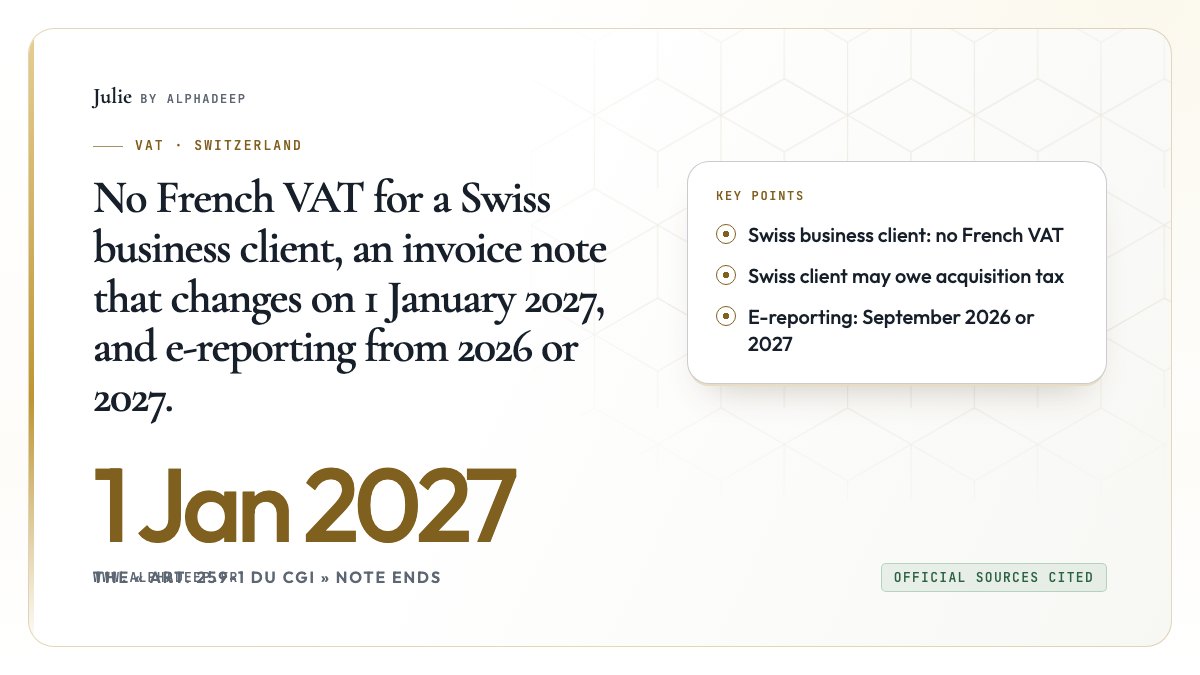
A service you supply from France to a business established in Switzerland carries no French VAT: it is taxed where the client is established (French tax code, article 259). You invoice without VAT, show both parties’ identifiers and the note « TVA non applicable, art. 259-1 du CGI ». On 1 January 2027 French VAT moves into a new code, the CIBS: article 259 is repealed and article L211-92 takes over, so the note must change.
Text in force1 January 2010Sources checked30 October 2026
- Official texts cited
- Sources checked on
- Drafted with AI assistance, our method
General legal information with official references and dated checks. It is not personalised advice: for a decision that commits you, have your situation checked by a qualified professional.
Julie by AlphaDeep
You invoice a client established in Switzerland from France: tell me who the client is and what you sell, and I will tell you the VAT rule, the invoice notes and what changes on 1 January 2027.
3 free questions at signup. Avoid names and sensitive information.
Do you charge French VAT to a Swiss business client?
No: a service you supply from France to a business established in Switzerland carries no French VAT, because it is taxed where the client has its business seat or the establishment that receives the service (French tax code, article 259, 1°). You invoice the net amount without adding French VAT.
The rule covers most business services: consulting, software development, design, translation, advertising, remote training. Some services follow their own place-of-supply rules, for example those linked to a building in France, so check them separately. The service is not « exempt » (exonéré): it falls outside French VAT, which is why the tax office (impots.gouv.fr) recommends the note « TVA non applicable » (VAT not applicable). On the Swiss side, your client may owe Swiss acquisition tax (impôt sur les acquisitions, Swiss VAT Act, article 45).
Code général des impôts (French tax code): article 259Prestations entre assujettis (VAT on services between businesses, in French)Swiss Federal VAT Act (LTVA), art. 45 (in French)
Which VAT note goes on the invoice, before and after 1 January 2027?
Until 31 December 2026 the note to print is « TVA non applicable, art. 259-1 du CGI », the wording given by impots.gouv.fr; from 1 January 2027 it points to a repealed article and should be replaced by a reference to the new code of taxes on goods and services (Code des impositions sur les biens et services, CIBS).
Ordinance no. 2025-1247 of 17 December 2025 moves French VAT from the general tax code (CGI) into the CIBS on 1 January 2027. Article 259 is repealed on that date and CIBS article L211-92 takes over the rule: when the recipient is a taxable business, the service is located where that business is established. A note such as « TVA non applicable, art. L211-92 du CIBS » follows the new text; check the wording the tax office adopts before you fix your template.
The other mandatory invoice details stay the same (CGI, annex II, article 242 nonies A):
- full name and address of your business and of the Swiss client
- your SIREN company number and your French VAT number
- a unique sequential invoice number and the issue date
- description, quantity and net unit price of each service
- the date the service was performed, if different from the invoice date
Prestations entre assujettis (VAT on services between businesses, in French)Ordonnance n° 2025-1247 du 17 décembre 2025 (VAT recodification ordinance)Code des impositions sur les biens et services (CIBS): article L211-92 (in force 1 January 2027)Code général des impôts, annex II: article 242 nonies A (invoice details)
Which VAT rule and note apply to your invoice?
Enter the client, the service and when the invoice is issued: the worksheet returns the VAT rule, the note to print, your e-reporting date and the Swiss client’s position. It computes no tax amount and does not replace reading the contract.
Fictional example · VAT rule for this invoice
No French VAT: the service is located in Switzerland, where the client is established (CGI, article 259, 1°). Print « TVA non applicable, art. 259-1 du CGI » and plan to change this note for invoices issued from 1 January 2027.
- E-invoicing
- Not required: the client is not established in France (CGI, article 289 bis)
- E-reporting required from
- 1 September 2027 (CGI, article 290)
- Swiss acquisition tax
- Owed by your client, registered for Swiss VAT (LTVA, article 45)
- Latest payment date (60 days, French law)
- 2027-01-15
- Note the client’s Swiss business number (IDE/UID, format CHE-123.456.789) and its Swiss VAT status.
- Print the note that matches the issue date, with your SIREN and French VAT number.
- Send the sale data through your approved platform once e-reporting applies to your business.
- Set the currency, the governing law and, if French law governs, payment by 2027-01-15 at the latest in the contract.
The worksheet applies CGI articles 259 and 259 B, CIBS article L211-92 and LTVA articles 10 and 45. It does not cover sales of goods or services with special place-of-supply rules (buildings, transport, events).
Which figures and dates matter?
The dates that change your invoice template and the Swiss thresholds, taken from the official texts.
- French VAT moves from the CGI to the CIBS, article 259 repealed
- 1 January 2027
- 2027 · Ordinance no. 2025-1247 of 17 December 2025
- All businesses receive e-invoices; large and mid-sized companies issue them
- 1 September 2026
- 2026 · Service-public, Entreprendre, sheet F39785 (checked 7 August 2026)
- E-invoice issuing and e-reporting for SMEs and micro-businesses
- 1 September 2027
- 2027 · Law no. 2022-1157 of 16 August 2022, article 26
- Annual purchases above which a non-registered Swiss client pays acquisition tax
- CHF 10,000
- per calendar year · LTVA, article 45 (version of 31 March 2025)
- Maximum agreed payment term between businesses under French law
- 60 days
- from the invoice date · French Commercial Code, article L441-10
Does French e-invoicing apply to invoices sent to Swiss clients?
No: mandatory e-invoicing (facturation électronique) only covers invoices between two taxable businesses established in France (CGI, article 289 bis), so an invoice to a Swiss client can stay a PDF. The sale does fall under e-reporting: you send the tax office, through your approved platform (plateforme agréée), the data on services not located in France (CGI, article 290).
The timetable depends on the size of your business. According to article 26 of the law of 16 August 2022, e-reporting applies from 1 September 2026 to large companies and mid-sized companies (ETI), and from 1 September 2027 to SMEs and micro-businesses, and a decree may push each date back by three months at most. According to Service-public (2026), every business must also be able to receive e-invoices from 1 September 2026, which concerns your French suppliers, not your Swiss client.
Code général des impôts: article 289 bis (e-invoicing)Code général des impôts: article 290 (e-reporting)Loi n° 2022-1157 du 16 août 2022: article 26 (e-invoicing timetable)Se mettre en conformité avec la facturation électronique (sheet F39785, in French)
What does article 259 of the French tax code say?
Le lieu des prestations de services est situé en France :
1° Lorsque le preneur est un assujetti agissant en tant que tel et qu'il a en France :
a) Le siège de son activité économique, sauf lorsqu'il dispose d'un établissement stable non situé en France auquel les services sont fournis ;
b) Ou un établissement stable auquel les services sont fournis ;
c) Ou, à défaut du a ou du b, son domicile ou sa résidence habituelle ;
2° Lorsque le preneur est une personne non assujettie, si le prestataire :
a) A établi en France le siège de son activité économique, sauf lorsqu'il dispose d'un établissement stable non situé en France à partir duquel les services sont fournis ;
b) Ou dispose d'un établissement stable en France à partir duquel les services sont fournis ;
c) Ou, à défaut du a ou du b, a en France son domicile ou sa résidence habituelle.
In plain English: Article 259 places in France the services supplied to a business established in France. A service supplied to a business established in Switzerland is therefore located in Switzerland and outside French VAT. The article is repealed on 1 January 2027 and replaced by CIBS article L211-92.
For a private client, point 2° places the service in France, except for the services listed in article 259 B.
Business client, private client, Swiss supplier: which rule applies?
| Situation | VAT | Invoice note or step | Source |
|---|---|---|---|
| Swiss business, invoice issued up to 31 December 2026 | No French VAT | « TVA non applicable, art. 259-1 du CGI », e-reporting | CGI, art. 259, 1° |
| Swiss business, invoice issued from 1 January 2027 | No French VAT | Update the note with a CIBS reference | CIBS, art. L211-92 |
| Private client in Switzerland, consulting, advertising, data or licences | No French VAT | Cite article 259 B; Swiss acquisition tax above CHF 10,000 of purchases a year | CGI, art. 259 B; LTVA, art. 45 |
| Private client in Switzerland, other service | French VAT due | Invoice with French VAT | CGI, art. 259, 2° |
| Electronic or telecom services to a non-registered Swiss client | No French VAT | Swiss VAT registration from CHF 100,000 worldwide turnover | LTVA, art. 10 |
| Swiss supplier invoicing your business in France | French VAT self-assessed by you (reverse charge, autoliquidation) | Net amount on line A2 of the CA3 return, deductible VAT on line 20 | CGI, art. 283, 2; CIBS, art. L215-5 from 2027 |
Sales of goods and services linked to a building, transport or an event follow other place-of-supply rules.
Code général des impôts (French tax code): article 259Code des impositions sur les biens et services (CIBS): article L211-92 (in force 1 January 2027)Code général des impôts: article 259 BSwiss Federal VAT Act (LTVA), art. 45 (in French)Swiss Federal VAT Act (LTVA), art. 10 (in French)Code général des impôts: article 283Code des impositions sur les biens et services (CIBS): article L215-5 (in force 1 January 2027)Prestations entre assujettis (VAT on services between businesses, in French)
Does your Swiss client pay Swiss VAT on your services?
Usually yes: your client pays Swiss VAT itself, as acquisition tax, if it is on the Swiss VAT register or if it buys more than CHF 10,000 of such services from foreign businesses in a calendar year (Swiss VAT Act, LTVA, article 45). You collect nothing on its behalf.
According to the Swiss Federal Tax Administration (AFC/ESTV), this covers in particular consulting, advertising, data processing, staff leasing and the transfer of rights. The Swiss standard rate is 8.1% (LTVA, article 25): your client computes and declares it. A Swiss business that is not registered and stays under CHF 10,000 of such purchases a year pays nothing. Your invoice should therefore show neither French nor Swiss VAT.
Swiss Federal VAT Act (LTVA), art. 45 (in French)Assujettissement à l’impôt sur les acquisitions TVA (acquisition tax, in French)Swiss Federal VAT Act (LTVA), art. 25 (in French)
Must you register for Swiss VAT once turnover passes CHF 100,000?
No, not if the only services you supply in Switzerland are taxed at the client’s location: LTVA article 10(2)(b) frees a business established abroad from Swiss VAT registration, whatever its turnover, when its services are located in Switzerland at the recipient and subject to acquisition tax.
The CHF 100,000 worldwide turnover threshold (LTVA article 10(2)(a)) therefore applies to other cases. The most common one: telecommunications or IT services supplied to Swiss clients who are not VAT-registered, such as private individuals. There the exemption does not apply, and Swiss VAT registration is required once your worldwide turnover reaches CHF 100,000 over a year. According to the AFC, a foreign business that registers must first appoint a tax representative established in Switzerland.
Swiss Federal VAT Act (LTVA), art. 10 (in French)Assujettissement à l’impôt sur les acquisitions TVA (acquisition tax, in French)
Which special cases come up when invoicing Switzerland?
Does a private client in Switzerland pay French VAT?
A private client living in Switzerland pays no French VAT if the service is on the list in CGI article 259 B: consulting, engineering, advertising, data processing, licences, electronic services. For other services French VAT is in principle due, because the service is located in France when the supplier is established there (CGI, article 259, 2°).
Code général des impôts: article 259 BCode général des impôts (French tax code): article 259
Can you invoice a Swiss client in Swiss francs?
Yes, an invoice to a Swiss client can be issued in Swiss francs: under CGI article 289, invoice amounts may be expressed in any currency, provided any tax due is determined in euros. For a service to a Swiss business, with no French VAT, nothing prevents it. If French law governs the contract, payment is due within 60 days of the invoice at most (Commercial Code, article L441-10).
Code général des impôts: article 289 (invoice currency)Code de commerce (Commercial Code): article L441-10
Which Swiss identification number should the invoice show?
The invoice should show the Swiss client’s business identification number (IDE in French, UID in English), made of « CHE » and nine digits, for example CHE-123.456.789, according to the Swiss Federal Statistical Office. CGI annex II article 242 nonies A requires the client’s full name and address; the UID identifies the client and lets you check on the public register whether it is registered for Swiss VAT.
Business identification number (IDE/UID, in French)Code général des impôts, annex II: article 242 nonies A (invoice details)
A Swiss consultant invoices your French company without VAT: what do you declare?
When a supplier established in Switzerland invoices your French company without VAT, you self-assess French VAT (autoliquidation): CGI article 283, 2 makes the client liable. According to impots.gouv.fr, you report the net amount on line A2 of the CA3 VAT return and the deductible VAT on line 20. From 1 January 2027 the rule sits in CIBS article L215-5.
Code général des impôts: article 283Prestations entre assujettis (VAT on services between businesses, in French)Code des impositions sur les biens et services (CIBS): article L215-5 (in force 1 January 2027)
Which official texts back these France-Switzerland VAT rules?
- Code général des impôts (French tax code): article 259République française / DILA : Légifrance
- Prestations entre assujettis (VAT on services between businesses, in French)French tax administration (DGFiP): impots.gouv.fr
- Swiss Federal VAT Act (LTVA), art. 45 (in French)Swiss Confederation: Fedlex
- Ordonnance n° 2025-1247 du 17 décembre 2025 (VAT recodification ordinance)République française / DILA : Légifrance
- Code des impositions sur les biens et services (CIBS): article L211-92 (in force 1 January 2027)République française / DILA : Légifrance
- Code général des impôts, annex II: article 242 nonies A (invoice details)République française / DILA : Légifrance
- Code général des impôts: article 289 bis (e-invoicing)République française / DILA : Légifrance
- Code général des impôts: article 290 (e-reporting)République française / DILA : Légifrance
- Loi n° 2022-1157 du 16 août 2022: article 26 (e-invoicing timetable)République française / DILA : Légifrance
- Se mettre en conformité avec la facturation électronique (sheet F39785, in French)République française / DILA : Entreprendre Service-Public
- Assujettissement à l’impôt sur les acquisitions TVA (acquisition tax, in French)Swiss Federal Tax Administration (AFC/ESTV)
- Swiss Federal VAT Act (LTVA), art. 25 (in French)Swiss Confederation: Fedlex
- Swiss Federal VAT Act (LTVA), art. 10 (in French)Swiss Confederation: Fedlex
- Code de commerce (Commercial Code): article L441-10République française / DILA : Légifrance
- Code général des impôts: article 259 BRépublique française / DILA : Légifrance
- Code général des impôts: article 283République française / DILA : Légifrance
- Code des impositions sur les biens et services (CIBS): article L215-5 (in force 1 January 2027)République française / DILA : Légifrance
- Code général des impôts: article 289 (invoice currency)République française / DILA : Légifrance
- Business identification number (IDE/UID, in French)Swiss Federal Statistical Office (FSO)
Texts cited last checked: 30 October 2026