Business · Freelance · contract
Freelance contracts between businesses in France: the clauses to check before you sign
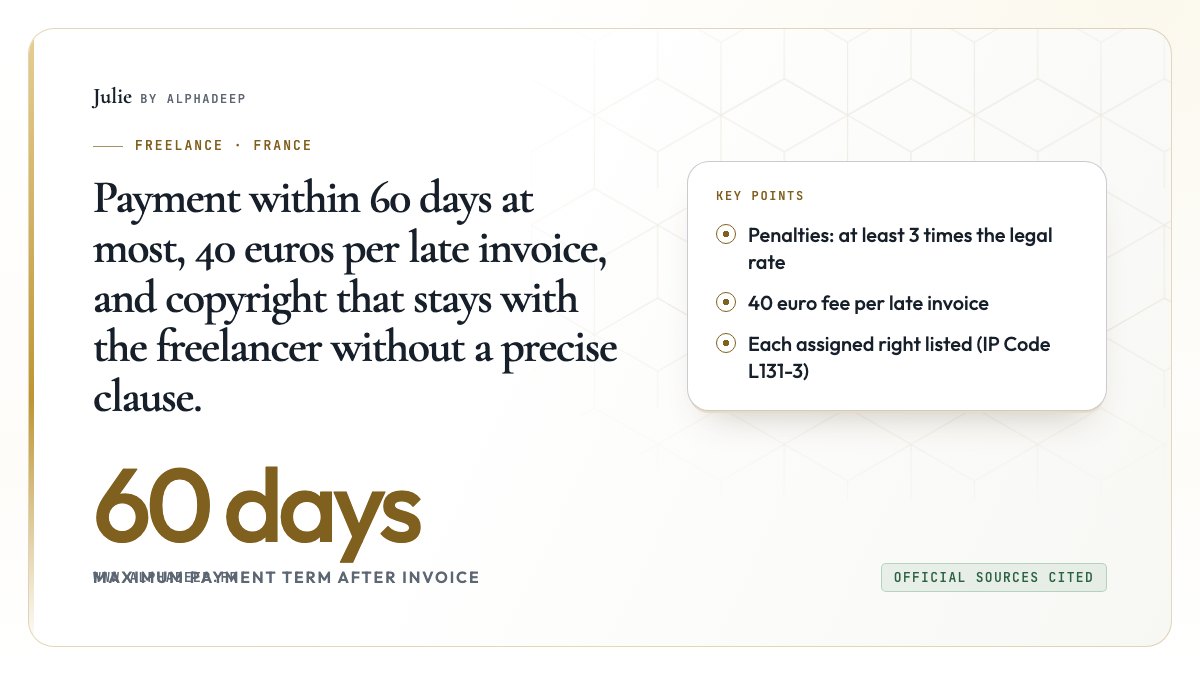
Between businesses in France, a freelance service contract is checked first on three points. Payment: 60 days from the invoice at most, or 45 days end of month if agreed, with penalties and a 40 euro fee for late payment. Copyright: without a clause listing each right assigned, with its scope, purpose, place and duration, the rights stay with you (Intellectual Property Code, article L131-3). Then termination: notice and grounds.
- Official texts cited
- Sources checked on
- Drafted with AI assistance, our method
General legal information with official references and dated checks. It is not personalised advice: for a decision that commits you, have your situation checked by a qualified professional.
Julie by AlphaDeep
Your French client sent you a service contract: I can go through it with you, clause by clause, and check payment, IP assignment and termination.
3 free questions at signup. Avoid names and sensitive information.
Does your contract pass the checkpoints?
Tick what the draft contract says and enter an overdue invoice: the worksheet flags clauses that conflict with the French Commercial, Civil or Intellectual Property Codes and computes the minimum late penalties. It does not say whether a court would side with you.
Fictional example · Points to check and your penalties
Payment term too long: between businesses, the agreed term cannot exceed 60 days from the invoice, or 45 days end of month if written in the contract (Commercial Code, article L441-10). Sign-off cannot delay payment unless expressly agreed. Ask for the correction before signing.
- Points to renegotiate
- 3
- Minimum penalties (8.25 % a year, 3 × 2.75 %)
- 48.82 €
- Fixed recovery fee
- 40 €
- Minimum to claim on top of the invoice
- 48.82 € + 40 €
- List each flagged clause and propose replacement wording in writing before signing.
- Ask for the payment term to run from the invoice and not exceed 60 days.
- Replace the blanket assignment with a list of uses, territories and durations, with a price.
- State the late-penalty rate and the 40 euro fee on every invoice.
- For an invoice already overdue, claim 48.82 € in penalties and the 40 € fee in writing.
Penalties use the contractual floor rate for the second half of 2026, over 365 days. The worksheet flags clauses to discuss; it does not replace reading the whole contract or advice from a lawyer.
What does French law say, clause by clause?
| Clause | Rule | Text | What to check |
|---|---|---|---|
| Payment term | 60 days from invoice at most, or 45 days end of month if written; 30 days if the contract is silent | Commercial Code, art. L441-10 | Starting point (invoice, not sign-off) and length |
| Acceptance or sign-off | 30 days at most after delivery, unless expressly agreed and not abusive; does not delay payment without an express clause | Commercial Code, art. L441-10, III | Length of acceptance and effect on the payment date |
| Penalties and 40 euro fee | Penalties due from the day after the due date, at least 3 times the legal rate, plus 40 euros per invoice | Commercial Code, art. L441-10 and D441-5 | Rate written in the contract and on each invoice |
| Copyright assignment | Each assigned right named separately, with scope, purpose, place and duration | Intellectual Property Code, art. L131-3 | List of uses, territory, duration, price of the assignment |
| Liability cap | Valid in principle; deemed unwritten if it empties the essential obligation | Civil Code, art. 1170 and 1231-3 | Cap amount, exclusions, gross misconduct |
| Penalty clause | A judge can reduce a manifestly excessive penalty, even of its own motion | Civil Code, art. 1231-5 | Amount per day late and overall cap |
| Term and termination | Agreed or reasonable notice for an open-ended contract; otherwise performance to the end date | Civil Code, art. 1211, 1212 and 1226 | Notice on each side, payment for work done |
| General terms | Binding only if known and accepted; conflicting clauses have no effect | Civil Code, art. 1119 | Which terms of business or purchase conditions are attached and signed |
A contract can be more favourable to the freelancer than these rules, never less on payment terms.
Code de commerce (Commercial Code): article L441-10Code de commerce (Commercial Code): article D441-5Code de la propriété intellectuelle (Intellectual Property Code): article L131-3Code civil (Civil Code): article 1170Code civil (Civil Code): article 1231-3Code civil (Civil Code): article 1231-5Code civil (Civil Code): article 1211Code civil (Civil Code): article 1212Code civil (Civil Code): article 1226Code civil (Civil Code): article 1119
What payment term can a French business client impose on you?
Between businesses in France, the agreed payment term cannot exceed 60 days from the invoice date, or 45 days end of month if that term is expressly written into the contract and is not grossly unfair to you (Commercial Code, article L441-10). If the contract says nothing, the client must pay within 30 days of the service being performed.
A clause such as « payment at 90 days » or « payment after sign-off » should therefore be renegotiated. Acceptance or sign-off procedures (recette or validation) are capped too: no more than 30 days after the work is delivered, unless expressly agreed and not abusive, and they cannot extend or delay the payment term unless the contract expressly says so. Write the starting point (the invoice) and the length of the term into the contract. According to the Banque de France (2025 report of the Observatoire des délais de paiement), fewer than one large company in two pays within the 60 days.
Code de commerce (Commercial Code): article L441-10Le rapport annuel 2025 de l’Observatoire des délais de paiement (press release, 24 September 2026, in French)
What can you claim when a French client pays late?
When a French business client pays after the date on the invoice, it owes you late-payment penalties (pénalités de retard) from the next day, without any reminder, plus a fixed recovery fee (indemnité forfaitaire pour frais de recouvrement) of 40 euros (Commercial Code, articles L441-10 and D441-5). If your actual recovery costs are higher, you can claim more with proof.
The penalty rate is the one set in the contract, but it cannot be lower than three times the French legal interest rate. For the second half of 2026 that legal rate is 2.75 % (order of 26 June 2026), so the contractual floor is 8.25 % a year. If the contract sets no rate, the European Central Bank refinancing rate plus 10 percentage points applies.
These terms must appear on the invoice (article L441-9). According to the Banque de France (2025 Observatoire des délais de paiement report), late payments in France averaged 13.4 days at the end of 2025.
Code de commerce (Commercial Code): article L441-10Code de commerce (Commercial Code): article D441-5Arrêté du 26 juin 2026 relatif à la fixation du taux de l’intérêt légal (order setting the legal interest rate)Code de commerce (Commercial Code): article L441-9Le rapport annuel 2025 de l’Observatoire des délais de paiement (press release, 24 September 2026, in French)
Which thresholds and dates should you know?
According to the Banque de France (2025 Observatoire des délais de paiement report), French SMEs and micro-enterprises would have had 13 billion euros more cash without late payments.
- Maximum agreed payment term between businesses, from the invoice (or 45 days end of month if written)
- 60 days
- In force since 26 April 2019 · Commercial Code (Code de commerce), article L441-10
- Fixed recovery fee owed by a business that pays late
- 40 €
- In force since 27 February 2021 · Commercial Code (Code de commerce), article D441-5
- Contract value from which the client must check the contractor’s social-security filings
- 5,000 € excl. VAT
- In force since 1 May 2015 · Labour Code (Code du travail), article R8222-1
- Average payment delay of French companies
- 13.4 days
- End of 2025 · Banque de France, 2025 annual report of the Observatoire des délais de paiement
- Date from which SMEs and micro-enterprises must issue e-invoices
- 1 Sept 2027
- Timetable in force on 30 October 2026 · Law no. 2022-1157 of 16 August 2022, article 26
Who owns your deliverables without an assignment clause?
Without an assignment clause, the copyright in what you create (code, designs, texts) stays with you: under French law, a service agreement does not by itself transfer those rights to the client (Intellectual Property Code, article L111-1). The client gets the deliverable and may use it for the agreed purpose, but cannot adapt, resell or reuse it elsewhere without your consent.
To be valid, a copyright assignment (cession de droits d’auteur) must name each right assigned separately (reproduction, performance, adaptation, translation) and limit its scope, purpose, place and duration (article L131-3). Wording such as « the client acquires all rights in the deliverables for all uses » does not meet those conditions.
If the client insists on a broad assignment, negotiate a price that pays for it, a set duration and territory, and a list of the uses actually planned.
Code de la propriété intellectuelle (Intellectual Property Code): article L111-1Code de la propriété intellectuelle (Intellectual Property Code): article L131-3
Can a French client end the assignment without notice?
It depends on the contract’s term. An open-ended contract can be ended at any time, but with the notice the contract sets or, failing that, reasonable notice (Civil Code, article 1211). A fixed-term contract must be performed until its end date (article 1212): the client cannot end it early without grounds.
Outside any clause, the client can only terminate on its own initiative for a serious breach on your side, at its own risk, after a formal notice (mise en demeure) left unanswered for a reasonable time, except in an emergency (article 1226). A judge can later review whether the breach was serious enough.
Before signing, check three points: the term (one assignment, an end date or automatic renewal), the notice period on each side, and what is paid if the contract ends early (work already done, expenses incurred).
Code civil (Civil Code): article 1211Code civil (Civil Code): article 1212Code civil (Civil Code): article 1226
What does article L131-3 of the French Intellectual Property Code say?
La transmission des droits de l'auteur est subordonnée à la condition que chacun des droits cédés fasse l'objet d'une mention distincte dans l'acte de cession et que le domaine d'exploitation des droits cédés soit délimité quant à son étendue et à sa destination, quant au lieu et quant à la durée.
In plain English: A copyright assignment is valid only if the contract names each right assigned and sets, for each one, the scope, purpose, place and duration of use. A clause that assigns « all rights » without those details does not validly transfer your rights to the client.
The service agreement itself assigns nothing: without a compliant clause, the rights stay with the freelancer (article L111-1 of the same Code).
When could a freelance assignment be reclassified as employment in France?
A freelance assignment can be reclassified as employment (requalification en contrat de travail) when you work under the client’s permanent legal subordination, meaning its authority, with orders, supervision and possible sanctions. If you are registered (trade register, national business register or URSSAF), you are presumed self-employed, but that presumption falls if subordination is proven (Labour Code, article L8221-6).
Warning signs in the contract: set hours, required presence on the client’s premises, imposed tools and methods, a place in a management line, a single client over a long period, pay by the hour with no defined deliverable. A clause that leaves you to organise the work and sets a result to deliver points the other way.
On the client’s side, from 5,000 euros excluding VAT, it must check your social-security filings (article R8222-1), notably by asking for an URSSAF certificate (attestation de vigilance) under six months old, at signature and every six months (article D8222-5).
Code du travail (Labour Code): article L8221-6Code du travail (Labour Code): article R8222-1Code du travail (Labour Code): article D8222-5
What else should you ask before signing a French freelance contract?
Must your invoice mention the late penalties and the 40 euro fee?
Yes. Every invoice between businesses in France must state the date payment is due, any early-payment discount, the late-penalty rate and the 40 euro fixed recovery fee (Commercial Code, article L441-9). An invoice missing these mentions exposes its issuer to an administrative fine. Check that your invoicing software adds them by default.
Code de commerce (Commercial Code): article L441-9Code de commerce (Commercial Code): article D441-5
Is a clause capping your liability at the contract price valid?
Yes, in principle, a clause capping the freelancer’s liability at the contract price is valid between businesses in France. It is deemed unwritten if it deprives the contract’s essential obligation of its substance (Civil Code, article 1170), and the limit to foreseeable damage does not apply in case of gross or wilful misconduct (article 1231-3).
Code civil (Civil Code): article 1170Code civil (Civil Code): article 1231-3
Can a French judge reduce a penalty clause in the contract?
Yes. A French judge can, even of its own motion, reduce or increase a penalty clause (clause pénale) that is manifestly excessive or derisory, and any clause to the contrary is deemed unwritten (Civil Code, article 1231-5). Unless non-performance is final, the penalty is only owed after formal notice. An uncapped penalty for late delivery is worth renegotiating before you sign.
What if no price was agreed before the work started?
In a French service contract, if no price was agreed before the work started, the freelancer may set it, but must justify the amount if the client disputes it (Civil Code, article 1165). If the price is abusive, the client can claim damages. A signed quote or a written day rate before starting avoids the dispute.
What does French e-invoicing change for freelancers in 2026 and 2027?
Since 1 September 2026, every business established in France, freelancers included, must be able to receive e-invoices. The duty to issue invoices through an approved platform (plateforme agréée) applies to SMEs and micro-enterprises from 1 September 2027 (Law no. 2022-1157, article 26). Put the client’s e-invoicing address in the contract.
Loi n° 2022-1157 du 16 août 2022 de finances rectificative pour 2022 (amending finance law): article 26Se mettre en conformité avec la facturation électronique (e-invoicing compliance guide F39785, in French)
Which French texts are these freelance contract rules based on?
- Code de commerce (Commercial Code): article L441-10French Republic / DILA: Légifrance
- Code de commerce (Commercial Code): article D441-5French Republic / DILA: Légifrance
- Arrêté du 26 juin 2026 relatif à la fixation du taux de l’intérêt légal (order setting the legal interest rate)French Republic / DILA: Légifrance
- Code de commerce (Commercial Code): article L441-9French Republic / DILA: Légifrance
- Code de la propriété intellectuelle (Intellectual Property Code): article L131-3French Republic / DILA: Légifrance
- Code de la propriété intellectuelle (Intellectual Property Code): article L111-1French Republic / DILA: Légifrance
- Code civil (Civil Code): article 1170French Republic / DILA: Légifrance
- Code civil (Civil Code): article 1231-3French Republic / DILA: Légifrance
- Code civil (Civil Code): article 1231-5French Republic / DILA: Légifrance
- Code civil (Civil Code): article 1211French Republic / DILA: Légifrance
- Code civil (Civil Code): article 1212French Republic / DILA: Légifrance
- Code civil (Civil Code): article 1226French Republic / DILA: Légifrance
- Code civil (Civil Code): article 1119French Republic / DILA: Légifrance
- Code du travail (Labour Code): article L8221-6French Republic / DILA: Légifrance
- Code du travail (Labour Code): article R8222-1French Republic / DILA: Légifrance
- Code du travail (Labour Code): article D8222-5French Republic / DILA: Légifrance
- Le rapport annuel 2025 de l’Observatoire des délais de paiement (press release, 24 September 2026, in French)Banque de France
- Code civil (Civil Code): article 1165French Republic / DILA: Légifrance
- Loi n° 2022-1157 du 16 août 2022 de finances rectificative pour 2022 (amending finance law): article 26French Republic / DILA: Légifrance
- Se mettre en conformité avec la facturation électronique (e-invoicing compliance guide F39785, in French)French Directorate of Legal and Administrative Information (Entreprendre Service-Public)
Texts cited last checked: 30 October 2026