Business · Posting · Switzerland
Posting workers to Switzerland from France: online notification, the 90-day limit, Swiss minimum conditions and the A1
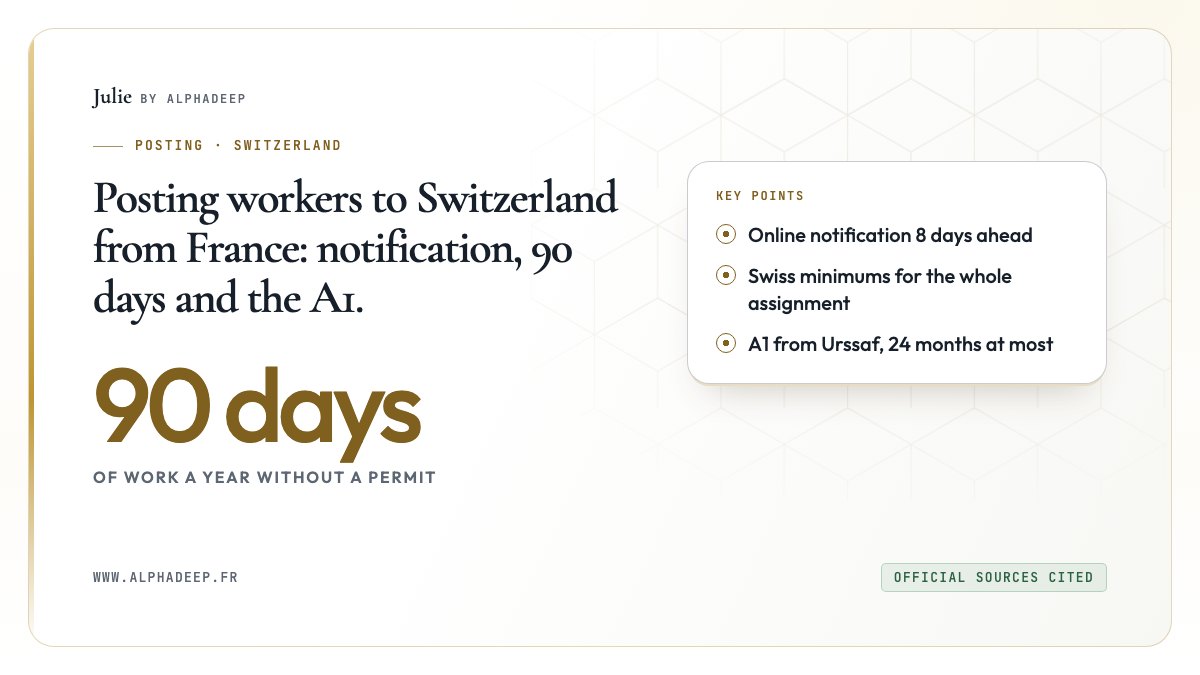
A French company can send an employee to Switzerland without a permit for up to 90 days of actual work per calendar year, under the EU-Swiss free movement agreement. Beyond 8 days a year, or from day one in construction, restaurants, cleaning or security, it must file an online notification, and work may start only 8 days later. The worker gets Swiss minimum pay and conditions (Posted Workers Act) and keeps French social security with an A1 certificate.
- Official texts cited
- Sources checked on
- Drafted with AI assistance, our method
General legal information with official references and dated checks. It is not personalised advice: for a decision that commits you, have your situation checked by a qualified professional.
Julie by AlphaDeep
You are sending an employee on a mission to Switzerland, or going yourself as a self-employed person: I can check with you the notification, the 90-day count, Swiss minimum pay and the A1 certificate.
3 free questions at signup. Avoid names and sensitive information.
Do you need a permit to send an employee to work in Switzerland?
No, as long as the work stays within 90 days of actual work per calendar year: the EU-Swiss Agreement on the Free Movement of Persons (AFMP, article 5) lets a French company provide a service in Switzerland without a permit, subject only to an online notification. The Swiss Ordinance on the Free Movement of Persons (OLCP, article 14) confirms that no short-stay permit is needed in that case.
The 90 days are counted twice: once for the company and once for each worker. According to SECO, three workers sent on the same five days use only five days of the company’s allowance, while a worker who has already worked 90 days in Switzerland for another employer cannot be posted again that year.
The worker can be of any nationality. A non-EU or non-EFTA national must first have been part of the regular labour market of a member state for at least twelve months with a residence card (SEM). Hiring out agency staff from abroad is prohibited in Switzerland.
EU-Swiss Agreement on the Free Movement of Persons (AFMP, SR 0.142.112.681): article 5 (in French)Ordinance on the Free Movement of Persons (OLCP, SR 142.203): article 14 (in French)SECO, Posting: FAQ (notification procedure, 90-day count, emergencies, minimum wage calculator)SEM, Notification procedure for short-term gainful employment
How many days are left, and when must you notify?
Enter the start date and the days already worked in Switzerland this year: the worksheet counts the company’s and the worker’s days against the 90 allowed, says whether notification is required and gives the latest filing date. It does not compute the minimum wage and does not replace the cantonal authority’s answer.
Fictional example · Days counted and notification deadline
Notification is required: file it on EasyGov at least 8 days before the first working day, a mandatory wait (article 6 LDét). Check that the company’s count and the worker’s count both stay at 90 days or fewer in the calendar year (article 5 of the free movement agreement).
- Latest date to file the notification
- 2026-11-15
- Company days in the year, this assignment included
- 75 of 90
- Employee days in the year, this assignment included
- 55 of 90
- Create the EasyGov profile and file the notification by 2026-11-15 at the latest.
- Find the applicable collective agreement and the minimum wage for the profile in SECO’s calculator.
- Request the A1 certificate from Urssaf (international mobility service) before departure.
- Give the employee the written information required for work abroad of over four weeks (French Labour Code, article R1221-36).
This count applies the free movement agreement, the LDét and the ODét to the days you enter. It does not compute the Swiss minimum wage and does not replace confirmation from the cantonal authority.
How do you keep French social security: what does article R761-2 of the French Social Security Code say?
La demande formée au titre de l'article L. 761-1 ou de l'article L. 761-2 est adressée par l'employeur à l'organisme compétent en matière de recouvrement.
[…]
En cas d'urgence, l'employeur avise l'organisme compétent du détachement et le travailleur est maintenu à titre provisoire dans les régimes français de sécurité sociale, sous réserve de régularisation de la demande par l'employeur dans un délai de 3 mois.
Lorsque sont remplies les conditions requises pour que le travailleur bénéficie des dispositions de l'article L. 761-1 ou de l'article L. 761-2, l'organisme compétent délivre à l'intéressé soit le document prévu par la convention ou le règlement international applicable, soit, à défaut, une attestation. Un arrêté du ministre chargé de la sécurité sociale précise les informations figurant dans cette attestation.
In plain English: To keep the employee under French social security during the Swiss assignment, the employer sends the request to Urssaf, which issues the A1 form. In an emergency, the employee stays covered provisionally if the employer completes the request within 3 months.
Cover is kept for an expected length of up to 24 months (Regulation 883/2004, article 12); beyond that, the employer asks for an exception, normally in the three months before the initial assignment ends.
How do you file the online notification, and how far ahead?
The notification is filed free of charge on the EasyGov portal at least 8 days before the first working day in Switzerland: the Swiss Posted Workers Act (LDét, article 6) bars any earlier start. The company creates a single profile, then records each assignment separately; the authority of the canton where the work takes place handles it (SEM).
For each worker, the notification gives identity and French social security number, gross hourly wage, start date and expected duration, activity and job, the exact place of work and a contact person (Posted Workers Ordinance, ODét, article 6). The employer adds a signed undertaking to respect Swiss minimum conditions.
It is required for work over 8 days per calendar year, and from day one in these sectors (ODét, article 6):
- construction, civil engineering and finishing trades
- restaurants, industrial or domestic cleaning
- surveillance and security
- itinerant trade, the sex industry, landscaping and grounds maintenance
Swiss Posted Workers Act (LDét, SR 823.20): article 6 (in French)SEM, Notification procedure for short-term gainful employmentSwiss Posted Workers Ordinance (ODét, SR 823.201): article 6 (in French)SECO, Posting: FAQ (notification procedure, 90-day count, emergencies, minimum wage calculator)
Which minimum pay and working conditions apply in Switzerland?
Throughout the assignment, the French employer must give the worker at least the Swiss conditions set by federal law, generally binding collective agreements (CCT) and standard employment contracts: minimum pay with its supplements, working and rest hours, minimum holidays, health and safety, protection of pregnant women and young workers, and non-discrimination (LDét, article 2).
There is no single federal minimum wage: the minimum depends on the sector, the canton and the worker’s profile. SECO’s minimum wage calculator identifies the applicable agreement; in sectors without one, cantonal tripartite commissions check the usual local wages. Travel, lodging and meal costs are reimbursed on top and do not count as pay.
Exception: minimum pay and holiday rules do not apply to initial assembly or installation lasting under 8 days as part of a contract for the supply of goods, except in construction, finishing trades, hotels and restaurants (LDét, article 4).
Swiss Posted Workers Act (LDét): article 2 (in French)SECO, Posting: FAQ (notification procedure, 90-day count, emergencies, minimum wage calculator)Swiss Posted Workers Act (LDét): article 4 (in French)
What does a company risk without notification or below Swiss minimums?
A missing or late notification exposes the company to an administrative penalty of up to 5,000 Swiss francs; breaching minimum pay and working conditions, to up to 30,000 francs or a ban on providing services in Switzerland for one to five years, both combined for serious breaches (LDét, article 9). Inspection costs can be charged to the company, and SECO publishes a list of penalised firms.
Criminal fines come on top: up to 40,000 francs for false information or obstructing an inspection, up to 1,000,000 francs for systematic underpayment for profit (LDét, article 12). In construction, a Swiss contractor that subcontracts is liable for its subcontractors’ minimum wages unless it checked their evidence (LDét, article 5), so expect it to ask for payslips and records.
According to SECO’s FlaM Report 2025, 27 % of notified posted workers were inspected in 2025.
Swiss Posted Workers Act (LDét): article 9 (in French)Swiss Posted Workers Act (LDét): article 12 (in French)Swiss Posted Workers Act (LDét): article 5 (in French)SECO, FlaM Report 2025 on the accompanying measures (June 2026, in French)
Which figures describe posting to Switzerland?
The figures come from SECO’s annual report on the Swiss accompanying measures, published in June 2026.
- Posted workers notified in Switzerland for a short assignment (down 3.7 %)
- 81,881
- 2025 · SECO, FlaM Report 2025 (June 2026)
- Self-employed service providers notified in Switzerland (down 13 %)
- 13,771
- 2025 · SECO, FlaM Report 2025 (June 2026)
- Share of notified posted workers inspected (target: 30 to 50 %)
- 27 %
- 2025 · SECO, FlaM Report 2025 (June 2026)
- A1 certificates issued by France, second behind Germany (508,246)
- 471,950
- 2024 · European Commission, quoted in the SECO, FlaM Report 2025 (June 2026)
Notification, 90 days, pay, A1, contract: who does what in Switzerland and in France?
| Step | Who and where | Deadline or limit | Source |
|---|---|---|---|
| Online notification | The employer, or the self-employed person, on EasyGov; handled by the canton of the workplace | At least 8 days before the start; from day one in the listed sectors | LDét art. 6, ODét art. 6 |
| 90-day count | The company and each worker, per calendar year | 90 days of actual work; beyond that, a permit with no entitlement | AFMP art. 5, OLCP art. 14 and 15 |
| Minimum pay and conditions | The employer, under the sector and local collective agreement (SECO calculator) | Throughout the assignment; expenses reimbursed on top of pay | LDét art. 2 |
| A1 certificate | The employer or self-employed person, from Urssaf (MSA for farming) | Before departure; expected length of 24 months at most | French Social Security Code art. R761-2, Regulation 883/2004 art. 12 |
| Written information for the employee | The employer, in the documents given to the employee | Work abroad over 4 consecutive weeks | French Labour Code art. L1221-5-1 and R1221-36 |
| Self-employed proof | The self-employed person, at the workplace if inspected | Notification, A1 and client contract; 2 days at most to produce them | LDét art. 1a |
Swiss Posted Workers Act (LDét, SR 823.20): article 6 (in French)Swiss Posted Workers Ordinance (ODét, SR 823.201): article 6 (in French)EU-Swiss Agreement on the Free Movement of Persons (AFMP, SR 0.142.112.681): article 5 (in French)Ordinance on the Free Movement of Persons (OLCP, SR 142.203): article 14 (in French)Ordinance on the Free Movement of Persons (OLCP): article 15 (in French)Swiss Posted Workers Act (LDét): article 2 (in French)SECO, Posting: FAQ (notification procedure, 90-day count, emergencies, minimum wage calculator)French Social Security Code: article R761-2Regulation (EC) No 883/2004 on the coordination of social security systems: article 12 (in French)Cleiss, Posting FAQ (which body issues the A1 form, in French)French Labour Code: article L1221-5-1French Labour Code: article R1221-36Swiss Posted Workers Act (LDét): article 1a (in French)
Can a French self-employed person work for a client in Switzerland?
Yes: a self-employed EU or EFTA national established in France, including a French micro-entrepreneur (auto-entrepreneur), can provide a service in Switzerland for up to 90 days of actual work per calendar year without a permit, but must file the online notification personally (SEM), with the same 8-day wait and the same day-one sectors.
Self-employed status is judged under Swiss law. During an on-site inspection, you must show a copy of the notification, the A1 form and a copy of the contract with the Swiss client (or the client’s written confirmation of the job), in a Swiss official language; failing that, you get at most two days to produce them (LDét, article 1a). Not producing them can cost up to 5,000 francs (LDét, article 9).
A micro-entrepreneur requests the A1 form from Urssaf, the French social contributions collector, through its international mobility service (Cleiss). According to SECO’s FlaM Report 2025, 13,771 self-employed providers notified work in Switzerland in 2025.
SEM, Notification procedure for short-term gainful employmentSwiss Posted Workers Act (LDét): article 1a (in French)Swiss Posted Workers Act (LDét): article 9 (in French)Cleiss, Posting FAQ (which body issues the A1 form, in French)SECO, FlaM Report 2025 on the accompanying measures (June 2026, in French)
What else should a French sender check before a Swiss assignment?
Are the 90 days counted per worker or for the whole company?
The 90 days of the Swiss notification procedure are counted both for the company and for each worker. For the company, only the number of days on which at least one worker is in Switzerland counts: three workers on the same five days use five days. For the worker, days add up even across several posting employers in the same calendar year (SECO).
SECO, Posting: FAQ (notification procedure, 90-day count, emergencies, minimum wage calculator)SEM, Notification procedure for short-term gainful employment
Does a mission of under 8 days in Switzerland need to be notified?
A Swiss assignment of 8 days or fewer in total over the calendar year does not need to be notified, except in construction, finishing trades, restaurants, cleaning, security, itinerant trade, the sex industry and landscaping, where notification is due from day one (ODét, article 6). Several short assignments add up and can cross the threshold.
Swiss Posted Workers Ordinance (ODét, SR 823.201): article 6 (in French)
Who pays travel, lodging and meals for a worker posted to Switzerland?
The French employer reimburses a worker posted to Switzerland for the costs of the posting, including travel, lodging and meals, and this reimbursement does not count towards Swiss minimum pay (LDét, article 2). Lodging provided must meet the usual local standards of hygiene and comfort, and deductions for lodging and meals cannot exceed usual local amounts (LDét, article 3).
Swiss Posted Workers Act (LDét): article 2 (in French)Swiss Posted Workers Act (LDét): article 3 (in French)
What must the employment contract add for a mission of over four weeks in Switzerland?
For a Swiss assignment of over four consecutive weeks, the French employer adds to the written information given to the employee the country and expected duration, the currency of pay, cash and in-kind benefits, and repatriation terms if repatriation is organised (French Labour Code, articles L1221-5-1 and R1221-36). The extra items in part II of article R1221-36 cover postings within the EU and EEA.
French Labour Code: article L1221-5-1French Labour Code: article R1221-36
What happens if the mission goes beyond 90 working days in the year?
Beyond 90 days of actual work in Switzerland in the calendar year, the notification procedure is no longer enough: a short-stay or EU/EFTA residence permit for the length of the service is needed, granted under Swiss immigration law (OLCP, article 15). There is no entitlement to it (SEM), so apply well before day 91.
Ordinance on the Free Movement of Persons (OLCP): article 15 (in French)SEM, Notification procedure for short-term gainful employment
Which Swiss and French texts set these posting rules?
- EU-Swiss Agreement on the Free Movement of Persons (AFMP, SR 0.142.112.681): article 5 (in French)Swiss Confederation: Fedlex, Classified Compilation
- Ordinance on the Free Movement of Persons (OLCP, SR 142.203): article 14 (in French)Swiss Confederation: Fedlex, Classified Compilation
- SECO, Posting: FAQ (notification procedure, 90-day count, emergencies, minimum wage calculator)State Secretariat for Economic Affairs (SECO)
- SEM, Notification procedure for short-term gainful employmentState Secretariat for Migration (SEM)
- Swiss Posted Workers Act (LDét, SR 823.20): article 6 (in French)Swiss Confederation: Fedlex, Classified Compilation
- Swiss Posted Workers Ordinance (ODét, SR 823.201): article 6 (in French)Swiss Confederation: Fedlex, Classified Compilation
- Swiss Posted Workers Act (LDét): article 2 (in French)Swiss Confederation: Fedlex, Classified Compilation
- Swiss Posted Workers Act (LDét): article 4 (in French)Swiss Confederation: Fedlex, Classified Compilation
- Swiss Posted Workers Act (LDét): article 9 (in French)Swiss Confederation: Fedlex, Classified Compilation
- Swiss Posted Workers Act (LDét): article 12 (in French)Swiss Confederation: Fedlex, Classified Compilation
- Swiss Posted Workers Act (LDét): article 5 (in French)Swiss Confederation: Fedlex, Classified Compilation
- SECO, FlaM Report 2025 on the accompanying measures (June 2026, in French)State Secretariat for Economic Affairs (SECO)
- Ordinance on the Free Movement of Persons (OLCP): article 15 (in French)Swiss Confederation: Fedlex, Classified Compilation
- French Social Security Code: article R761-2French Republic / DILA: Légifrance
- Regulation (EC) No 883/2004 on the coordination of social security systems: article 12 (in French)Swiss Confederation: Fedlex, Classified Compilation
- Cleiss, Posting FAQ (which body issues the A1 form, in French)Centre des liaisons européennes et internationales de sécurité sociale (Cleiss)
- French Labour Code: article L1221-5-1French Republic / DILA: Légifrance
- French Labour Code: article R1221-36French Republic / DILA: Légifrance
- Swiss Posted Workers Act (LDét): article 1a (in French)Swiss Confederation: Fedlex, Classified Compilation
- Swiss Posted Workers Act (LDét): article 3 (in French)Swiss Confederation: Fedlex, Classified Compilation
Texts cited last checked: 30 October 2026