Business · Company · share sale
SARL share transfer agreement in France: what the deed must cover, from price to registration
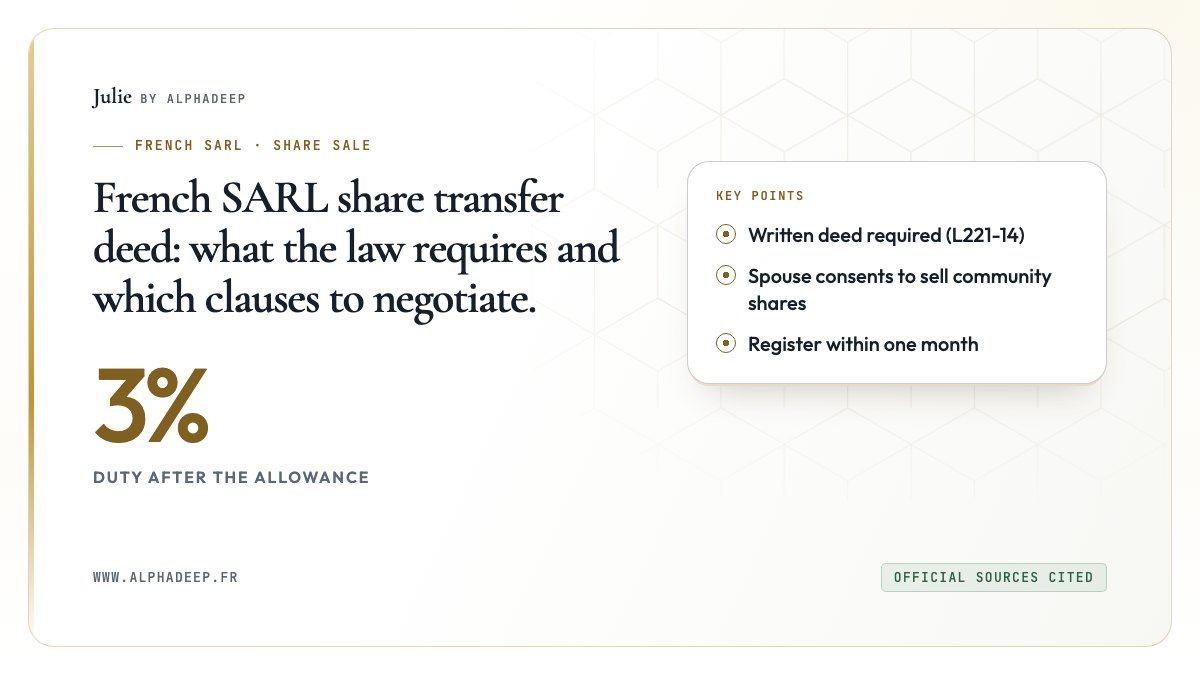
Under French law, a transfer of SARL shares must be made in writing (Commercial Code, article L221-14, applied to SARLs by L223-17). Payment in instalments, an asset and liability warranty and a seller non-compete are contractual tools: no statute imposes them, so their drafting decides your protection. If the shares are community property, your spouse must consent (Civil Code, article 1424). The deed is registered within a month, with 3% duty after a prorated 23,000 € allowance.
Text in force3 August 2014Sources checked30 October 2026
- Official texts cited
- Sources checked on
- Drafted with AI assistance, our method
General legal information with official references and dated checks. It is not personalised advice: for a decision that commits you, have your situation checked by a qualified professional.
Julie by AlphaDeep
You are selling or buying shares in a French SARL and the deed is being drafted: I can check the price terms, warranties and spouse consent with you and work out the registration duty.
3 free questions at signup. Avoid names and sensitive information.
What must a French SARL share transfer deed contain?
A French SARL share transfer deed (acte de cession de parts sociales) must be in writing and identify the seller, the buyer, the company, the number of shares sold and the price (Commercial Code, articles L221-14 and L223-17). No statute requires any other clause: everything else is a contractual choice, and it only protects you if it is written into the deed.
A complete deed also states when ownership passes, how the price is paid, the members’ approval (agrément) if the buyer is an outsider (article L223-14), the asset and liability warranty, any seller non-compete, the consent of a spouse married under community property, and who pays the duty. According to Service-Public (page checked on 22 July 2026), the deed is drawn up in as many copies as there are parties and must be registered within one month of its date.
French Commercial Code (Code de commerce), article L221-14French Commercial Code, article L223-17French Commercial Code, article L223-14Entreprendre.Service-Public: transfer of shares in a SARL (page F35999, checked 22 July 2026, in French)
Does your spouse have to consent to the sale of your SARL shares?
Yes, if you are married under a community property regime and the shares are community property: one spouse cannot, without the other, sell non-negotiable company rights held in community, which include SARL shares, or collect the price alone (Civil Code, article 1424).
Your spouse therefore signs the deed or gives a written consent attached to it. Without that consent, your spouse can ask a court to cancel the sale within two years of learning of it (article 1427). The risk falls mainly on the buyer, who has every reason to insist on the signature.
No consent is needed if you married under separate property or if the shares belong to you personally, for example because you received them by gift or inheritance. Spouse consent does not replace the members’ approval, which is a company decision.
French Civil Code (Code civil), article 1424French Civil Code, article 1427
Is your share transfer deed complete?
Tell the worksheet what the draft deed contains and enter the price and share numbers: it flags what French law requires, what is still open to negotiation, and computes the registration duty and the registration deadline. It does not say whether a clause would hold up in a dispute.
Fictional example · What the draft deed covers
Nothing protects the seller if the buyer stops paying. Add a termination clause naming the missed instalment (Civil Code, articles 1224 and 1225) and a security: a pledge of the shares or part of the price held in escrow.
- Prorated allowance (23,000 € × shares sold ÷ total)
- 9,200.00 €
- Amount taxed at 3%
- 70,800.00 €
- Estimated registration duty (minimum 25 €)
- 2,124.00 €
- Items to fix before signing
- 1
- Register the deed by
- 2026-12-16
- File the deed with the tax office and pay the duty before 2026-12-16.
- Serve the transfer on the company, or leave an original at the registered office against the manager’s receipt.
- Have the amended statutes published through the single online business portal within one month.
This result separates what French law requires from what the deed chooses; it does not say how a court would read a clause. The duty applies article 726 of the French General Tax Code to the price entered.
Which clause covers which risk for seller and buyer?
| Deed item | Rule or choice | Source |
|---|---|---|
| Form | Required: a written deed, private or before a notary | Commercial Code, arts. L221-14 and L223-17 |
| Parties, shares and price | Essential: the stated price is the base for registration duty | General Tax Code, art. 726, II |
| Payment in instalments | Choice: termination clause, pledge of the shares, escrow | Civil Code, arts. 1224, 1225 and 2355 |
| Warranty and non-compete | Choice: cap, threshold, duration, back-up security; area and duration of any non-compete | Civil Code, art. 1103 |
| Spouse consent | Required if the shares are community property; otherwise the sale can be cancelled for 2 years | Civil Code, arts. 1424 and 1427 |
| Members’ approval | Required for an outsider: majority of members holding half the shares; deemed given after 3 months of silence | Commercial Code, art. L223-14 |
| Registration and duty | Required within one month: 3% after the allowance, 5% for real-estate companies, 25 € minimum, paid by the buyer unless agreed otherwise | General Tax Code, arts. 635, 726 and 1712 |
| Binding effect | Required: service on or filing with the company, then publication of the amended statutes | Commercial Code, arts. L221-14 and R123-66 |
« Choice » means no statute imposes the clause: leaving it out does not void the deed, but leaves the risk with one of the parties.
French Commercial Code (Code de commerce), article L221-14French General Tax Code (Code général des impôts), article 726French Civil Code, article 1224French Civil Code, article 1103French Civil Code (Code civil), article 1424French Commercial Code, article L223-14French General Tax Code, article 635French General Tax Code, article 1712French Commercial Code, article R123-66
How can a seller be protected when the price is paid in instalments?
A seller paid in instalments is protected by combining, in the deed, a termination clause, a security over the shares and, where possible, part of the price held in escrow.
Registration duty is calculated on the full price stated in the deed, even when most of it is paid later (General Tax Code, article 726, II).
- Termination clause (clause résolutoire): it names the missed instalment that ends the sale; it applies after a formal notice (mise en demeure) that expressly mentions it, unless the deed waives that notice (Civil Code, articles 1224 and 1225).
- Pledge of the shares (nantissement) in favour of the seller (Civil Code, article 2355): if the company approved it under article L223-14, that approval covers the buyer in a forced sale (Commercial Code, article L223-15).
- Escrow (séquestre): part of the price is held by a lawyer or notary until the agreed date (Civil Code, article 1956).
- A written schedule, interest and acceleration of the whole balance on default.
French Civil Code, article 1224French Civil Code, article 1225French Civil Code, article 2355French Commercial Code, article L223-15French Civil Code, article 1956French General Tax Code (Code général des impôts), article 726
What goes into an asset and liability warranty?
An asset and liability warranty (garantie d’actif et de passif) is the seller’s promise to compensate the buyer, or the company, if a debt that arose before the sale surfaces afterwards, or if a declared asset does not exist. No statute governs it: it binds because the parties signed it (Civil Code, article 1103), so its scope depends entirely on the drafting.
With no cap or time limit, the seller stays exposed for years; with no back-up security, the buyer depends on the seller staying solvent. A seller non-compete works the same way: write its duration, area and activities.
- Cap: the maximum amount payable, often set against the price.
- Threshold or deductible: the amount below which no claim is accepted.
- Duration: often aligned with the time limits for tax and social security audits.
- Procedure: deadline to notify a claim, the seller’s right to run the defence.
- Back-up security: part of the price in escrow or a bank guarantee.
French Civil Code, article 1103French Civil Code, article 1956
When does the transfer bind the company and third parties?
The transfer binds the company once it is formally served on it by a bailiff (commissaire de justice), or once an original of the deed is left at the registered office against a receipt from the manager (gérant); it binds third parties only after those steps and the publication of the amended statutes in the Trade and Companies Register, the RCS (Commercial Code, article L221-14, referring to Civil Code, article 1690).
The company must apply for the amended entry within one month, through the single online business portal (article R123-66). If the manager does nothing, the seller or buyer sends a formal notice; eight days later, after referring the matter to the court president, either may file the deed with the register, which makes the transfer binding on third parties on a provisional basis (article R221-9).
French Commercial Code (Code de commerce), article L221-14French Civil Code, article 1690French Commercial Code, article R123-66French Commercial Code, article R221-9
How much registration duty does the transfer cost?
Under article 726 of the French General Tax Code, the allowance is 23,000 € multiplied by the number of shares sold and divided by the total number of shares; the rate applies to the rest of the price.
- Duty rate on a transfer of SARL shares, after the prorated 23,000 € allowance
- 3%
- In force since 1 January 2024 · French General Tax Code, article 726, I, 1° bis
- Duty on 500 of 1,000 shares sold for 100,000 € (allowance of 11,500 €)
- 2,655 €
- Example checked on 22 July 2026 · Entreprendre.Service-Public, page F35999
- Minimum registration duty on a share transfer deed
- 25 €
- Page checked on 22 July 2026 · Entreprendre.Service-Public, page F35999
- Rate with no allowance when the company mainly holds real estate
- 5%
- In force since 1 January 2024 · French General Tax Code, article 726, I, 2°
What does article L221-14 of the French Commercial Code say?
La cession des parts sociales doit être constatée par écrit. Elle est rendue opposable à la société, dans les formes prévues à l'article 1690 du code civil. Toutefois, la signification peut être remplacée par le dépôt d'un original de l'acte de cession au siège social contre remise par le gérant d'une attestation de ce dépôt.
Elle n'est opposable aux tiers qu'après accomplissement de ces formalités et, en outre, après publication des statuts modifiés au registre du commerce et des sociétés ; ce dépôt peut être effectué par voie électronique.
In plain English: The transfer must be in writing. It binds the company only once served on it, or once an original is left at the registered office against the manager’s receipt. It binds third parties only after those steps and the publication of the amended statutes in the Trade and Companies Register.
The text applies to SARLs through article L223-17 of the French Commercial Code.
What else do sellers and buyers of SARL shares ask?
Do you need a notary to sell shares in a French SARL?
No: shares in a French SARL can be transferred by a private written deed, since the law only requires writing (Commercial Code, article L221-14). A notary is required in one specific case: a transfer signed abroad of shares in a company that mainly holds French real estate must be recorded by a notary practising in France within one month (General Tax Code, article 726, III).
French Commercial Code (Code de commerce), article L221-14French General Tax Code (Code général des impôts), article 726
Does selling shares to your child need the other members’ approval?
Not as a rule: shares in a French SARL can be freely transferred between parents and children, and between spouses (Commercial Code, article L223-13). The statutes may still require members’ approval for a family member, but with no stricter majority or longer deadline than article L223-14 allows. Read the approval clause in the statutes before signing.
French Commercial Code, article L223-13French Commercial Code, article L223-14
What if the manager does not publish the amended statutes?
If the manager of a French SARL does not publish the amended statutes, the seller or buyer sends a formal notice. Eight days after it goes unanswered, and after referring the matter to the court president, either may file the transfer deed with the Trade and Companies Register, which makes the transfer binding on third parties provisionally (Commercial Code, article R221-9).
Is the duty higher when the SARL mainly holds real estate?
Yes: a transfer of shares in a French company that mainly holds real estate is taxed at 5%, without the 23,000 € allowance (General Tax Code, article 726, I, 2°). A company qualifies when its assets consist, or did during the year before the sale, mainly of buildings or property rights located in France.
French General Tax Code (Code général des impôts), article 726
You own shares in a Swiss Sàrl: are the transfer rules the same?
No. A Swiss Sàrl follows the Swiss Code of Obligations: the transfer must be in writing (article 785), and unless the statutes provide otherwise the members’ meeting must approve it by two thirds of the votes represented and an absolute majority of the capital (articles 786 and 808b). The transfer only takes effect on approval, which is deemed given after six months without refusal (article 787).
Swiss Code of Obligations (CO), articles 785 to 787 and 808b (French version)
Which French texts does this guide to the transfer deed rely on?
- French Commercial Code (Code de commerce), article L221-14République française / DILA : Légifrance
- French Commercial Code, article L223-17République française / DILA : Légifrance
- French Commercial Code, article L223-14République française / DILA : Légifrance
- Entreprendre.Service-Public: transfer of shares in a SARL (page F35999, checked 22 July 2026, in French)République française / DILA : Service-Public
- French Civil Code (Code civil), article 1424République française / DILA : Légifrance
- French Civil Code, article 1427République française / DILA : Légifrance
- French Civil Code, article 1224République française / DILA : Légifrance
- French Civil Code, article 1225République française / DILA : Légifrance
- French Civil Code, article 2355République française / DILA : Légifrance
- French Commercial Code, article L223-15République française / DILA : Légifrance
- French Civil Code, article 1956République française / DILA : Légifrance
- French General Tax Code (Code général des impôts), article 726République française / DILA : Légifrance
- French Civil Code, article 1103République française / DILA : Légifrance
- French Civil Code, article 1690République française / DILA : Légifrance
- French Commercial Code, article R123-66République française / DILA : Légifrance
- French Commercial Code, article R221-9République française / DILA : Légifrance
- French General Tax Code, article 635République française / DILA : Légifrance
- French General Tax Code, article 1712République française / DILA : Légifrance
- French Commercial Code, article L223-13République française / DILA : Légifrance
- Swiss Code of Obligations (CO), articles 785 to 787 and 808b (French version)Confédération suisse : Fedlex
Texts cited last checked: 30 October 2026