The route finderShort furnished let
Bail mobilité in France: who can sign it, for how long, and what it changes
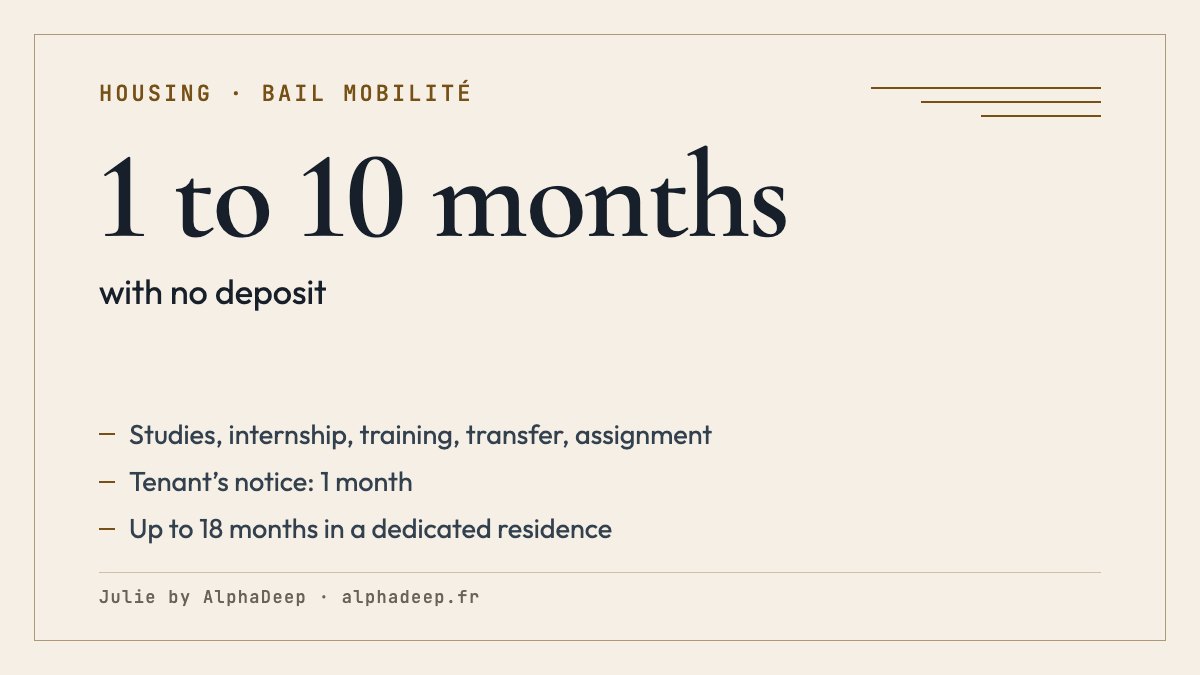
A mobility lease covers furnished housing and a tenant in higher education, internship, training, apprenticeship, civic service, transfer or temporary assignment. It normally lasts one to ten months without renewal, deposit or rent revision; the tenant can leave with one month’s notice. An employment-oriented residence permits one week to eighteen months. Housing hostels and homes under a State agreement are excluded from the ordinary regime (1989 housing law).
Go to the tool: the route finder
Julie by AlphaDeep is an AI legal assistant for French law: it researches official references to help answer your questions (Légifrance, case law, service-public), analyses your documents and drafts your letters, for individuals and professionals alike.
General legal information with official references and dated checks. It is not personalised advice: for a decision that commits you, have your situation checked by a qualified professional.

Let’s look at your situation
Give your situation, the length of the stay and what the draft lease provides.
Example questions
Your question carries over after signup. Maximum 400 characters. Avoid health data and names.
Who can rent a home with a bail mobilité?
A tenant who shows, on the date the lease takes effect, that they are in vocational training, higher education, an apprenticeship contract, an internship, civic service, a job transfer or a temporary work assignment (article 25-12 of the law of 6 July 1989). Outside these situations, the ordinary furnished lease applies.
The reason must appear in the lease, as must its length. Without them, or without the statement that it is a bail mobilité, the contract becomes an ordinary one-year furnished lease (article 25-13).
Sources: Law of 1989, art. 25-12 · Law of 1989, art. 25-13
Can a bail mobilité be extended or renewed?
The length can be changed once by an amendment, without exceeding 10 months in total, or 18 months in a job-focused residence (article 25-14 of the law of 6 July 1989). The lease cannot be renewed or rolled over.
If, at the end, the parties sign a new lease for the same furnished home, that new lease is an ordinary furnished lease, of at least a year, with its own rules.
Source: Law of 1989, art. 25-14
How do you leave a bail mobilité before the end?
The tenant can leave at any time by giving one month’s notice, by registered letter with acknowledgement of receipt, by a commissaire de justice’s deed or by hand delivery against a receipt (article 25-15 of the law of 6 July 1989). The notice runs from receipt of the letter, the service or the delivery.
Rent and charges remain due throughout the notice, unless another tenant moves in before the end with the landlord’s agreement.
Source: Law of 1989, art. 25-15
Does your stay allow a bail mobilité, or which furnished lease should you choose?
Give your situation, the moving-in date and the length of the stay: the route finder says whether the bail mobilité is possible and compares the three furnished leases, your case highlighted. The example: a 6-month internship from 1 October 2026. The result is indicative: confirm the ordinary-case conditions; a special case or unknown decisive fact prevents calculation.
Fictional example · furnished lease route finder
A bail mobilité is possible: from 1 October 2026 to 31 March 2027, with no deposit, not renewable.
| Criterion | Bail mobilitéYour case | Student furnished let, 9 months | Standard furnished let, 1 year |
|---|---|---|---|
| For whom | Training, studies, apprenticeship, internship, civic service, job transfer or temporary assignment | A student | Any tenant |
| Length | 1 to 10 months; 1 week to 18 months in a job-focused residence | 9 months | 1 year at least |
| At the end | The lease ends, with no renewal; a new lease is a standard furnished let | The lease ends, with no renewal | Renewed for a year, unless notice is given |
| Deposit | Prohibited | 2 months’ rent at most | 2 months’ rent at most |
| Tenant’s notice | 1 month | 1 month | 1 month |
| Rent review | Impossible during the lease | Yearly if the lease provides for it | Yearly if the lease provides for it |
| Charges | Flat rate, with no adjustment | Advance payments or flat rate | Advance payments or flat rate |
The home must be decent and furnished, and the rent remains capped in the cities where rent control applies.
What must a bail mobilité contain?
The statements that make the contract a bail mobilité, and the clauses it cannot contain.
| Statement | What it says | If it is missing |
|---|---|---|
| Reason for the bail mobilité | Studies, training, internship, apprenticeship, civic service, job transfer or assignment | The contract becomes an ordinary furnished lease |
| Length | From 1 to 10 months, or from 1 week to 18 months in a job-focused residence | The contract becomes an ordinary furnished lease |
| The words "bail mobilité" | The contract is governed by title I ter of the 1989 law | The contract becomes an ordinary furnished lease |
| Rent and flat-rate charges | Amount, payment terms, a flat rate with no adjustment | To be specified in the contract |
| Ban on a deposit | The landlord cannot require a deposit | A deposit clause is prohibited |
The lease also states the previous tenant’s last rent if they left less than 18 months ago, and the works done since the last lease (article 25-13).
Sources: Law of 1989, art. 25-13 · Service-public F34759
What changed for the bail mobilité in 2025?
The simplification law of 26 November 2025 created a case where the bail mobilité lasts longer.
Creation of the job-focused residence (résidence à vocation d’emploi): its furnished homes are let on a bail mobilité from a week to 18 months (law no. 2025-1129 of 26 November 2025, Construction and Housing Code, article L631-16-1, and article 25-14 of the 1989 law).
Sources: Law of 1989, art. 25-14 · CCH L631-16-1
What does article 25-14 of the law of 6 July 1989 say about the length?
The length of the bail mobilité, as worded since 28 November 2025.
Le bail mobilité est conclu pour une durée minimale d’un mois et une durée maximale de dix mois, non renouvelable et non reconductible.
Par dérogation au premier alinéa, le bail mobilité peut être conclu pour une durée minimale d’une semaine et une durée maximale de dix-huit mois lorsque le logement sur lequel il porte fait partie d’une résidence à vocation d’emploi définie à l’article L. 631-16-1 du code de la construction et de l’habitation.
In English, briefly (our summary, not an official translation): The bail mobilité is signed for a minimum of one month and a maximum of ten months, and cannot be renewed or rolled over. By way of exception, it can be signed for a minimum of one week and a maximum of eighteen months when the home is part of a job-focused residence defined in article L. 631-16-1 of the Construction and Housing Code. The same article allows the length to be changed once by amendment, within these limits.
What do tenants and landlords ask before signing?
Can the landlord ask for a guarantor or a deposit?
No deposit: it is prohibited (article 25-17 of the law of 6 July 1989). A guarantor remains possible; according to service-public, the tenant can then use the Visale guarantee, including as a student.
Can the rent of a bail mobilité rise during the lease?
No. The rent is set freely but cannot be reviewed during the lease (article 25-16 of the law of 6 July 1989). According to service-public, it remains capped in the communes where rent control applies.
Are the charges of a bail mobilité adjusted?
No. They are paid as a flat rate with the rent, with no top-up or later adjustment, and the flat rate cannot be manifestly disproportionate (article 25-18 of the law of 6 July 1989).
What is a job-focused residence?
A set of self-contained furnished homes let from a week to 18 months to students, interns, apprentices or employees on a transfer or an assignment, on a bail mobilité. At least 80% of the homes respect income and rent ceilings (Construction and Housing Code, article L631-16-1).
Which texts is this comparison of furnished leases based on?
- Law no. 89-462 of 6 July 1989, article 25-12 (who can have a bail mobilité)Légifrance, in French
- Law no. 89-462 of 6 July 1989, article 25-13 (statements in the bail mobilité)Légifrance, in French
- Law no. 89-462 of 6 July 1989, article 25-14 (length)Légifrance, in French
- Law no. 89-462 of 6 July 1989, articles 25-15 to 25-18 (notice, rent, deposit, charges)Légifrance, in French
- What are the rules of a bail mobilité? (fiche F34759)Service-public.fr, in French · checked by the publisher on 6 June 2025
- Construction and Housing Code, article L631-16-1 (job-focused residence)Légifrance, in French
- Law no. 89-462 of 6 July 1989, articles 25-6 to 25-8 (ordinary and student furnished leases)Légifrance, in French
Texts cited last checked: 25 September 2026