The exhibit listExhibit list · Solidarity rent surcharge
Social housing rent surcharge (SLS) in France: the landlord’s yearly survey, the documents to send and the 2026 calculation
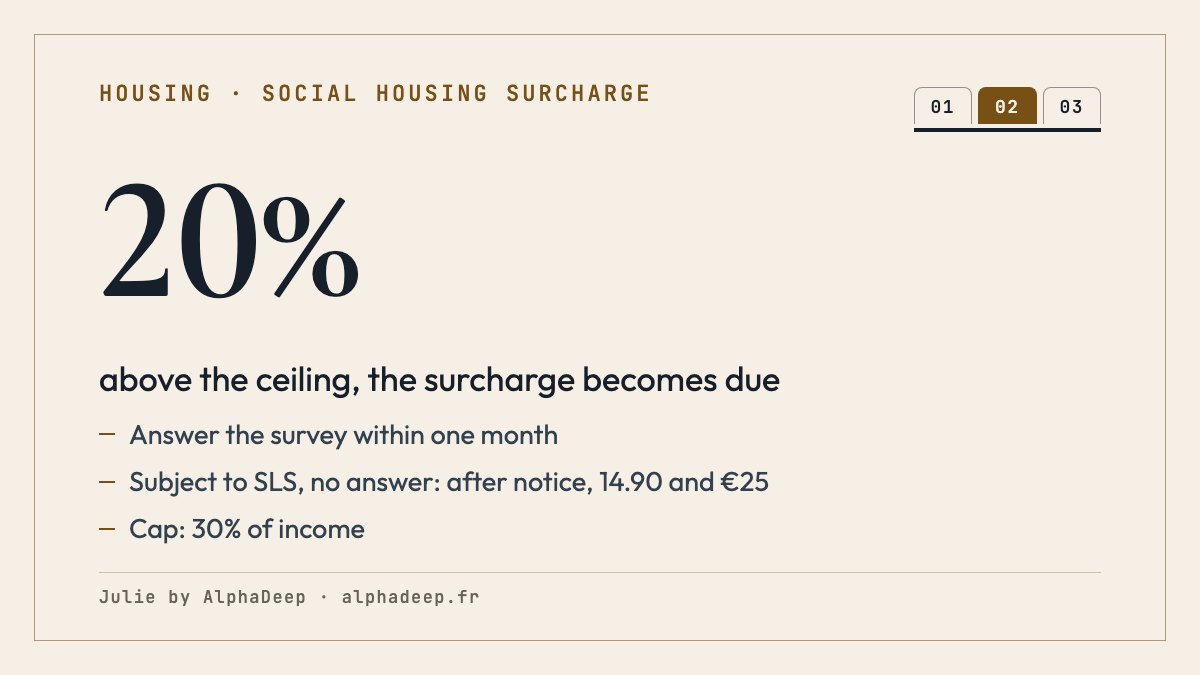
Outside statutory exemptions, a French social landlord charges a solidarity rent surcharge (SLS) when the household’s income exceeds the allocation ceiling by at least 20% (Construction and Housing Code, article L441-3). Each year, you have one month to answer its survey with the household’s tax notices; with no answer after a 15-day formal notice, it applies the maximum coefficient of 14.90.
Go to the tool: the exhibit list
Julie by AlphaDeep is an AI legal assistant for French law: it researches official references to help answer your questions (Légifrance, case law, service-public), analyses your documents and drafts your letters, for individuals and professionals alike.
General legal information with official references and dated checks. It is not personalised advice: for a decision that commits you, have your situation checked by a qualified professional.

Let’s look at your situation
Give the household’s income, the type of social housing, the town, the area and the landlord’s letter.
Example questions
Your question carries over after signup. Maximum 400 characters. Avoid health data and names.
How does the landlord’s yearly survey work?
Four stages, two of which depend only on you: answer within the month, then react to a formal notice.
- Document 1
The survey
Each year, the landlord asks for the tax or non-tax notices and who lives in the household; you have one month to answer (article L441-9).
- Document 2
The formal notice
Without an answer, it sends a formal notice; the letter reproduces article L441-9 and gives you 15 days.
- Document 3
The provisional surcharge
After those 15 days, it charges the surcharge at the maximum coefficient of 14.90 (article R441-26) and bills €25 of file costs (sheet F21051).
- Document 4
The correction
Once your documents arrive, the surcharge for the late period is recalculated and any overpayment refunded within 2 months (article L441-9).
What surcharge, and which documents for the survey?
Give the household’s income, your home’s allocation ceiling, the habitable area, the zone and the rent: the exhibit list works out the excess coefficient, the monthly surcharge and its cap, lists the survey documents and dates your answer. The example: €36,600 of income against a €30,000 ceiling, 60 m² in a large urban area, €450 of rent, survey received on 5 October 2026.
Fictional example · the surcharge and the survey
Estimated surcharge of €29.25 a month.
- Excess over the ceiling
- 22%
- Excess coefficient
- 0.39
- Calculated surcharge
- €29.25 a month
- Room under the 30% cap
- €465.00 a month
- Surcharge due
- €29.25 a month
- Answer the survey by
- 5 November 2026
- After a 15-day formal notice left unanswered
- €1,117.50 a month at coefficient 14.90, and €25 of file costs
| No. | Exhibit | What it proves | Status |
|---|---|---|---|
| 01 | Survey questionnaire, filled in and signed | Who lives in the household | To obtain |
| 02 | Tax or non-tax notice of each household member | The income used for the calculation | To obtain |
| 03 | Dated proof of sending | The answer within one month | To obtain |
Indicative estimate: the landlord uses the reference year’s income and the ceiling in force on the surcharge date; its notice must let you check the calculation.
What reference supplement applies in 2026?
The monthly surcharge is worked out per square metre of habitable area, at a rate set by the home’s zone.
| Zone of the home | Per m² a month | For 60 m², coefficient 0.39 |
|---|---|---|
| Paris and bordering towns | €3.11 | €72.77 |
| Other towns of the Paris conurbation, development zones and new towns of Île-de-France | €2.49 | €58.27 |
| Rest of Île-de-France; urban areas and groupings over 100,000 people elsewhere | €1.25 | €29.25 |
| Corsica | €0.30 | €7.02 |
| Other towns outside Île-de-France | €0.31 | €7.25 |
| Guadeloupe, French Guiana, Martinique, Réunion and Mayotte | €0.31 | €7.25 |
Rates revised each 1 January on the rent reference index (article R441-21). Base rent and surcharge together do not exceed 30% of the household’s income.
Sources: Service-public F21051 · CCH R441-21 · CCH R441-20
What does article L441-9 of the Construction and Housing Code say?
The deadline to answer the survey, and what follows a missing answer.
Le locataire est tenu de répondre à cette demande dans un délai d’un mois.
A défaut et après mise en demeure restée infructueuse pendant quinze jours, l’organisme d’habitations à loyer modéré liquide provisoirement le supplément de loyer.
Lorsque le locataire a communiqué les renseignements et avis mentionnés au premier alinéa, le supplément de loyer afférent à la période de retard est liquidé définitivement. Le trop-perçu de supplément de loyer est reversé au locataire dans les deux mois.
In English, briefly (our summary, not an official translation): The tenant must answer the request within one month. Failing that, and after a formal notice left unanswered for fifteen days, the social landlord charges the surcharge provisionally. Once the tenant has sent the information and notices, the surcharge for the late period is settled for good, and any overpayment is refunded to the tenant within two months. Our note: article R441-26 sets the provisional coefficient at its maximum, 14.90.
When is the solidarity rent surcharge due?
As soon as the income of everyone in the household exceeds your home’s allocation ceiling by at least 20% (article L441-3): the PLUS ceiling for a PLAI or PLUS home, the PLS ceiling for a PLS home (sheet F21051).
It does not apply if the home is, or was when you moved in, in a France ruralités revitalisation zone or a priority urban district (article L441-3), nor to a PLI home (sheet F21051).
Sources: CCH L441-3 · Service-public F21051
How is the surcharge calculated?
Habitable area × excess coefficient × the zone’s reference supplement (article R441-20). The coefficient is 0.27 at a 20% excess, then adds 0.06 per whole point up to 59%, 0.08 from 60% to 149% and 0.10 from 150% (article R441-21).
Half a point does not count: at 20.5%, the coefficient stays 0.27. Base rent and surcharge, over the year, do not exceed 30% of the household’s income (articles L441-4 and R441-20).
Sources: CCH R441-20 · CCH R441-21 · CCH L441-4
What is the risk of not answering the survey?
A provisional surcharge at coefficient 14.90 and €25 of file costs, after a formal notice left unanswered for 15 days (article L441-9; sheet F21051); it is corrected once the documents are sent.
In high-demand zones set by decree, two consecutive years without an answer end the right to stay 18 months after the following 1 January, except at 65, with a disability or in a priority district (article L442-3-4).
Sources: CCH L441-9 · Service-public F21051 · CCH L442-3-4
What do social housing tenants ask about the SLS survey?
Is the survey compulsory if I receive APL?
The landlord does not have to send it to tenants receiving APL or a housing allowance (article L441-9); if you receive it anyway, answer within the month.
My income has fallen: can the surcharge go down?
Yes, on your request, if your latest income is at least 10% below the reference year’s; a change in the household during the year also counts (article L441-3).
Can you lose social housing because of your income?
In zones set by decree, yes: income above 150% of the PLS ceiling two years running ends the right to stay 18 months after the following 1 January, with exceptions (article L442-3-3).
Can the surcharge exceed 30% of income?
No: with the base rent, it is capped at 30% of the income of everyone living in the household (article L441-4).
Which texts does the solidarity rent surcharge rest on?
- Construction and Housing Code, article L441-3 (20% threshold, exemptions)Légifrance
- Construction and Housing Code, article L441-9 (yearly survey)Légifrance
- Construction and Housing Code, article R441-20 (calculation and 30% cap)Légifrance
- Construction and Housing Code, article R441-21 (coefficient and reference)Légifrance
- Construction and Housing Code, article L441-4 (cap)Légifrance
- Construction and Housing Code, article R441-26 (coefficient 14.90)Légifrance
- Construction and Housing Code, article L442-3-3 (income above 150%)Légifrance
- Construction and Housing Code, article L442-3-4 (two years without an answer)Légifrance
- Social housing: solidarity rent surcharge (sheet F21051, in French)Service-public.fr · checked on 1 January 2026
- Keeping social housing when income rises (sheet F31601, in French)Service-public.fr
Texts cited last checked: 27 September 2026