The exhibit listExhibit list · Decennial insurance
Decennial insurance in France: the certificate to demand from a builder, the entries to check and the other documents before signing the quote
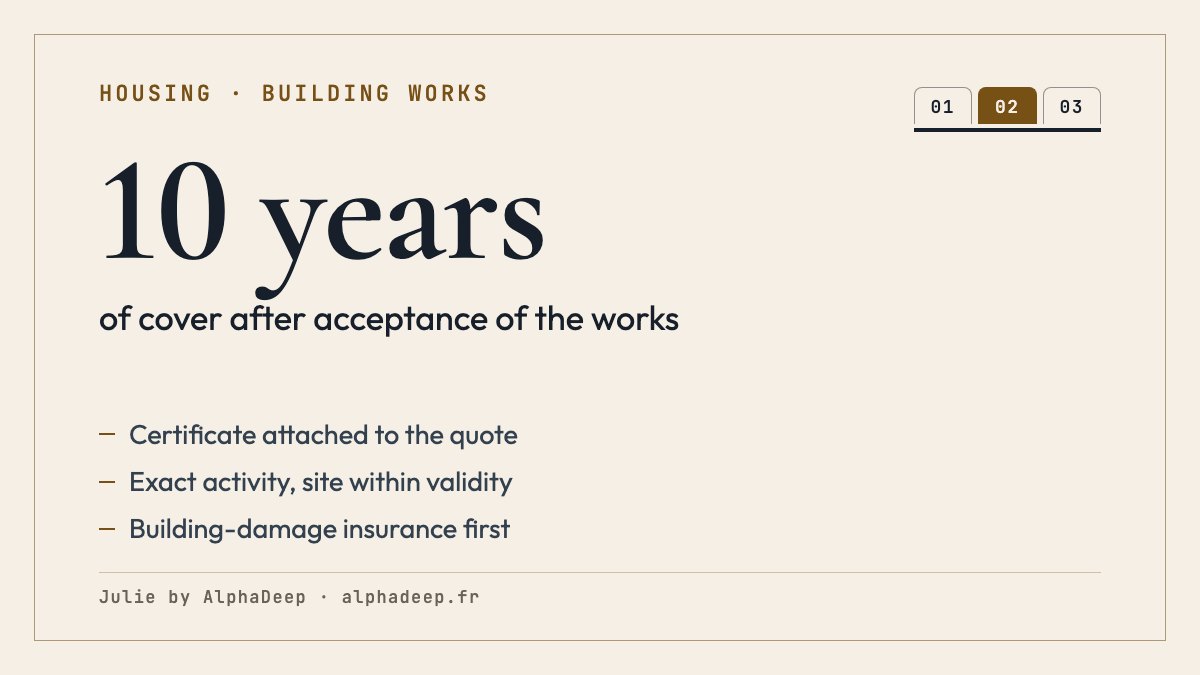
A builder in France is liable for 10 years after acceptance of the works for damage that undermines the soundness of the work or makes it unfit for its purpose (Civil Code, articles 1792 and 1792-4-1). They must be insured and prove it when the site opens, with a certificate attached to the quote (Insurance Code, articles L241-1 and L243-2) that must cover your exact works.
Go to the tool: the exhibit list
Julie by AlphaDeep is an AI legal assistant for French law: it researches official references to help answer your questions (Légifrance, case law, service-public), analyses your documents and drafts your letters, for individuals and professionals alike.
General legal information with official references and dated checks. It is not personalised advice: for a decision that commits you, have your situation checked by a qualified professional.

Let’s look at your situation
Give the planned works, the company, the quote amount and what the certificate received says.
Example questions
Your question carries over after signup. Maximum 400 characters. Avoid health data and names.
Which documents to demand, and does the certificate cover your works?
Give the type of works, what the builder gave you, what the certificate says and the site opening date: the exhibit list sorts each document, flags what blocks signing and dates the end of the guarantee after acceptance. The example: a conservatory on foundations, a certificate attached to the quote that does not list the activity, a site opening on 2 November 2026.
Fictional example · the file before signing
To settle before signing: the activity covered.
- Decennial insurance
- Compulsory for these works
- Site opening
- 2 November 2026, within the validity period
- Owner’s building-damage insurance
- Depends on the works and statutory exceptions
- Points to settle before signing
- 1
| No. | Exhibit | What it proves | Status |
|---|---|---|---|
| 01 | Detailed, dated quote | The works, the prices and the company that commits | In the file |
| 02 | Decennial insurance certificate attached to the quote | Cover for these works when the site opens | To obtain |
| 03 | RNE or Kbis extract of the company | The unique number shown on the certificate | In the file |
| 04 | Professional liability certificate | Damage caused during the works, if the company has one | Optional |
| 05 | Your building-damage insurance (dommages-ouvrage) | Repairs paid upfront, without waiting for liability to be settled | Optional |
| 06 | Signed acceptance report (procès-verbal de réception) | The start of the 10 years | Optional |
Indicative result: decennial cover depends on the nature of the work and of the damage, and the certificate binds the insurer only within the contract’s limits; if in doubt, ask the insurer named.
Who must provide which insurance?
The builder insures their liability; you, as the client, insure the upfront funding of repairs for a construction.
- Document 1
The builder’s decennial insurance
Compulsory for any builder whose ten-year liability may be engaged; they prove it when each site opens (article L241-1).
- Document 2
The certificate
Attached to quotes and invoices (article L243-2), on the regulatory model of article A243-3.
- Document 3
Your building-damage insurance
The owner having a building built takes it out before the site opens; it pays for repairs without waiting for liability to be settled (article L242-1).
- Document 4
The RGE certificate
For an energy-renovation grant: it proves a qualification, not insurance (sheet F32251).
Which works require decennial insurance?
The works that require decennial insurance are those that engage the builder’s liability: damage that undermines the soundness of the work or makes it unfit for its purpose, including through an item of equipment (Civil Code, article 1792).
Service-public lists new builds, extensions and renovations depending on their scale, foundations and structure, works with foundations (conservatory, terrace, in-ground pool) and inseparable equipment (sheet F2034). Equipment replaced or added on an existing building, when it is not itself a construction work, falls under ordinary contractual liability without compulsory decennial insurance (Cass. 3e civ., 21 March 2024, no. 22-18.694). Some works, such as existing structures not incorporated into the new work, fall outside the duty (article L243-1-1).
Sources: C. civ. 1792 · Service-public F2034 · C. assur. L243-1-1
What should you check on the certificate?
The central headings « Attestation d’assurance » and « Assurance de responsabilité décennale obligatoire », then the company’s name, address and unique number, the insurer, the contract and the validity period (article A243-3).
Above all, the activities covered, the area, the maximum site cost and the techniques: only the works declared in the contract are covered, and the site must open within the validity period (sheet F2034).
Sources: C. assur. A243-3 · Service-public F2034
Do you also need building-damage insurance?
Yes, for the owner having construction works carried out: before the site opens (article L242-1). The insurer has 60 days after the claim to say whether it covers it, then 90 days for a compensation offer.
Failing to take out the compulsory insurance is punishable by 6 months’ prison and a €75,000 fine, except for a person building a home to live in or for their spouse, ascendants or descendants to live in (article L243-3).
Sources: C. assur. L242-1 · C. assur. L243-3 · Service-public F2032
What do homeowners ask before signing a quote?
How long does the decennial guarantee last?
Ten years from acceptance of the works (Civil Code, article 1792-4-1): keep the signed acceptance report with the quote, the invoice and the certificate.
Is a professional liability certificate enough?
No: the decennial certificate carries the central heading « Assurance de responsabilité décennale obligatoire » (article A243-3); professional liability covers other damage.
What does a builder working without decennial cover risk?
Six months’ prison and a €75,000 fine, or one of these penalties (Insurance Code, article L243-3).
What if the company has since closed?
The guarantee can still be used even if the builder has gone bankrupt: contact the insurer whose details are on the certificate (sheet F2034).
Is the certificate needed to sell the house?
For a sale within the 10 years, the deed states whether the insurance exists, and the certificate is annexed to it (article L243-2).
Which entries must the decennial certificate show?
The regulatory model sets minimum entries; each one is compared with the quote and the site.
| Entry | Compare with | Why |
|---|---|---|
| « Assurance de responsabilité décennale obligatoire » | The title of the document received | Professional liability cover does not replace it |
| Name, address and unique number | The quote and the RNE or Kbis extract | The insured company is the one that commits |
| Insurer and contract number | The details to contact the insurer | It answers even if the company closes |
| Validity period | The site opening date | The site must open while it is valid |
| Activities or missions covered | Each line of the quote | Only declared works are covered |
| Area, maximum cost and techniques | The address, amount and method of the site | A site outside these limits is not covered |
The certificate cannot bind the insurer beyond the terms of the contract it refers to (article A243-3).
Sources: C. assur. A243-3 · Service-public F2034
What does article L241-1 of the French Insurance Code say?
The duty to insure, and when the builder must prove it.
Toute personne physique ou morale, dont la responsabilité décennale peut être engagée sur le fondement de la présomption établie par les articles 1792 et suivants du code civil, doit être couverte par une assurance.
A l’ouverture de tout chantier, elle doit justifier qu’elle a souscrit un contrat d’assurance la couvrant pour cette responsabilité.
In English, briefly (our summary, not an official translation): Any natural or legal person whose ten-year liability may be engaged on the basis of the presumption in articles 1792 and following of the Civil Code must be covered by insurance. When any site opens, they must prove that they have taken out an insurance contract covering them for that liability. Our note: the last paragraph adds that the contract is deemed to keep the cover for the whole duration of the ten-year liability.
Which texts does decennial insurance rest on?
- Cour de cassation, third civil chamber, 21 March 2024, no. 22-18.694 (equipment on an existing building)Légifrance
- Civil Code, article 1792 (builder’s liability)Légifrance
- Civil Code, article 1792-4-1 (ten years after acceptance)Légifrance
- Insurance Code, article L241-1 (duty to insure)Légifrance
- Insurance Code, article L243-2 (certificate attached to quotes)Légifrance
- Insurance Code, article A243-3 (model certificate)Légifrance
- Insurance Code, article L242-1 (building-damage insurance)Légifrance
- Insurance Code, article L243-1-1 (excluded works)Légifrance
- Insurance Code, article L243-3 (criminal penalty)Légifrance
- Builders’ ten-year guarantee (sheet F2034)Service-public.fr · French page checked on 10 April 2026
- Building-damage insurance (sheet F2032)Service-public.fr · French page checked on 17 September 2026
- Obtaining the RGE label (sheet F32251, in French)Service-public.fr · checked on 9 June 2026
Texts cited last checked: 27 September 2026