The gazetteShort-term rental · 20 May 2026
Short-term rental in France: national registration since 20 May 2026, the 120-day cap, the DPE and co-ownership rules
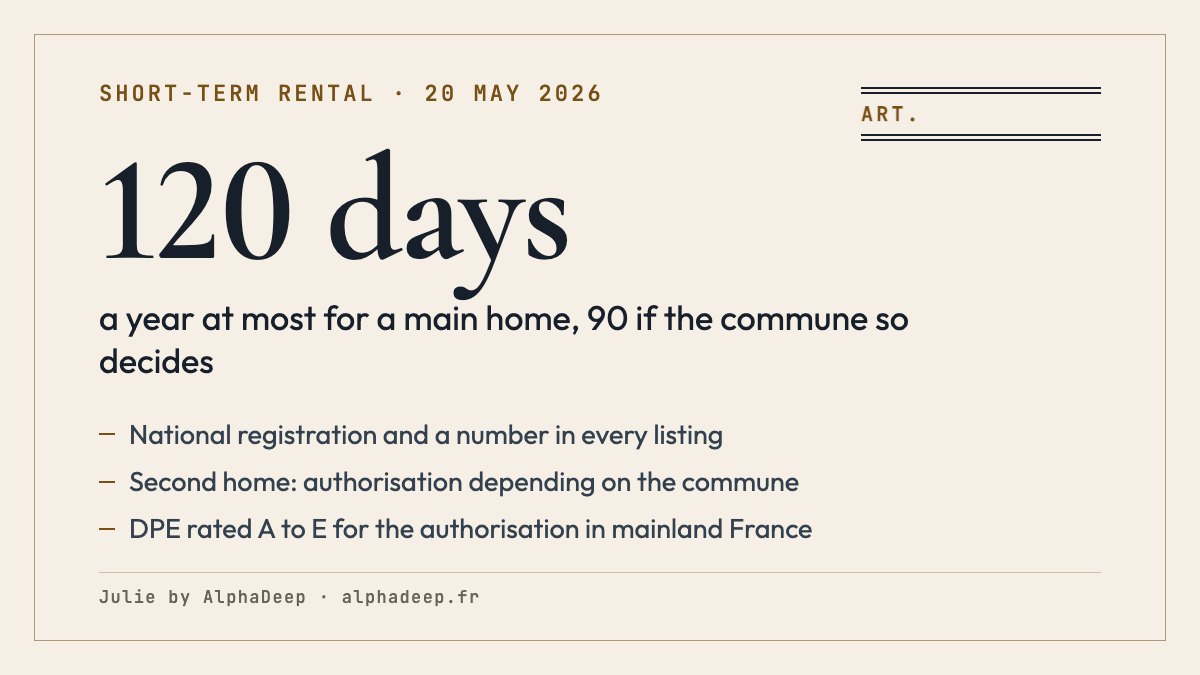
Since 20 May 2026, furnished tourist lets in France require national online registration before listing and display their number. Main homes are capped at 120 days a year, 90 if the commune decides, except for professional obligations, health or force majeure. Second homes may need change-of-use authorisation, with an A to E DPE in mainland France (Code du tourisme, article L324-1-1). A claimed day-cap exception needs supporting facts, rather than a ticked box alone.
Julie by AlphaDeep is an AI legal assistant for French law: it researches official references to help answer your questions (Légifrance, case law, service-public), analyses your documents and drafts your letters, for individuals and professionals alike.
General legal information with official references and dated checks. It is not personalised advice: for a decision that commits you, have your situation checked by a qualified professional.

Let’s look at your situation
Give the commune, the type of home, the rental days planned and your receipts.
Example questions
Your question carries over after signup. Maximum 400 characters. Avoid health data and names.
What must you do to let your home as a furnished tourist let?
Give the type of home, the days planned, your commune’s rule and your receipts: the gazette applies the rules in force since 20 May 2026. The example: a main home let for 100 days, for €9,000 of receipts.
Fictional example · gazette of your letting
Letting possible: declare it and show the number in every listing.
- Declaration
- required, number in every listing
- Letting cap
- 120 days a year
- Change of use
- no authorisation required
- Tax regime
- micro-BIC, 30% allowance
- Taxable profit under the micro-BIC
- €6,300
Until 19 May 2026
- Main home: no declaration, unless the commune required registration
- 120-day cap only in communes with registration
- Exceeding the cap: a fine of €10,000 at most
Since 20 May 2026
- National registration and a number for every tourist let
- 120-day cap everywhere, 90 if the commune so decides
- Exceeding the cap: a fine of €15,000 at most
Applicable provisions
In view of your plan, the Code du tourisme, the CCH and the CGI:
- Before any listing, declare the let on the national online service: the number you receive appears in every offer (Code du tourisme, articles L324-1-1 and L324-2).
- Main home: 100 days planned, within the cap of 120 days per calendar year (article L324-1-1).
- Main home: no change-of-use authorisation for short lets (CCH, article L631-7-1 A).
- Receipts of €9,000: micro-BIC, a 30% allowance, so €6,300 taxable (CGI, article 50-0).
- In a co-owned building, tell the syndic about your declaration (loi of 10 July 1965, article 9-2).
Indicative analysis: your commune’s decision sets the cap and any authorisation; check it at the town hall.
What changed for short-term rentals in France, and when?
The law of 19 November 2024 and its effective dates, up to those of 2034.
Loi n° 2024-1039 comes into force: a DPE rated A to E to obtain a change-of-use authorisation in mainland France, the fine raised to €100,000 per unit, and co-ownership rules required to state whether tourist lets are allowed (CCH, articles L631-10 and L651-2; loi of 10 July 1965, article 8-1-1).
Sources: Loi n° 2024-1039 · CCH L631-10 · CCH L651-2 · Loi of 10 July 1965, article 8-1-1
Communes with registration may lower the main-home cap from 120 to 90 days; for income received from 2025, the micro-BIC for an unclassified let drops to €15,000 of receipts and a 30% allowance (loi n° 2024-1039, articles 4 and 7).
Sources: L324-1-1, former version · Loi n° 2024-1039 · CGI 50-0
National registration: every furnished tourist let, main homes included, is declared on a national online service, the number appears in every listing, and the 120-day cap applies in every commune (articles L324-1-1 and L324-2).
Sources: Code du tourisme L324-1-1 · Code du tourisme L324-2
The micro-BIC ceiling for classified lets rises to €83,600 of receipts, with a 50% allowance; the ceiling for unclassified lets stays at €15,000 (CGI, article 50-0; décret n° 2026-562 of 29 June 2026).
Sources: CGI 50-0 · Décret n° 2026-562
Coming: apart from a main home, a furnished tourist let will have to meet the energy performance of decent housing, and the change-of-use authorisation will require a DPE rated A to D (Code du tourisme, article L324-2-2; CCH, article L631-10).
Sources: Code du tourisme L324-2-2 · CCH L631-10
Which rule applies depending on whether it is your main home?
The rules in force on 26 September 2026, for each type of home.
| Question | Main home | Second home |
|---|---|---|
| Declaration and number | Required | Required |
| Day cap | 120 a year, 90 if the commune so decides, subject to supported statutory exceptions | No national cap |
| Change-of-use authorisation | Not required | Depends on the commune |
| DPE for the authorisation, mainland France | Not applicable | Rating A to E, then A to D in 2034 |
| Energy performance in 2034 | Not required | Level of decent housing |
| Co-ownership | Tell the syndic | Tell the syndic; a ban is possible |
| Maximum fine | €15,000 beyond the cap, absent a supported exception | €100,000 per unit without authorisation |
| Micro-BIC, unclassified let | €15,000 of receipts, 30% allowance | €15,000 of receipts, 30% allowance |
| Micro-BIC, classified let | €83,600 of receipts, 50% allowance | €83,600 of receipts, 50% allowance |
Without a declaration, the fine can reach €10,000, and €20,000 for a false declaration or a fake number (article L324-1-1). The micro-BIC allowance is never below €305 (CGI, article 50-0).
Sources: Code du tourisme L324-1-1 · CCH L631-7 · CCH L631-7-1 A · CCH L631-10 · Code du tourisme L324-2-2 · Loi of 10 July 1965, article 9-2 · Loi of 10 July 1965, article 26 · CCH L651-2 · CGI 50-0
What must you do before letting a furnished tourist let in France?
Before any offer, you declare the let in person on the national online service; the declaration states whether it is your main home, with proof, and the acknowledgement gives a number (Code du tourisme, article L324-1-1). That number appears in every listing, which states whether it comes from a private individual or a professional (article L324-2).
In a co-owned building, you tell the managing agent (syndic) about your declaration, and an item on tourist lets is put on the agenda of the next general meeting (loi of 10 July 1965, article 9-2).
Sources: Code du tourisme L324-1-1 · Code du tourisme L324-2 · Loi of 10 July 1965, article 9-2
How many days can you let your main home?
At most 120 days per calendar year, except for work obligations, health reasons or force majeure; the commune may lower the cap by a reasoned decision, but not below 90 days. It may ask you, until 31 December of the following year, how many days were let, to be sent within 1 month (article L324-1-1).
A main home is housing occupied at least 8 months a year (loi of 6 July 1989, article 2), and letting it for short stays needs no change-of-use authorisation (CCH, article L631-7-1 A).
Sources: Code du tourisme L324-1-1 · Loi n° 89-462, article 2 · CCH L631-7-1 A
Do you need an authorisation to let a second home?
There is no national day cap, but letting housing to tourists is a change of use: where the commune has made it subject to authorisation, you must obtain it before letting (CCH, articles L631-7 and L631-9). A council decision may create a temporary authorisation, with quotas by area, and the application must comply with the co-ownership rules (article L631-7-1 A).
In mainland France, the application comes with a DPE (energy performance certificate) rated A to E, A to D from 1 January 2034 (article L631-10). Letting without authorisation exposes you to a civil fine of €100,000 per unit and a penalty of up to €1,000 per day and per square metre (article L651-2).
Sources: CCH L631-7 · CCH L631-9 · CCH L631-7-1 A · CCH L631-10 · CCH L651-2
What can the co-owners decide?
Co-ownership rules drawn up since loi n° 2024-1039 must state expressly whether furnished tourist lets are allowed or banned (loi of 10 July 1965, article 8-1-1).
In a building whose rules ban commercial activity outside the commercial units, the general meeting may, by a majority of co-owners holding at least two-thirds of the votes, ban tourist lets of residential units that are not main homes (article 26 of the same law).
Sources: Loi of 10 July 1965, article 8-1-1 · Loi of 10 July 1965, article 26
What does article L324-1-1 of the Code du tourisme say?
The day-cap text, applicable in every commune since 20 May 2026.
IV. Toute personne qui offre à la location un meublé de tourisme qui est déclaré comme sa résidence principale ne peut le faire au-delà de cent vingt jours au cours d’une même année civile, sauf obligation professionnelle, raison de santé ou cas de force majeure. La commune peut, sur délibération motivée, abaisser le nombre maximal de jours de location mentionné au premier alinéa du présent IV, dans la limite de quatre-vingt-dix jours.
In English, briefly (our summary, not an official translation): Anyone who offers for rent a furnished tourist let declared as their main home may not do so beyond one hundred and twenty days in the same calendar year, except for work obligations, health reasons or force majeure. The commune may, by a reasoned decision, lower this maximum number of rental days, down to a limit of ninety days. Until 19 May 2026, the cap applied only in communes that had set up registration of furnished tourist lets.
What do hosts ask about short-term rentals in France?
Must you declare a main home let on a platform?
Yes: since 20 May 2026, the declaration on the national online service and the number in the listing apply to every furnished tourist let, main homes included (Code du tourisme, articles L324-1-1 and L324-2).
Can your commune limit lettings to 90 days?
Yes, by a reasoned decision, never below 90 days; without such a decision, the cap stays at 120 days (article L324-1-1).
Does the 120-day cap apply to a second home?
No: it only concerns a let declared as a main home; a second home falls, depending on the commune, under the change-of-use authorisation (article L324-1-1; CCH, article L631-7).
What is the fine for letting without a declaration?
Up to €10,000, imposed by the commune; €20,000 for a false declaration or a fake number, and €15,000 for exceeding the day cap absent a supported exception (article L324-1-1).
What allowance applies to an unclassified tourist let?
30%, under the micro-BIC, if receipts do not exceed €15,000; a classified let gets 50% up to €83,600 (CGI, article 50-0; fiche F32744).
Which texts and fiches is this gazette based on?
- Code du tourisme, article L324-1-1 (declaration, cap, fines)Légifrance, in French
- Code du tourisme, article L324-1-1, version of 1 January 2025 to 19 May 2026Légifrance, in French
- Code du tourisme, article L324-2 (number in the listing)Légifrance, in French
- Loi n° 2024-1039 of 19 November 2024 strengthening local tools to regulate furnished tourist letsLégifrance, Journal officiel, in French
- Loi n° 89-462 of 6 July 1989, article 2 (main home)Légifrance, in French
- Construction and Housing Code, article L631-7 (change of use)Légifrance, in French
- Construction and Housing Code, article L631-7-1 A (temporary authorisation, main home)Légifrance, in French
- Construction and Housing Code, article L631-9 (decision by other communes)Légifrance, in French
- Construction and Housing Code, article L631-10 (DPE required)Légifrance, in French
- Construction and Housing Code, article L651-2 (fine and penalty)Légifrance, in French
- Loi n° 65-557 of 10 July 1965, article 8-1-1 (co-ownership rules)Légifrance, in French
- Loi n° 65-557 of 10 July 1965, article 9-2 (informing the syndic)Légifrance, in French
- Loi n° 65-557 of 10 July 1965, article 26 (two-thirds majority)Légifrance, in French
- General Tax Code, article 50-0 (micro-BIC)Légifrance, in French
- Décret n° 2026-562 of 29 June 2026 (micro-BIC thresholds)Légifrance, Journal officiel, in French
- Furnished lettings: how is the income taxed? (fiche F32744)Service-public.fr, in French · checked by the publisher on 15 April 2026
- Code du tourisme, article L324-2-2 (energy performance, in force on 1 January 2034)Légifrance, in French
Texts cited last checked: 26 September 2026