The route finderEnergy performance · letting
Homes rated F or G on the French DPE: when letting becomes illegal, and what changes for the rent
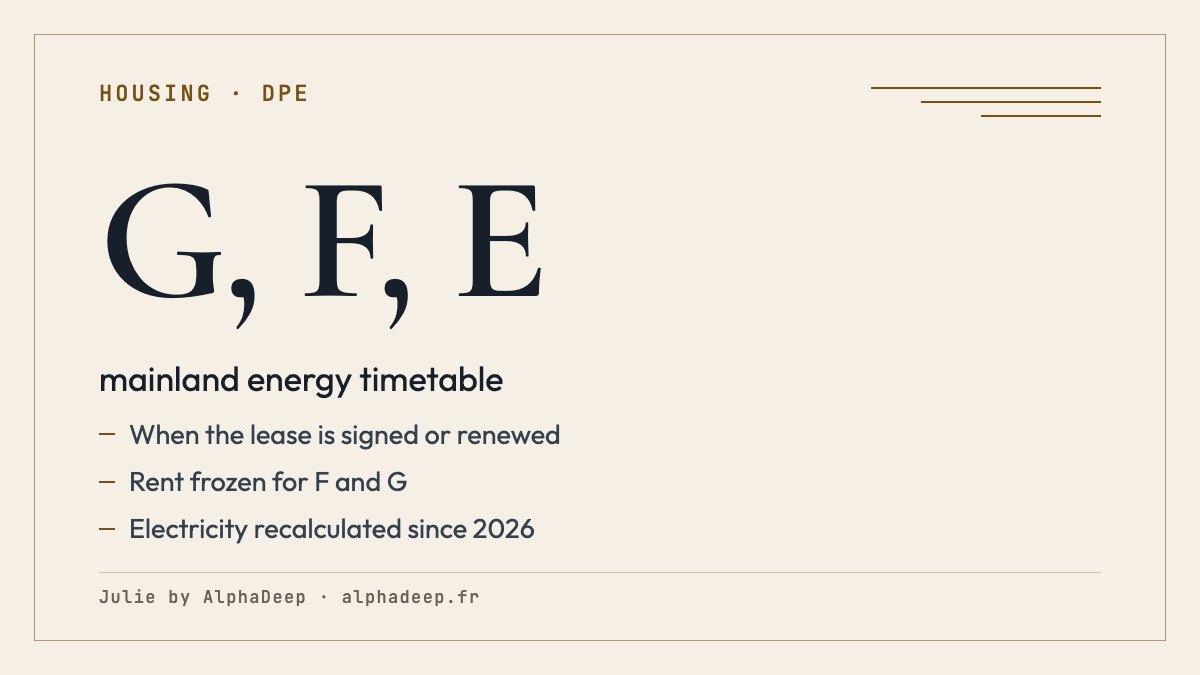
In mainland France, the energy-decency criterion for a rented main home requires DPE classes A to F since 2025, A to E from 2028 and A to D from 2034 (article 6 of the law of 6 July 1989). It applies at signature, renewal or tacit renewal. The five overseas departments follow 2028 and 2031 dates. Other decency conditions still need checking; F/G rent controls are a separate rule.
Go to the tool: the route finder
Julie by AlphaDeep is an AI legal assistant for French law: it researches official references to help answer your questions (Légifrance, case law, service-public), analyses your documents and drafts your letters, for individuals and professionals alike.
General legal information with official references and dated checks. It is not personalised advice: for a decision that commits you, have your situation checked by a qualified professional.

Let’s look at your situation
Give the DPE class, the date of the lease and whether the home is heated by electricity.
Example questions
Your question carries over after signup. Maximum 400 characters. Avoid health data and names.
Can your home be let on this date, and at what rent?
For a main home in mainland France, choose the valid DPE class and the lease signature, renewal or tacit-renewal date: the route finder checks only the energy criterion on that date and at the next statutory cutover, and compares the rent rules by class, yours highlighted. The example: a home rated F let again on 1 October 2026.
Fictional example · DPE route finder
The energy criterion is met for this lease, but no longer for a lease signed or renewed from 1 January 2028.
| Criterion | Class G | Class FYour case | Class E | Classes A to D |
|---|---|---|---|---|
| Lease signed or renewed in 2025, 2026 or 2027 | Prohibited: the home is not decent | Possible | Possible | Possible |
| Lease signed or renewed from 2028 to 2033 | Prohibited | Prohibited: the home is not decent | Possible | Possible |
| Lease signed or renewed from 2034 | Prohibited | Prohibited | Prohibited: the home is not decent | Possible |
| Rent on a new let | Capped at the last rent | Capped at the last rent | Free, except under rent control | Free, except under rent control |
| Yearly rent review | Prohibited | Prohibited | Possible if the lease provides for it | Possible if the lease provides for it |
Class F or G: the rent of a new let cannot exceed the previous tenant’s last rent, and it cannot be reviewed.
Only the energy criterion is examined here; check the other decency requirements too. Overseas, the timetable is shifted: classes A to F from 2028, A to E from 2031.
What has changed for homes rated F and G since 2025?
A ban that has come into force, then two changes to how the DPE is calculated.
In mainland France, rented main homes rated G no longer satisfy the energy-decency criterion: they can no longer be let under a lease signed, renewed or tacitly renewed (article 6 of the law of 6 July 1989, from the Climate and Resilience law of 22 August 2021).
Sources: Law of 1989, art. 6 · Service-public F2042
Electricity weighs less in the calculation: its primary energy conversion factor falls from 2.3 to 1.9. An older DPE remains valid, and a certificate of the new label can be downloaded free (order of 13 August 2025).
Sources: Order of 13 August 2025 · Service-public F16096
The electricity factor falls again, from 1.9 to 1.7, and the DPE adapts to EU law with a new class (orders of 11 June and 19 August 2026).
Sources: Order of 19 August 2026 · Service-public F16096
Does the ban end leases already signed?
No. According to service-public, the performance level is assessed on the date the lease is signed, renewed or tacitly renewed: a lease in progress is not terminated when a deadline arrives. But on its renewal or tacit renewal, the home must reach the class required on that date.
In mainland France, a rented main home rated G whose lease is tacitly renewed after 1 January 2025 is therefore no longer decent within the meaning of the law, and the tenant can ask for it to be brought up to standard.
Sources: Service-public F2042 · Law of 1989, art. 6
What can you request if the energy criterion is not met?
Ask the landlord to bring it up to standard, without calling the lease into question. Without agreement or an answer within 2 months, the tenant can refer the matter to the court, which sets the works and their time limit and can reduce or suspend rent until completion. The departmental conciliation committee is optional; referral to it is not a compulsory preliminary step (article 20-1 of the law of 6 July 1989).
The court cannot order energy performance works in two cases: a co-owner who proves that their requests to the co-ownership went unheeded, or architectural or heritage constraints. If the tenant receives housing benefit, the paying body’s notice to the landlord counts as a request to bring the home up to standard. For health hazards and evidence beyond the DPE, consult the unhealthy housing remedies guide in French.
Source: Law of 1989, art. 20-1
Can the landlord raise the rent of a home rated F or G?
No. On a new let, the rent cannot exceed the last rent charged to the previous tenant (article 17 of the law of 6 July 1989). During the lease, neither the yearly review nor an increase for works can be applied (article 17-1). To challenge a requested increase, use the rent increase challenge guide in French, with the lease, its date and the DPE.
Sources: Law of 1989, art. 17 · Law of 1989, art. 17-1
Is your DPE still valid?
A DPE’s validity depends on the date the diagnostic was carried out.
| DPE carried out | Validity | What to do |
|---|---|---|
| From 1 January 2018 to 30 June 2021 | No longer valid since 1 January 2025 | Redo it before letting |
| From 1 July 2021 to 31 December 2025 | 10 years | Electric heating: ask for the certificate of the new label |
| Since 1 January 2026 | 10 years | It already uses the factor of 1.9 |
Since 1 July 2024, the label thresholds have also been adapted for homes of 40 m² or less, with a certificate that can be downloaded from the Ademe website (service-public).
Source: Service-public F16096
What does article 6 of the law of 6 July 1989 say about energy performance?
The timetable of energy decency, in mainland France.
Le niveau de performance d’un logement décent est compris, au sens de l’article L. 173-1-1 du code de la construction et de l’habitation :
1° A compter du 1er janvier 2025, entre la classe A et la classe F ;
2° A compter du 1er janvier 2028, entre la classe A et la classe E ;
3° A compter du 1er janvier 2034, entre la classe A et la classe D.
In English, briefly (our summary, not an official translation): The performance level of a decent home, within the meaning of article L. 173-1-1 of the Construction and Housing Code, is between class A and class F from 1 January 2025, between class A and class E from 1 January 2028, and between class A and class D from 1 January 2034. In Guadeloupe, Martinique, French Guiana, La Réunion and Mayotte, the same article sets classes A to F from 2028 and A to E from 2031.
What do landlords and tenants ask about the DPE?
Can my 2024 DPE change with the new calculation?
Yes, if it concerns a home heated by electricity. Since 1 January 2026, a certificate replaces the label with the new one, free and without a new visit from the diagnostician, according to service-public. Without a certificate, the original DPE remains valid (order of 13 August 2025).
Can a home rated F still be let in 2027?
In mainland France, class F still meets the energy criterion for a main-home lease signed, renewed or tacitly renewed up to 31 December 2027, with rent controls. Other decency criteria still need checking. From 1 January 2028, F fails the energy criterion (article 6 of the law of 6 July 1989).
Do the rules apply to a furnished let?
Yes, for a furnished home let as a main residence: article 6 and article 17 on the rent apply to it (article 25-3 of the law of 6 July 1989).
What does the landlord of a home that is not decent risk?
The court seized by the tenant can set the works and their time limit, reduce the rent or suspend its payment until they are done, and sends its decision to the prefect (article 20-1 of the law of 6 July 1989).
Which texts are these letting and DPE rules based on?
- Law no. 89-462 of 6 July 1989, article 6 (decent home and energy performance)Légifrance, in French
- Law no. 89-462 of 6 July 1989, article 17 (rent of homes rated F and G)Légifrance, in French
- Law no. 89-462 of 6 July 1989, article 17-1 (rent review and works increases for F- and G-rated homes)Légifrance, in French
- Law no. 89-462 of 6 July 1989, article 20-1 (bringing the home up to standard)Légifrance, in French
- Construction and Housing Code, article L173-1-1 (DPE classes)Légifrance, in French
- Energy performance certificate (fiche F16096)Service-public.fr, in French · checked by the publisher on 1 January 2026
- Decent housing (fiche F2042)Service-public.fr, in French · checked by the publisher on 21 March 2025
- Order of 13 August 2025 changing the DPE electricity conversion factorLégifrance, Journal officiel, in French
- Order of 19 August 2026 changing the DPE electricity conversion factorLégifrance, Journal officiel, in French
Texts cited last checked: 25 September 2026