The legal briefHousing · insurance
Water damage in France: the contractual reporting deadline, the IRSI agreement, the leak search and repairs
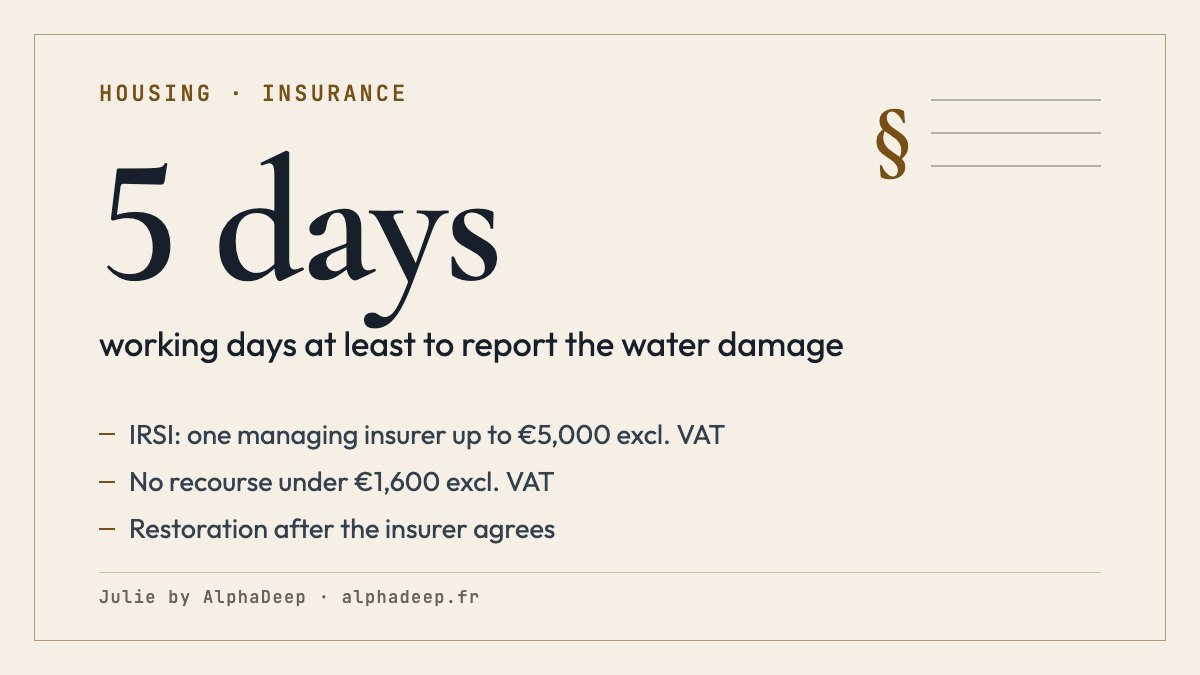
Water damage is reported to your French insurer as soon as it is discovered, at the latest within the contract’s time limit, which cannot be under 5 working days (Insurance Code, article L113-2). In a building, the IRSI agreement between insurers names a single managing insurer for damage up to €5,000 excluding VAT. Stop the leak and make urgent repairs, but wait for the insurer’s agreement before final restoration work.
Go to the tool: the legal brief
Julie by AlphaDeep is an AI legal assistant for French law: it researches official references to help answer your questions (Légifrance, case law, service-public), analyses your documents and drafts your letters, for individuals and professionals alike.
General legal information with official references and dated checks. It is not personalised advice: for a decision that commits you, have your situation checked by a qualified professional.

Let’s look at your situation
Say where and when the leak was discovered, where it comes from and the damage found.
Example questions
Your question carries over after signup. Maximum 400 characters. Avoid health data and names.
How soon must you report water damage in France?
As soon as you know about it, and at the latest within the time limit set by the contract, which cannot be under 5 working days (Insurance Code, article L113-2, 4°); service-public counts it from the discovery of the damage (fiche F1352).
A forfeiture clause for late reporting can only be used against you if the insurer proves that the delay harmed it, and never when the delay is due to a fortuitous event or force majeure (article L113-2).
Sources: C. assur. L113-2 · Service-public F1352
Who reports the claim, and to which insurer?
If the leak comes from a private part, a tap for example, the co-owner or occupant reports it to their own insurer; if it comes from the common parts, a shared pipe for example, the managing agent (syndic) reports it to the building’s insurer (fiche F2027).
The amicable water-damage report form (constat amiable) is not compulsory, but it speeds up the handling of the claim (fiche F1352).
Sources: Service-public F2027 · Service-public F1352
What does the IRSI agreement between insurers change?
For damage affecting several units of a building, up to €5,000 excluding VAT of material damage, it names a single managing insurer that coordinates the expert assessment, the leak search and compensation; for the common parts, it is the co-ownership’s insurer (fiche F2027).
Under €1,600 excluding VAT, the managing insurer pays without recourse against another insurer; from €1,600 to €5,000 excluding VAT, it organises the assessment, pays and may seek recourse. It does not apply to hotel or guest rooms, to damage from outside the building, or above €5,000 excluding VAT (fiche F2027).
Source: Service-public F2027
Who pays to repair the leak, tenant or landlord?
The landlord carries out repairs, other than tenant repairs, needed to keep the home in good condition (loi of 6 July 1989, article 6); the tenant handles routine upkeep and minor repairs, unless they result from wear and tear (vétusté), poor workmanship, a construction defect, a fortuitous event or force majeure (article 7, d).
The tenant must insure against tenant risks and prove it when receiving the keys, then each year on the landlord’s request (article 7, g, of the same law).
Sources: Loi 1989, art. 6 · Loi 1989, art. 7
Who handles your water damage, and by when must you report it?
Enter the discovery date, where the leak comes from, the unit it comes from and the estimated damage: the brief ends with its reasons. The example: a leak discovered on Thursday 24 September 2026 in an occupied flat, with €2,400 excluding VAT of damage.
Fictional example · brief on your water damage
IRSI may organise the claim across the affected units: confirm its conditions with the insurer.
- Report by
- 1 October 2026
- IRSI agreement
- €1,600 to €5,000 excl. VAT
For these reasons
In view of your answers, the Insurance Code and the service-public fiches:
- Claim: to your insurer, by 1 October 2026 at the latest, 5 working days after discovery, unless your contract gives longer (Insurance Code, article L113-2, 4°).
- Leak search: organised by the insurer of the occupant of the unit the leak comes from (fiche F1352).
- IRSI: if several units are affected, from €1,600 to €5,000 excluding VAT, the managing insurer organises the assessment, pays and may seek recourse (fiche F2027).
- Repairs: stop the leak and make urgent repairs, keeping the invoices, but wait for the insurer’s agreement, or the expert’s visit, before final restoration (fiche F1352).
Legal minimum counted in working days, excluding Saturdays, Sundays and public holidays; your contract may give a longer time limit.
IRSI allocates claim handling between insurers; it does not guarantee payment or replace the cover and exclusions in your policy.
What should your claim include?
The information service-public advises giving, by registered letter or online depending on your insurer.
- Document 1
Your details and your contract
Name, address and insurance contract number.
- Document 2
A description of the damage event
Its nature, date, time and place.
- Document 3
The damaged belongings
An estimated list of the furniture and objects destroyed or damaged.
- Document 4
The damage
Its nature, material or physical, and its extent.
- Document 5
Damage caused to third parties
At the neighbours’ for example, with the victims’ contact details.
- Document 6
Steps already taken
A plumber’s visit, with the invoices.
Who does what in a water damage claim?
Reporting, the leak search and compensation do not always fall to the same insurer.
| Step | Who | Source |
|---|---|---|
| Reporting the claim | The occupant to their insurer; the syndic for common parts | Fiche F2027 |
| Time limit to report | At least 5 working days after discovery | Art. L113-2 Insurance Code |
| Leak search, occupied unit | The occupant’s insurer; the owner’s if the search could destroy the unit or the occupant is uninsured | Fiche F1352 |
| Leak search, empty unit | The owner’s insurer, or the building’s if the owner is uninsured | Fiche F1352 |
| Leak search, common parts | The building’s insurer | Fiche F1352 |
| IRSI, under €1,600 excluding VAT | The managing insurer pays without recourse | Fiche F2027 |
| IRSI, €1,600 to €5,000 excluding VAT | Assessment, compensation, recourse possible | Fiche F2027 |
| Above €5,000 excluding VAT | Outside IRSI: each insurer under its contract | Fiche F2027 |
Special insurance-contract rules apply in the Bas-Rhin, Haut-Rhin and Moselle départements (fiche F1352).
Sources: Service-public F2027 · C. assur. L113-2 · Service-public F1352
What does article L113-2 of the Insurance Code say?
The text that sets the minimum time limit to report a claim.
De donner avis à l’assureur, dès qu’il en a eu connaissance et au plus tard dans le délai fixé par le contrat, de tout sinistre de nature à entraîner la garantie de l’assureur. Ce délai ne peut être inférieur à cinq jours ouvrés. Ce délai minimal est ramené à deux jours ouvrés en cas de vol et à vingt-quatre heures en cas de mortalité du bétail. Les délais ci-dessus peuvent être prolongés d’un commun accord entre les parties contractantes.
In English, briefly (our summary, not an official translation): The insured must notify the insurer, as soon as they know of it and at the latest within the time limit set by the contract, of any event likely to trigger the cover. This time limit cannot be under five working days; the minimum is two working days for theft and twenty-four hours for livestock deaths, and the parties may agree longer limits. The same article only allows a late-reporting forfeiture where the insurer proves a prejudice.
What do water damage victims ask?
Can you repair before the expert visits?
Yes for the urgent repair that stops the leak, keeping the invoices; no for restoration work, paint, floors or ceilings, before the insurer agrees: compensation could otherwise be reduced or refused (fiche F1352).
Is the amicable report form compulsory?
No: it is not compulsory, but it speeds up the insurer’s handling of the claim (fiche F1352).
Who pays for a leak search that starts in a flat?
In the common parts, the building’s insurer organises it; but if the source is in a private unit, that unit owner’s insurer bears the cost (fiche F1352).
What if the tenant’s notice ends on the day of the damage?
The leak search then passes to the insurer of the unit’s owner, as when the occupant is uninsured or the search could destroy the unit (fiche F1352).
The damage came from a storm: does IRSI apply?
No: it does not apply to damage from outside the building, such as storms, floods or a natural disaster (fiche F2027); report it to your insurer under your contract.
Which texts and fiches is this brief based on?
- Insurance Code, article L113-2 (reporting a claim)Légifrance, in French
- Water damage: what to do? (fiche F1352)Service-public.fr, in French · checked by the publisher on 25 July 2025
- Co-ownership: which insurance for common or private parts? (fiche F2027)Service-public.fr, in French · checked by the publisher on 22 July 2025
- Loi n° 89-462 of 6 July 1989, article 6 (landlord’s obligations)Légifrance, in French
- Loi n° 89-462 of 6 July 1989, article 7 (tenant’s obligations)Légifrance, in French
Texts cited last checked: 26 September 2026