Consumer and banking · Water · bills
Your French water bill after a leak: working out the cap and claiming it
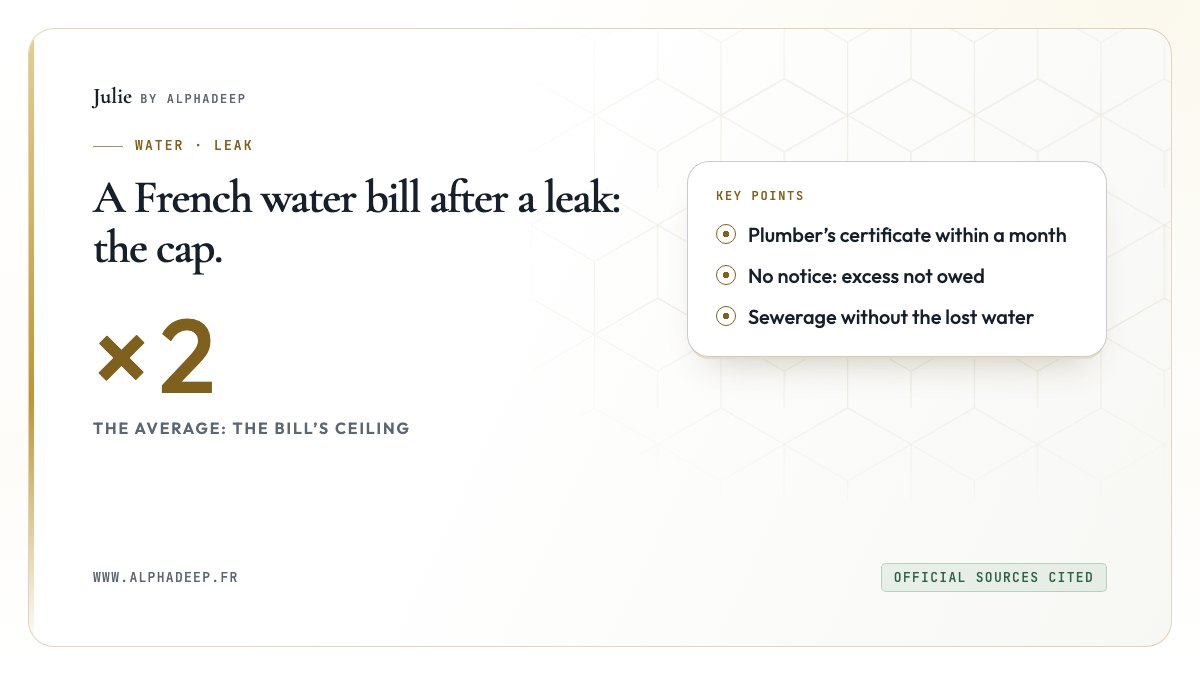
When a French water utility sees consumption more than twice your average, it must warn you. If the rise comes from a leak on a pipe after the meter, you pay no more than twice your average consumption, provided you send within one month a plumbing firm’s certificate stating the repair (article L2224-12-4 of the local authorities code). Leaks from household appliances or sanitary fittings are excluded.
- Official texts cited
- Sources checked on
- Drafted with AI assistance, our method
General legal information with official references and dated checks. It is not personalised advice: for a decision that commits you, have your situation checked by a qualified professional.
Julie by AlphaDeep
You received an abnormal water bill after a leak in France: I can work out the capped amount and draft the request to the water utility.
3 free questions at signup. Avoid names and sensitive information.
When does water use count as abnormally high?
When the volume used since the last reading is more than twice the average used by the subscriber, or by the home’s occupants, over the same period in the three previous years. Without that history, the comparison uses average use in similar homes in the area.
As soon as it sees such a rise, which may come from a leak, the water utility must tell you without delay, at the latest with the bill, explaining how to get the bill capped.
Code général des collectivités territoriales, article L2224-12-4Code général des collectivités territoriales, article R2224-20-1
How much do you owe once the cap applies?
Enter the volumes and prices from your bill: the tool applies the legal cap and removes the sewerage charge on the leaked water.
Fictional example · amount after the cap
Cap secured: water billed at twice the average, sewerage without the leaked volume. Amount reduced to €292.50.
- Abnormal threshold (twice the average)
- 90 m³
- Without the cap
- €688
- Water billed on
- 90 m³
- Sewerage billed on
- 45 m³
- Amount due
- €292.50
- Saving
- €395.50
Prices per m³: use those on your bill, with standing charges and taxes left out. Leave blank if you are not connected.
Which figures set the cap?
Which leaks qualify for the cap?
| Source of the leak | Cap applies | Basis |
|---|---|---|
| A drinking-water pipe after the meter | Yes, with a plumber’s certificate within a month | CGCT, L2224-12-4 III bis; R2224-20-1 |
| A household appliance, such as a washing machine | No | R2224-20-1 |
| Sanitary equipment, such as a toilet cistern or tap | No | R2224-20-1 |
| Heating equipment, such as a boiler | No | R2224-20-1 |
| A pipe leak with no notice from the utility | Use above twice the average is not owed | L2224-12-4 III bis |
| No leak found | Meter check on request within the month | L2224-12-4 III bis; R2224-20-1 III |
Code général des collectivités territoriales, article L2224-12-4Code général des collectivités territoriales, article R2224-20-1
What must the plumber’s certificate say?
It comes from a plumbing firm and states that the leak was repaired, where it was and on what date. Send it within a month of the utility’s notice.
The utility can make any checks it needs; only leaks on a drinking-water pipe after the meter qualify for the cap.
Code général des collectivités territoriales, article R2224-20-1Code général des collectivités territoriales, article L2224-12-4
The utility never warned you: do you owe the excess?
No. Without that notice, the subscriber does not have to pay the part of the use above twice the average, and need not even produce a certificate.
This applies to a pipe leak after the meter in a home: it does not cover leaks from appliances or sanitary equipment.
Code général des collectivités territoriales, article L2224-12-4Code général des collectivités territoriales, article R2224-20-1
What does article L2224-12-4 of the local authorities code say?
Dès que le service d’eau potable constate une augmentation anormale du volume d’eau consommé par l’occupant d’un local d’habitation susceptible d’être causée par la fuite d’une canalisation, il en informe sans délai l’abonné. Une augmentation du volume d’eau consommé est anormale si le volume d’eau consommé depuis le dernier relevé excède le double du volume d’eau moyen consommé par l’abonné ou par un ou plusieurs abonnés ayant occupé le local d’habitation pendant une période équivalente au cours des trois années précédentes ou, à défaut, le volume d’eau moyen consommé dans la zone géographique de l’abonné dans des locaux d’habitation de taille et de caractéristiques comparables. L’abonné n’est pas tenu au paiement de la part de la consommation excédant le double de la consommation moyenne s’il présente au service d’eau potable, dans le délai d’un mois à compter de l’information prévue au premier alinéa du présent III bis, une attestation d’une entreprise de plomberie indiquant qu’il a fait procéder à la réparation d’une fuite sur ses canalisations.
A défaut de l’information mentionnée au premier alinéa du présent III bis, l’abonné n’est pas tenu au paiement de la part de la consommation excédant le double de la consommation moyenne.
In plain English: As soon as the water utility sees an abnormal rise in the water used in a home that may be caused by a pipe leak, it tells the subscriber without delay. A rise is abnormal when the volume used since the last reading is more than twice the subscriber’s average over the same period in the three previous years, or failing that the local average for comparable homes.
The same article lets you, if no leak is found, ask within the same month for the meter to be checked: the excess is then only owed after an investigation rules out a meter fault.
What else do households ask?
Is a leaking toilet cistern covered by the cap?
No. The cap only covers leaks on a drinking-water pipe after the meter, excluding leaks from household appliances and sanitary or heating equipment, which includes the toilet cistern.
Code général des collectivités territoriales, article R2224-20-1
Does the tenant or the landlord pay for the extra water?
The cap benefits the subscriber, meaning whoever holds the water contract, tenant or owner. Who pays for the repair between landlord and tenant follows other rules, set by the lease.
Code général des collectivités territoriales, article L2224-12-4
No leak found: how do you get the meter checked?
Within a month of the utility’s notice, ask it to check that the meter works properly. It replies within a month, and you only owe the excess after it notifies you that the rise is not due to the meter.
Code général des collectivités territoriales, article L2224-12-4Code général des collectivités territoriales, article R2224-20-1
Does the cap also apply to the sewerage charge?
Yes, in another way. When the water bill is capped, the water lost through the leak, meaning the abnormal volume minus the average, is left out of the sewerage charge.
Code général des collectivités territoriales, article R2224-19-2
Which texts is this calculator based on?
- Code général des collectivités territoriales, article L2224-12-4Légifrance
- Code général des collectivités territoriales, article R2224-20-1Légifrance
- Code général des collectivités territoriales, article R2224-19-2Légifrance
Texts cited last checked: 17 October 2026