Consumer and banking · Disputes · reporting
SignalConso: what your report does in France, and what it does not
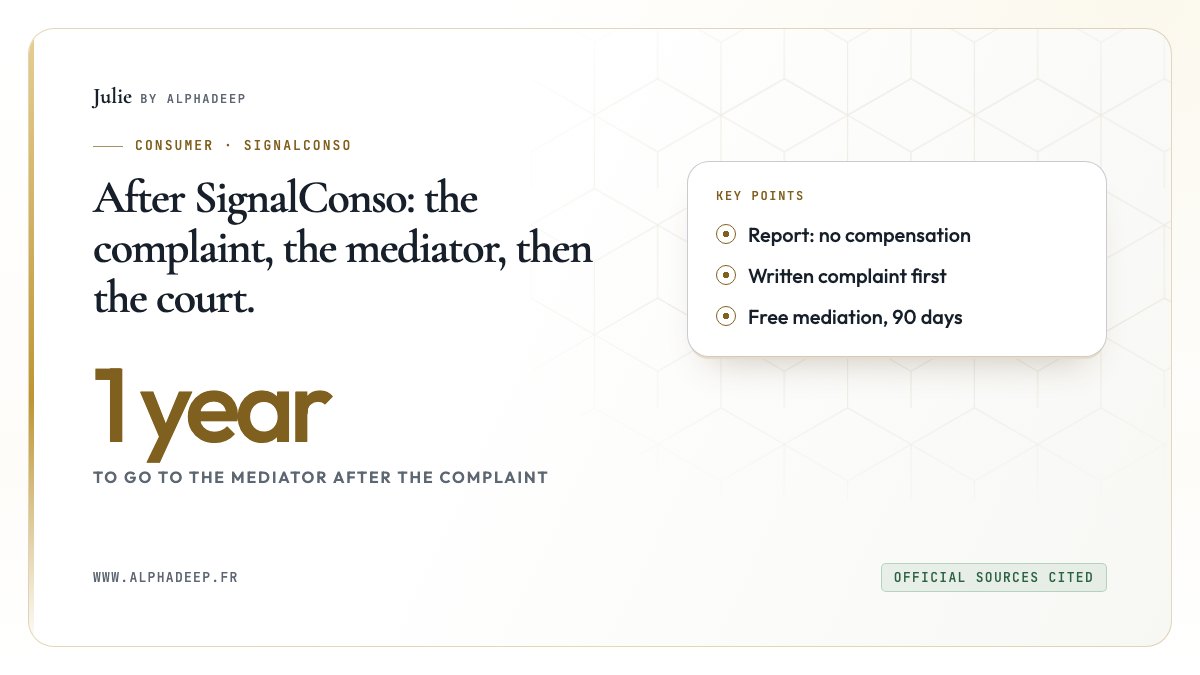
SignalConso is the French consumer authority’s (DGCCRF) public service for reporting a problem with a business. Your report goes to the company, which may reply, and feeds official inspections. It does not replace a complaint: the DGCCRF cannot make the company compensate you. To get redress you need a written complaint, then a free consumer mediator, contacted within one year (article L612-2 of the Consumer Code).
- Official texts cited
- Sources checked on
- Drafted with AI assistance, our method
General legal information with official references and dated checks. It is not personalised advice: for a decision that commits you, have your situation checked by a qualified professional.
Julie by AlphaDeep
You reported a business in France, or you are thinking about it: I can tell you what it will change and which step can get you a refund.
3 free questions at signup. Avoid names and sensitive information.
What happens after you file a report on SignalConso?
The SignalConso team checks that the report falls within the service’s scope, then makes it visible to the business concerned and to DGCCRF officers. The business may reply to you or fix the problem, and SignalConso tells you by email what it has done.
The report goes into the DGCCRF database. If reports pile up against the same business or the problem looks serious, the DGCCRF may decide to monitor or inspect it.
Does the company have to reply?
SignalConso only says the business may reply or improve. Your written complaint, by contrast, creates a precise duty: if the dispute is not settled, the business must give you the details of the consumer mediator it belongs to.
Those details must also appear clearly on its website, its terms and conditions or its order forms.
SignalConso: how does it work?Code de la consommation, article L616-1Code de la consommation, article R616-1
Can SignalConso get you a refund?
No. The DGCCRF alone decides whether to investigate and cannot make the business compensate you: to seek compensation you must file a criminal complaint or go to a civil court.
It can, however, order the business to comply with the law or remove an unlawful term, with a penalty of up to €3,000 a day. Nor does it settle disputes over a badly performed contract, a delivery or a subscription.
Service-public: when to contact the DGCCRFCode de la consommation, article L521-1
What do SignalConso’s public figures show?
- Reports filed since launch
- 1,051,253
- running total read on 17 October 2026 · SignalConso public statistics
- Promises of action by businesses
- 232,599
- since launch, read on 17 October 2026 · SignalConso public statistics
- Businesses registered on SignalConso
- 240,633
- accounts created, read on 17 October 2026 · SignalConso public statistics
Which step comes after your report?
Say who you are dealing with, the problem and the date of your complaint: the tool gives the next step and its deadlines.
Fictional example · next step
With no satisfactory answer, go to the business’s mediator: SignalConso advises waiting two months, until 20 September 2026, and the law requires you to apply by 20 July 2027 at the latest.
- Next step
- Consumer mediator
- Mediator advised from
- 20 September 2026
- Mediator admissible until
- 20 July 2027
- Before going to court
- Amicable attempt required
- The mediator’s details appear on the business’s website, terms of sale or order form.
- Mediation is free and ends within 90 days, unless extended.
- It suspends limitation periods; a report does not.
- Up to €5,000, conciliation, mediation or a participatory procedure must be tried before court, save exceptions.
SignalConso says a letter to the business is still needed before the next steps.
Report, mediator or court: what can each step achieve?
| Step | What it can achieve | Time limit | Cost |
|---|---|---|---|
| SignalConso report | The business is informed and may reply; an investigation if the DGCCRF decides, with no compensation for you | No individual follow-up | Free |
| Written complaint to the business | Its answer and, if that fails, its mediator’s details | As soon as possible | Registered post costs |
| Consumer mediator | An amicable arrangement with the business | Within a year of the complaint; outcome in 90 days | Free |
| Court conciliator | An agreement, including when you cannot find the mediator | Before court, for €5,000 or less | Free |
| Court | A binding decision, including a refund | Generally five years from when you learned the facts | Free, apart from a lawyer or expert |
SignalConso says a letter to the business is still needed before the next steps.
SignalConso: terms of useService-public: when to contact the DGCCRFSignalConso: steps to take alongside your reportCode de la consommation, article L616-1Code de la consommation, article L612-1Code de la consommation, article L612-2Code de la consommation, article R612-5Code de procédure civile, article 750-1Code civil, article 2224
Does a report stop time limits from running?
No. Limitation periods are suspended by mediation, conciliation or a participatory procedure, from the parties’ agreement or the first meeting; a report is not one of them. The general five-year period therefore keeps running.
Once mediation or conciliation ends, it starts again for at least six months.
When should you go to a consumer mediator instead?
As soon as a written complaint to the business has gone without a satisfactory answer: SignalConso advises waiting two months after the registered letter. The law requires you to go to the mediator within one year of the complaint.
Mediation is free for you and ends within 90 days of notification, unless extended for a complex dispute. A mediator who turns down your request must tell you within three weeks.
SignalConso: steps to take alongside your reportCode de la consommation, article L612-2Code de la consommation, article L612-1Code de la consommation, article R612-5
What do articles L612-1 and L612-2 of the Consumer Code say?
Tout consommateur a le droit de recourir gratuitement à un médiateur de la consommation en vue de la résolution amiable du litige qui l’oppose à un professionnel. A cet effet, le professionnel garantit au consommateur le recours effectif à un dispositif de médiation de la consommation.
In plain English: Every consumer has the right to use a consumer mediator free of charge to settle amicably a dispute with a business. To that end, the business guarantees the consumer effective access to a consumer mediation scheme.
Article L612-2 adds two admissibility conditions: a prior written complaint to the business, and an application to the mediator within one year of that complaint.
What do people ask after reporting?
Will the company see your name?
Not if you choose to stay anonymous towards the business. You must, however, give your name and email address to SignalConso and the DGCCRF. Knowingly reporting something false can lead to five years’ imprisonment and a €45,000 fine.
Can you report a private seller on SignalConso?
No: SignalConso does not take disputes with private individuals, and a consumer mediator only handles disputes between a consumer and a business. Court conciliation remains, free of charge; up to €5,000, an amicable attempt is in principle required before court.
SignalConso: terms of useCode de la consommation, article L612-1Code de procédure civile, article 750-1
How do you follow up a report you already sent?
SignalConso offers no individual case follow-up: reports are handled collectively. You are told by email what the business has done, and the DGCCRF alone decides, in the light of other reports, whether to investigate.
SignalConso: terms of useSignalConso: how does it work?Service-public: when to contact the DGCCRF
What if the company breaks its promised fix?
Go back to the dispute route: a complaint by registered letter, attaching your report as a PDF as SignalConso suggests, then the consumer mediator within a year of that complaint, and finally the court.
SignalConso: steps to take alongside your reportCode de la consommation, article L612-2
Which sources is this guide based on?
- Code de la consommation, article L612-1Légifrance
- Code de la consommation, article L612-2Légifrance
- Code de la consommation, article L616-1Légifrance
- Code de la consommation, article R616-1Légifrance
- Code de la consommation, article R612-5Légifrance
- Code de procédure civile, article 750-1Légifrance
- Code civil, article 2238Légifrance
- Code civil, article 2224Légifrance
- Code de la consommation, article L521-1Légifrance
- Code pénal, article 226-10Légifrance
- Service-public: when to contact the DGCCRFService-public.fr
- SignalConso: how does it work?SignalConso (DGCCRF)
- SignalConso: steps to take alongside your reportSignalConso (DGCCRF)
- SignalConso: terms of useSignalConso (DGCCRF)
- SignalConso: public statisticsSignalConso (DGCCRF)
Texts cited last checked: 17 October 2026