Consumer and banking · Purchases · pricing
Price errors in France: must the seller honour the displayed price?
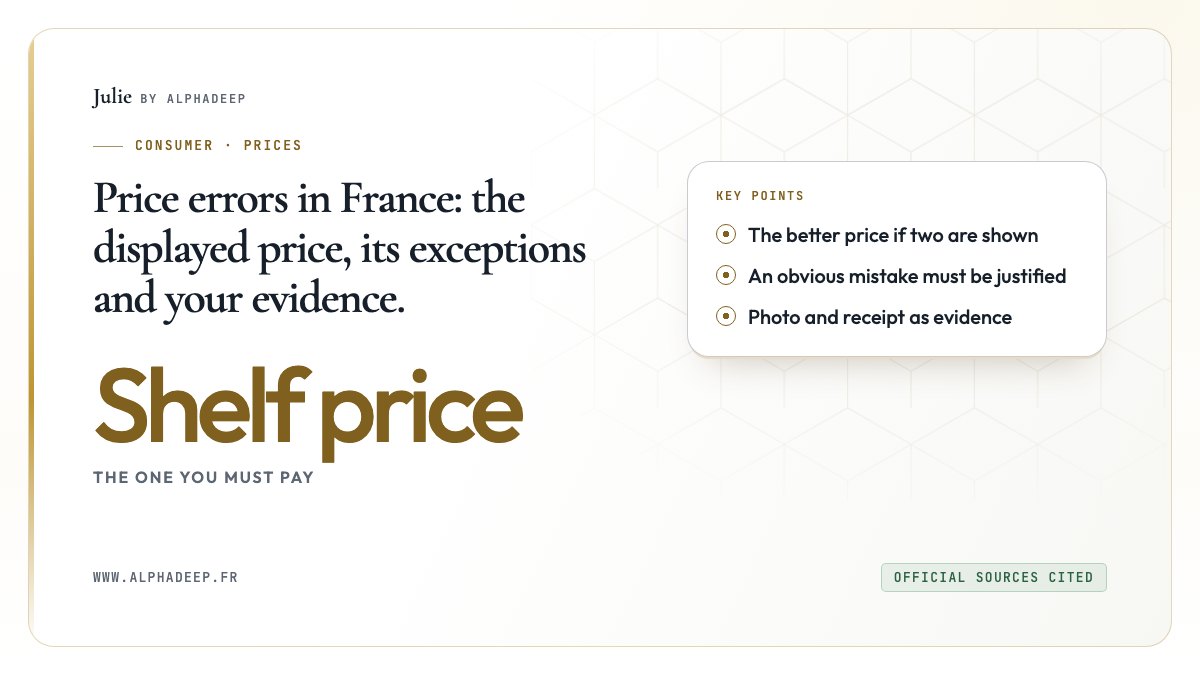
A displayed price is mandatory information in France: every seller must show consumers the price they will actually pay, all taxes included, clearly and without ambiguity (article L112-1 of the Consumer Code and the order of 3 December 1987). At the till, the displayed price should normally apply. The exception is an obvious mistake, where the price is derisory compared with the product’s value. Online, the order is only concluded once you confirm the total price.
- Official texts cited
- Sources checked on
- Drafted with AI assistance, our method
General legal information with official references and dated checks. It is not personalised advice: for a decision that commits you, have your situation checked by a qualified professional.
Julie by AlphaDeep
The price charged does not match the price displayed: I can tell you whether the seller must honour it and how to insist.
3 free questions at signup. Avoid names and sensitive information.
Must a French shop charge the shelf price?
In principle, yes. Every seller must tell the consumer the price, and that price must be the total including all taxes actually paid, shown on or next to the item with no possible doubt. For the French consumer authority (DGCCRF), the displayed price is the one you must pay.
If two different prices are shown next to the same item, practice is to apply the one more favourable to you; if a promotion’s conditions are not displayed before the till, the promotional price applies.
Code de la consommation, article L112-1Order of 3 December 1987 on price information, article 1Order of 3 December 1987, article 5Conso.gouv.fr: shelf price and till price differ
What counts as an obvious pricing mistake?
A price so low compared with the item’s value that it can only be a mistake: the DGCCRF gives the example of a phone shown at €50 when it is worth €1,000. The shop is then not automatically bound to honour it, but it must be able to justify the mistake.
There is no set threshold. Under civil law, a contract is void when the agreed consideration is illusory or derisory. Where there is doubt or a reasonable gap, ask for the displayed price.
Conso.gouv.fr: shelf price and till price differCode civil, article 1169
Can a French website cancel an order over a pricing error?
Whoever makes an offer online stays bound by it while it remains accessible through them. The contract is concluded once you could check the order details and total price and then confirmed; the site must acknowledge receipt without delay.
After that confirmation, the site can only get out of it by relying, for example, on a derisory price, which makes the contract void: a court decides, in the light of the gap.
Code civil, article 1127-1Code civil, article 1127-2Code civil, article 1169
Undercharged at the till: can the shop claim the difference?
In principle, yes. For the DGCCRF, price information binds seller and customer alike: the displayed price is the one you must pay, even if the till recorded less.
So the shop can ask you for the difference, just as you can insist on the displayed price when the till shows more.
Is the displayed price owed to you in your situation?
Enter the displayed price and the price asked: the tool gives the price owed, the difference to claim and the exception that may apply.
Fictional example · price owed
The displayed price is owed to you: ask at the till for €45 to be applied, with a photo of the label.
- Price owed in principle
- €45
- Difference
- €14
Official example of an obvious error: a phone shown at €50 when it is worth €1,000.
Shelf, till or website: which rule applies?
| Situation | Price owed | Basis |
|---|---|---|
| Shelf price lower than the till price | The shelf price | Order of 3 December 1987; DGCCRF |
| Two different prices next to the same item | The more favourable one, by practice | DGCCRF |
| Promotion conditions not displayed before the till | The promotional price | DGCCRF |
| Item with no label | The price the seller must state before payment | DGCCRF |
| Manifestly derisory price, mistake justified | Not automatically the displayed price | DGCCRF; Civil Code, 1169 |
| Online order checked and confirmed | The total price checked before confirming | Civil Code, 1127-2 |
| Till error in your favour | The displayed price, which binds both sides | DGCCRF |
Order of 3 December 1987 on price information, article 1Order of 3 December 1987, article 5Conso.gouv.fr: shelf price and till price differCode civil, article 1169Code civil, article 1127-2
What do article L112-1 and the order of 3 December 1987 say?
Tout vendeur de produit ou tout prestataire de services informe le consommateur, par voie de marquage, d’étiquetage, d’affichage ou par tout autre procédé approprié, sur les prix et les conditions particulières de la vente et de l’exécution des services, selon des modalités fixées par arrêtés du ministre chargé de l’économie, après consultation du Conseil national de la consommation.
In plain English: Every seller of goods or provider of services informs the consumer, by marking, labelling, display or any other appropriate means, of prices and the particular conditions of sale and performance of services, as set by orders of the economy minister after consulting the national consumer council.
The order of 3 December 1987 sets the details: the price announced is the total sum including all taxes actually paid, in euros, shown on or next to the item so that there is no doubt which item it refers to.
Where do you report a shop that ignores its displayed price?
First to the store manager, with the photo and receipt; if they refuse, by a written complaint. With no favourable answer, conso.gouv.fr lets you send a complaint to the business, which is invited to reply.
You can also report the practice to the DGCCRF after signing in with FranceConnect: a report helps target its inspections, but does not settle your dispute with the shop.
What do customers ask about a wrong price?
What is the fine for not displaying prices properly?
An administrative fine of up to €3,000 for an individual and €15,000 for a company. If the information misleads about the price, such as a fake discount, misleading commercial practice is an offence punishable by two years’ imprisonment and a €300,000 fine, rising to five years and €750,000 when it goes through an online service.
Code de la consommation, article L131-5Code de la consommation, article L121-2Code de la consommation, article L132-2Service-public: price display rules
Is a photo of the label enough evidence?
It is the evidence the DGCCRF recommends: photograph the label or shelf price before you reach the till, with the item visible, then keep the receipt. Together they show the gap.
Can the seller refuse to sell at the displayed price?
Refusing to sell to a consumer is prohibited, unless there is a legitimate reason, and punished by the fine for fifth-class petty offences. The displayed price binds the seller; only an obvious mistake, which it must justify, releases it.
Code de la consommation, article L121-11Code de la consommation, article R132-1Conso.gouv.fr: shelf price and till price differ
Do promotions follow the same display rules?
Yes, with extra rules: any announced price cut must show the previous price, meaning the lowest price charged in the thirty days before the reduction. The promotion’s conditions must be clearly displayed before the till.
Code de la consommation, article L112-1-1Conso.gouv.fr: shelf price and till price differ
Which texts set the displayed-price rule?
- Code de la consommation, article L112-1Légifrance
- Code de la consommation, article L131-5Légifrance
- Code de la consommation, article L121-2Légifrance
- Code de la consommation, article L132-2Légifrance
- Code de la consommation, article L121-11Légifrance
- Code de la consommation, article R132-1Légifrance
- Code civil, article 1169Légifrance
- Code civil, article 1127-1Légifrance
- Code civil, article 1127-2Légifrance
- Code de la consommation, article L112-1-1Légifrance
- Order of 3 December 1987 on price information, article 1Légifrance
- Order of 3 December 1987, article 5Légifrance
- Conso.gouv.fr: shelf price and till price differDGCCRF
- Service-public: price display rulesService-public.fr
Texts cited last checked: 17 October 2026