The exhibit listExhibit list · Decent housing
Substandard rental in France: the decency criteria, the evidence to gather and the steps to make the landlord do the works
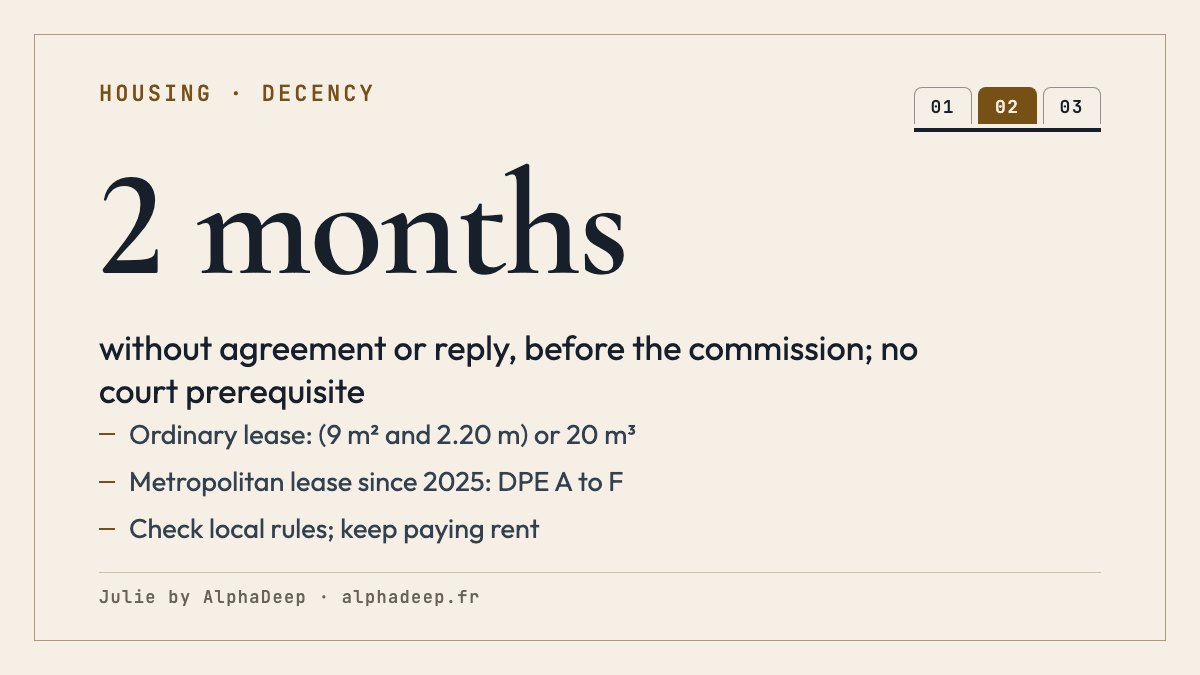
The landlord provides a home without manifest risks or pests. Ordinary lease: (9 m² and 2.20 m) or 20 m³; local rules may be stricter. In metropolitan France, a lease signed, renewed or reconducted since 2025 requires DPE A to F (law of 6 July 1989, article 6). Give formal notice and pay rent; commission after 2 months without agreement or reply, with no prerequisite for court.
Go to the tool: the exhibit list
Julie by AlphaDeep is an AI legal assistant for French law: it researches official references to help answer your questions (Légifrance, case law, service-public), analyses your documents and drafts your letters, for individuals and professionals alike.
General legal information with official references and dated checks. It is not personalised advice: for a decision that commits you, have your situation checked by a qualified professional.

Let’s look at your situation
Describe the defects, since when, what you have already written to the landlord and the evidence you have.
Example questions
Your question carries over after signup. Maximum 400 characters. Avoid health data and names.
Which evidence do you have, and what is the next step?
Tick the defects, the documents you have and the date of your formal notice: the exhibit list numbers the documents, flags the missing ones and dates the commission referral without imposing a prerequisite for court; dimensions and DPE are assessed by lease and territory. The example: damp and poor heating, photos, lease and exchanges gathered, formal notice sent on 15 July 2026.
Fictional example · the substandard-housing file
Conciliation commission or judge from 15 September 2026, with no agreement or answer from the landlord; the judge can be approached without the commission.
- Criteria at stake
- weathertightness, normal heating
- Conciliation commission from
- 15 September 2026
- Rent
- To be paid in full, unless the judge decides otherwise
| No. | Exhibit | What it proves | Status |
|---|---|---|---|
| 01 | Lease and check-in inventory | The state of the home on arrival and the landlord’s obligations | In the file |
| 02 | Dated photos and videos of the defects | The defect, its extent and how long it has lasted | In the file |
| 03 | Formal notice by registered post | The request to bring the home up to standard (article 20-1) | In the file |
| 04 | Technical report or professional’s certificate | The cause of the defect, not just its effect | To obtain |
| 05 | Energy performance diagnosis | The energy class of the home | Optional |
| 06 | Exchanges with the landlord or managing agent | That they knew of the problem, and their answers | In the file |
| 07 | CAF or MSA finding that the home is substandard | That the housing allowance is kept | Optional |
Partial criteria, no overall decency certification: ordinary lease, (9 m² and 2.20 m) or 20 m³; individual flat-share lease, 9 m² and 20 m³. Check stricter local sanitary rules. The judge weighs each defect and its cause.
Which criteria make a home substandard?
Each defect points to a precise criterion; that is what the evidence must establish.
| Defect | Criterion at stake | What must be proved | Text |
|---|---|---|---|
| Damp, mould, leaks | Weathertight structure, protection against water and leaks | The cause: roof, windows, rising damp, ventilation | Decree no. 2002-120, article 2 |
| No or poor heating | Normal heating, safe equipment in working order | The equipment and how it works | Decree no. 2002-120, articles 2 and 3 |
| Dangerous electricity or gas | Compliant networks, with no safety risk | The defect, by a professional | Decree no. 2002-120, article 2 |
| Dimensions, ordinary rental or shared lease | (9 m² and 2.20 m) or 20 m³; individual flat-share leases: 9 m² and 20 m³ | Measured area, height, volume and lease type | Decree no. 2002-120, article 4; F2042 |
| Bedbugs, cockroaches, rodents | A home free of pests and parasites | The infestation and its date | Law of 6 July 1989, article 6 |
| Energy class by lease and territory | Metropolitan France: A to F for leases signed, renewed or reconducted since 1 January 2025 | Valid DPE, territory and lease date | Law of 6 July 1989, article 6 |
Check local sanitary rules. Metropolitan France: A to E from 2028, A to D from 2034. Guadeloupe, Martinique, French Guiana, Réunion and Mayotte: A to F from 2028, A to E from 2031 (article 6). Meeting one criterion does not certify overall decency.
Sources: Décret n° 2002-120, art. 2 · Décret n° 2002-120, art. 4 · Loi n° 89-462, art. 6 · Service-public F2042
Which steps, and with whom?
The formal notice opens every route; never stop paying the rent on your own.
- Document 1
Formal notice to the landlord
The tenant asks for the home to be brought up to standard, without the lease being called into question; registered post keeps the date (article 20-1).
- Document 2
The departmental conciliation commission
With no agreement or no answer from the landlord within 2 months, it can be approached and gives an opinion; it is not a required step before the judge (articles 20 and 20-1).
- Document 3
The protection litigation judge
They set the works and their deadline, and can reduce the rent or suspend its payment until the works are done (article 20-1).
- Document 4
The CAF or the MSA
If it finds the home substandard, it keeps the housing allowance for up to 18 months and you pay the rent minus the allowance (Construction and Housing Code, articles L843-1 and R843-2).
Must you keep paying the rent?
Yes: only the judge can reduce the rent or suspend its payment, with or without deposit, until the works are done (law of 6 July 1989, article 20-1). Stopping payment on your own exposes you to proceedings for arrears. If you have already received a payment command, use the rent-arrears and payment-command guide (in French).
Exception: when the CAF or the MSA has found the home substandard and keeps the housing allowance, you pay only the rent and charges minus that allowance, and the landlord cannot use that to end the lease (Construction and Housing Code, article L843-1).
Sources: Loi n° 89-462, art. 20-1 · CCH L843-1
What if the landlord does not do the works?
The judge decides the works and their deadline, and can reduce or suspend the rent (article 20-1). They send the prefect the decision finding that the home does not meet the decency requirements.
On the CAF side, if the home still does not comply at the end of the period, the allowance kept is not paid to the owner, who cannot claim it from the tenant (article L843-2). The Cour de cassation has confirmed that this part payment is not rent arrears (14 December 2023, no. 22-23.267).
Sources: Loi n° 89-462, art. 20-1 · CCH L843-2 · Cass. 3e civ., 14 déc. 2023, n° 22-23.267
Substandard or unfit for habitation: what is the difference?
Decency is the landlord’s obligation towards the tenant, decided by the civil judge (law of 6 July 1989, articles 6 and 20-1). Unfitness for habitation (insalubrité) is an administrative police matter: a danger to health or safety is reported to the prefect, who can order the works (fiche F16158).
Both routes can run together, but a substandard home is not always unfit: poor heating is enough to make it substandard (decree no. 2002-120, article 3).
This guide builds the civil decency file against the landlord and the CAF or MSA component. For reporting a health danger, contacting public authorities and making the home safe, use the unfit-housing administrative route (in French).
Sources: Loi n° 89-462, art. 6 · Loi n° 89-462, art. 20-1 · Service-public F16158
How long do you have to act?
Claims arising from the lease are time-barred 3 years after the day you learned of the facts (law of 6 July 1989, article 7-1). Do not wait: evidence fades and defects change.
After your formal notice, the landlord has 2 months to answer or reach an agreement before the commission can be approached (article 20-1); the judge can be approached without it.
Sources: Loi n° 89-462, art. 7-1 · Loi n° 89-462, art. 20-1
What does article 20-1 of the French law of 6 July 1989 say?
The text that gives the tenant the route to bring the home up to standard, and the judge power over the rent.
Si le logement loué ne satisfait pas aux dispositions des premier et deuxième alinéas de l’article 6, le locataire peut demander au propriétaire sa mise en conformité sans qu’il soit porté atteinte à la validité du contrat en cours. A défaut d’accord entre les parties ou à défaut de réponse du propriétaire dans un délai de deux mois, la commission départementale de conciliation peut être saisie et rendre un avis dans les conditions fixées à l’article 20. La saisine de la commission ou la remise de son avis ne constitue pas un préalable à la saisine du juge par l’une ou l’autre des parties.
Le juge saisi par l’une ou l’autre des parties détermine, le cas échéant, la nature des travaux à réaliser et le délai de leur exécution. Il peut réduire le montant du loyer ou suspendre, avec ou sans consignation, son paiement et la durée du bail jusqu’à l’exécution de ces travaux.
In English, briefly (our summary, not an official translation): If the rented home does not meet the first two paragraphs of article 6, the tenant may ask the owner to bring it up to standard without affecting the validity of the current lease. Failing agreement, or failing an answer from the owner within two months, the departmental conciliation commission may be approached and give an opinion; approaching the commission or receiving its opinion is not a prerequisite for going to the judge. The judge decides, where needed, the works to be done and their deadline, and may reduce the rent or suspend its payment, with or without deposit, and the running of the lease until the works are done. Our note: the sentence left out says that notice to the landlord from the CAF or the MSA counts as the tenant’s request.
What do tenants of a substandard home in France ask?
Does a room under 9 m² always make the home substandard?
No for the national ordinary-rental or shared-lease criterion: at least 20 m³ of habitable volume is an alternative to 9 m² and 2.20 m. With individual flat-share leases, each room requires 9 m² and 20 m³. Local sanitary rules may be stricter (decree no. 2002-120, article 4; F2042).
Is mould enough to prove the home is substandard?
Not always: the cause must be shown, a leak, rising damp or poor ventilation, which decree no. 2002-120 covers (article 2).
Is the conciliation commission compulsory?
No: approaching it and its opinion are not a prerequisite for the judge (law of 6 July 1989, article 20-1).
Can the CAF step in?
Yes: if it finds the home substandard, it keeps the housing allowance for up to 18 months and informs the landlord, and that notice counts as a request to bring the home up to standard (Construction and Housing Code, articles L843-1 and R843-2; article 20-1).
Is an energy class G home substandard?
For a metropolitan lease signed, renewed or reconducted since 1 January 2025, G fails the A-to-F criterion. In the five overseas departments listed in article 6, that criterion starts in 2028, then A to E in 2031. Check the date and territory, rather than just the DPE letter.
Which texts is the substandard-housing file based on?
- Law no. 89-462 of 6 July 1989, article 6 (decent housing)Légifrance
- Law no. 89-462 of 6 July 1989, article 20-1 (bringing up to standard)Légifrance
- Law no. 89-462 of 6 July 1989, article 20 (conciliation commission)Légifrance
- Decree no. 2002-120 of 30 January 2002, article 2 (safety and health)Légifrance
- Decree no. 2002-120 of 30 January 2002, article 4 (minimum size)Légifrance
- Construction and Housing Code, article L843-1 (allowance kept)Légifrance
- Construction and Housing Code, article L843-2 (allowance not recovered)Légifrance
- Law no. 89-462 of 6 July 1989, article 7-1 (3-year limitation)Légifrance
- Cour de cassation, third civil chamber, 14 December 2023, no. 22-23.267 (rent minus the allowance)Légifrance
- Construction and Housing Code, article R843-2 (18-month period)Légifrance
- A decent home to rent (fiche F2042, in French)Service-public.fr
- Approaching the departmental conciliation commission (fiche F1216, in French)Service-public.fr
- Unfit or substandard housing (fiche F16158, in French)Service-public.fr · checked on 12 July 2024
Texts cited last checked: 30 September 2026