The calendarProperty sale · preliminary contract
Selling a home in France: the calendar from the preliminary contract to the deed, step by step
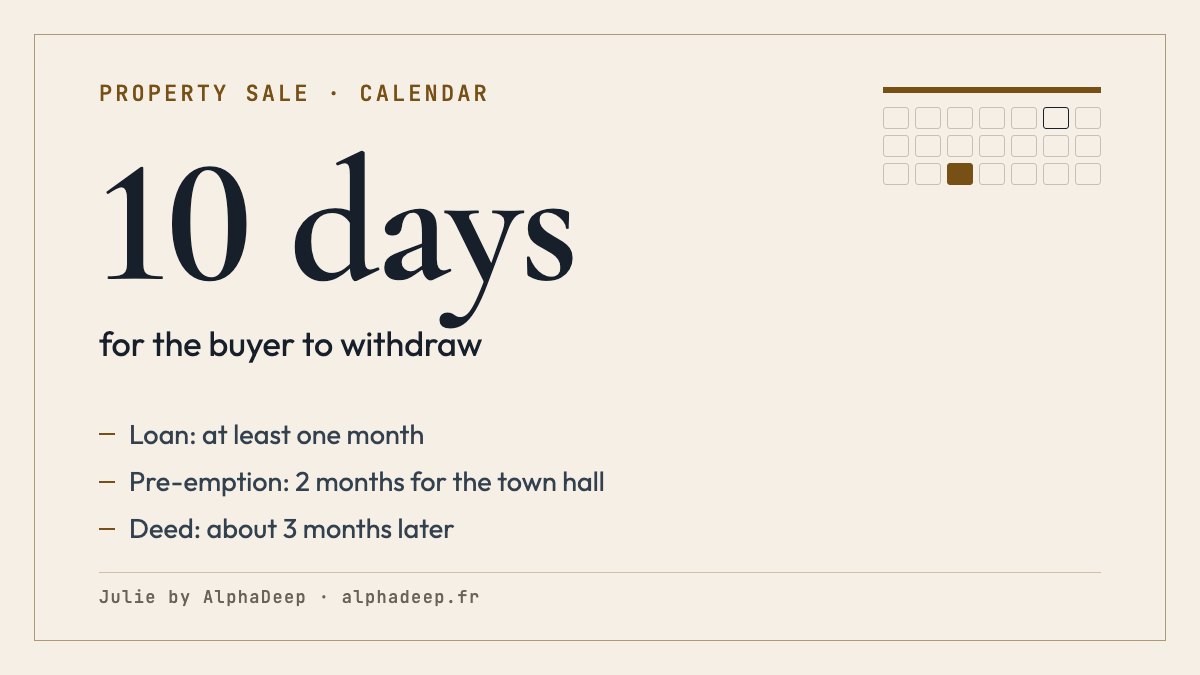
Once the preliminary contract (compromis or promesse) is signed, the seller is bound; a non-professional buyer can withdraw for 10 days from the day after notification (Construction and Housing Code, article L271-1). If the buyer borrows, the loan condition lasts at least one month (Consumer Code, article L313-41). In a pre-emption zone, the town hall has 2 months. Allow about 3 months until the deed.
Julie by AlphaDeep is an AI legal assistant for French law: it researches official references to help answer your questions (Légifrance, case law, service-public), analyses your documents and drafts your letters, for individuals and professionals alike.
General legal information with official references and dated checks. It is not personalised advice: for a decision that commits you, have your situation checked by a qualified professional.

Let’s look at your situation
Give the dates of the compromis, the notification, the loan and the declaration to the town hall.
Example questions
Your question carries over after signup. Maximum 400 characters. Avoid health data and names.
When can you sign the deed of sale?
Give the date of the preliminary contract, the date it was notified to the buyer, the end of the loan condition and the town hall’s receipt of the declaration: the calendar gives indicative expiry dates without establishing the earliest lawful deed date. The example: a compromis signed on 15 September 2026, notified on 16 September, a loan condition until 14 November, the declaration received by the town hall on 18 September.
Fictional example · sale calendar
Indicative benchmark: 19 November 2026, after the expiry of the town hall’s pre-emption period. This does not establish the earliest lawful deed date.
| M | T | W | T | F | S | S |
|---|---|---|---|---|---|---|
| 1 | 2 | 3 | 4 | 5 | 6 | |
| 7 | 8 | 9 | 10 | 11 | 12 | 13 |
| 14 | 15 | 16 | 17 | 18 | 19 | 20 |
| 21 | 22 | 23 | 24 | 25 | 26 | 27 |
| 28 | 29 | 30 |
| M | T | W | T | F | S | S |
|---|---|---|---|---|---|---|
| 1 | ||||||
| 2 | 3 | 4 | 5 | 6 | 7 | 8 |
| 9 | 10 | 11 | 12 | 13 | 14 | 15 |
| 16 | 17 | 18 | 19 | 20 | 21 | 22 |
| 23 | 24 | 25 | 26 | 27 | 28 | 29 |
| 30 |
- Preliminary contract signed
- Notified to the buyer
- Declaration received by the town hall
- End of the withdrawal period
- End of the loan condition
- End of the pre-emption period
- Benchmark after the entered expiry dates
The tenth day falls on a Saturday, a Sunday or a public holiday: withdrawal remains possible until the next working day.
Practical benchmark: about 3 months of formalities at the notary’s, that is around 15 December 2026.
This calculation requires the confirmations above and an unchanged loan deadline. It includes the 11 national public holidays; local holidays and other non-working days need checking. It does not cover sales without a preliminary contract, auctions or special regimes, or suspended pre-emption. CPC 642 does not extend the municipal pre-emption period when it ends on a Saturday, Sunday or public holiday. An obtained loan or an express town-hall waiver may allow an earlier signature; suspension or missing documents may delay it. The notary checks fulfilled conditions, documents and the deed date (L313-41, L213-2 and L721-3).
Which time limits run between the preliminary contract and the deed?
Three legal time limits, depending on the applicable regime, can delay the deed: the withdrawal period, the buyer’s loan and the town’s pre-emption right.
| Step | Time limit | Starting point | Text |
|---|---|---|---|
| Withdrawal by the non-professional buyer | 10 days | The day after the first presentation of the letter, or the hand delivery of the contract | CCH L271-1 |
| Withdrawal: last day on a Saturday, Sunday, public holiday or non-working day | Moved to the next working day | The normal end of the period | CPC 642 |
| Return of the deposit after a withdrawal | 21 days | The day after the withdrawal | CCH L271-2 |
| Loan condition precedent | At least 1 month, 45 to 60 days in practice | Signature, or registration of a private contract subject to mandatory registration on pain of nullity | C. consom. L313-41; F188 |
| Pre-emption by the town | 2 months | The receipt of the declaration of intent to sell (DIA) | C. urb. L213-2 |
| Co-ownership financial statement (état daté) | €380 incl. VAT at most | The request to the managing agent for the sale | Service-public F37294 |
For the ordinary sale of an existing home to a non-professional buyer, no direct payment before withdrawal ends: a mandated professional with a financial guarantee can receive the deposit. L271-2 also provides express statutory exceptions, including certain construction or new-home sales, outside this calendar.
Sources: CCH L271-1 · CCH L271-2 · CPC 642 · C. consom. L313-41 · C. urb. L213-2 · Service-public F37294
When do the buyer’s 10 withdrawal days start?
The day after the first presentation of the registered letter notifying the preliminary contract, even if the buyer collects it later; if a mandated professional hands the contract over under the statutory conditions with attestation, the day after that delivery (Construction and Housing Code, article L271-1). The period counts calendar days.
If it ends on a Saturday, Sunday, public holiday or non-working day, it runs until the next working day (Code of Civil Procedure, article 642). In co-ownership, missing documents or information required under L721-2 II, 1° and 2° move the starting point to the day after delivery in the forms required by L271-1 (L721-3); L721-2 includes exceptions for existing co-owners, ancillary lots and certain small co-ownerships. Other missing documents do not automatically cause this postponement.
Sources: CCH L271-1 · CPC 642 · CCH L721-3 · CCH L721-2
Can the seller change their mind after the compromis?
In principle no: the 10-day withdrawal period is reserved for the non-professional buyer of a home (Construction and Housing Code, article L271-1). The seller is bound by the preliminary contract, on its terms and conditions.
If the buyer withdraws, the professional who received a deposit must return it within 21 days from the day after the withdrawal (article L271-2).
Sources: CCH L271-1 · CCH L271-2
How long does the loan condition last?
At least one month from signature, or from registration for a private contract subject to that formality on pain of nullity, when the preliminary contract states that the price is paid, even partly, with a loan covered by this regime (Consumer Code, articles L313-40 and L313-41). In practice, the preliminary contract generally provides 45 to 60 days, according to service-public.
If the loan is not obtained within the agreed time and conditions, any sum paid in advance by the buyer is refunded in full, with no deduction or compensation (article L313-41).
Sources: C. consom. L313-41 · Service-public F188 · C. consom. L313-40
When can the town hall pre-empt the home?
In a pre-emption zone, the owner sends a declaration of intent to sell (déclaration d’intention d’aliéner) to the town hall; the town has 2 months from its receipt to decide, and its silence means it waives the right (Town Planning Code, article L213-2). The owner’s receipt of a document or visit request suspends this period; it resumes on receipt of the documents, refusal of the visit or the visit, with at least one month remaining (L213-2).
The preliminary contract can be signed on condition that the town does not pre-empt, but the notarial deed cannot be signed until it has waived, according to service-public. If it pre-empts, it buys the property in place of the intended buyer.
Sources: C. urb. L213-2 · Service-public F16
What does article L271-1 of the Construction and Housing Code say?
The text of the 10-day withdrawal period and its starting point.
Pour tout acte ayant pour objet la construction ou l’acquisition d’un immeuble à usage d’habitation, […] l’acquéreur non professionnel peut se rétracter dans un délai de dix jours à compter du lendemain de la première présentation de la lettre lui notifiant l’acte.
Cet acte est notifié à l’acquéreur par lettre recommandée avec demande d’avis de réception ou par tout autre moyen présentant des garanties équivalentes pour la détermination de la date de réception ou de remise. La faculté de rétractation est exercée dans ces mêmes formes.
In English, briefly (our summary, not an official translation): For any act concerning the construction or acquisition of a residential building, the non-professional buyer can withdraw within ten days from the day after the first presentation of the letter notifying the act. The act is notified by registered letter with acknowledgement of receipt or by any other means with equivalent guarantees as to the date of receipt or delivery, and the withdrawal is exercised in the same forms.
What do sellers ask between the compromis and the deed?
How long between the compromis and signing at the notary’s?
Generally, outside special regimes, there is no fixed legal time limit: ANIL says about 3 months are needed for the formalities, a period the parties can extend, for example to let the buyer sell another property. The date depends on withdrawal, obtaining the loan and waiver of pre-emption, as well as documents and any suspension: expiry dates alone do not establish it. In Alsace-Moselle, a private compromis must be followed by an authentic deed or, if a party refuses, a court claim within 6 months, on pain of lapse (article 42 of the law of 1 June 1924).
Can the deed be signed before the town hall answers?
No: the notarial deed cannot be signed until the town has waived its pre-emption right, expressly or by letting the ordinary unsuspended two-month period pass, according to service-public. A property in a pre-emption zone must first be checked for actual applicability; the calendar alone does not determine it.
How much does the co-ownership financial statement cost?
Its cost is capped at €380 including VAT, and a higher amount can be contested, according to service-public. Only the managing agent (syndic) draws it up, at the request of the notary or the seller, and sends it to the notary.
Can the buyer pay a deposit at the signature?
For the ordinary sale of an existing home to a non-professional buyer, no direct payment before withdrawal ends; a mandated professional with a financial guarantee can receive the deposit. Other express L271-2 exceptions, including certain new-home sales, fall outside this calendar; demanding or receiving a payment in breach of these rules is punishable by a €30,000 fine (Construction and Housing Code, article L271-2).
Which texts is this sale calendar based on?
- Consumer Code, article L313-40 (financing stated in the preliminary contract)Légifrance, in French
- Construction and Housing Code, article L721-2 (required documents and exceptions)Légifrance, in French
- Law of 1 June 1924, article 42 (authentic form in Alsace-Moselle)Légifrance, in French
- CAA Marseille, 10 October 2016, 15MA04788 (pre-emption without CPC 642 extension)Légifrance, in French
- Construction and Housing Code, article L271-1 (10-day withdrawal period)Légifrance, in French
- Construction and Housing Code, article L271-2 (payments and deposit)Légifrance, in French
- Code of Civil Procedure, article 642 (a time limit ending on a non-working day)Légifrance, in French
- Consumer Code, article L313-41 (loan condition precedent)Légifrance, in French
- Town Planning Code, article L213-2 (declaration of intent to sell)Légifrance, in French
- Construction and Housing Code, article L721-3 (co-ownership documents)Légifrance, in French
- The loan condition precedent in a promise to sell (fiche F188)Service-public.fr, in French · checked by the publisher on 24 August 2026
- Selling a property in a pre-emption zone (fiche F16)Service-public.fr, in French · checked by the publisher on 23 December 2025
- Is an état daté needed to sell a home in a co-owned building? (fiche F37294)Service-public.fr, in French · checked by the publisher on 18 February 2026
- Promise to sell an existing home: unilateral promise or compromis (fiche F2965)Service-public.fr, in French · checked by the publisher on 10 April 2026
- Buying an existing home (Acheter un logement existant)ANIL, the national housing information agency, in French · consulted on 30 September 2026
Texts cited last checked: 26 September 2026