The calculation sheetPrivate-sector employees
Retirement payment in France: voluntary retirement or retired by the employer
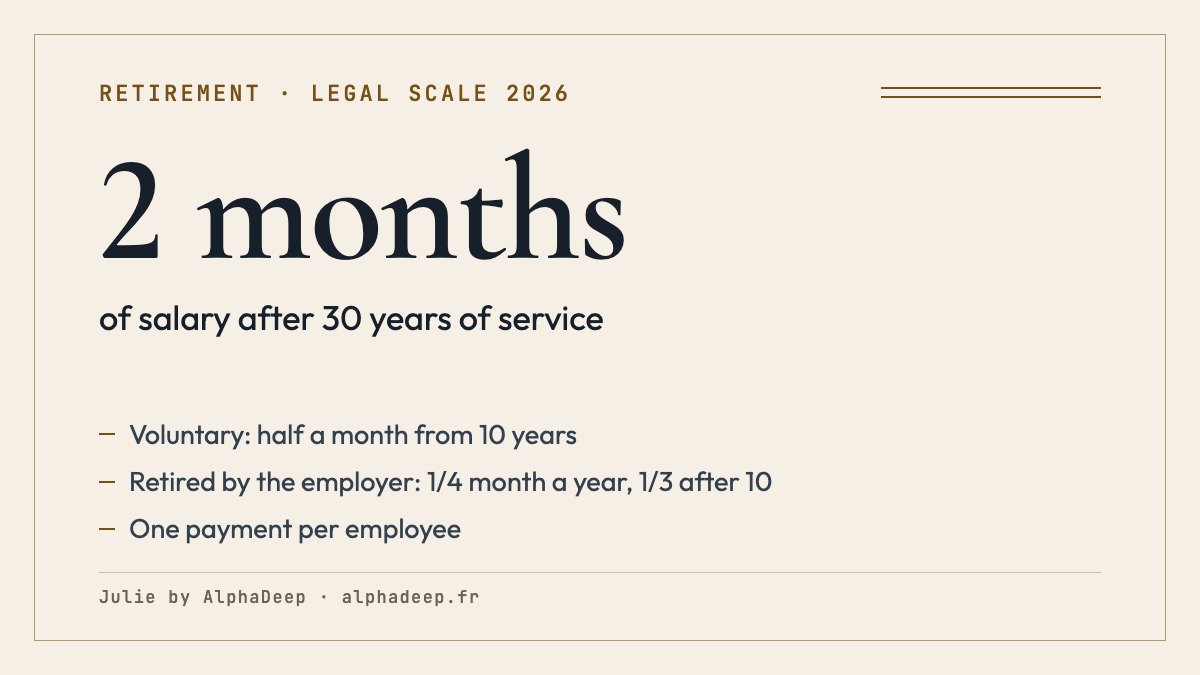
An employee in France who chooses to retire is owed a legal payment after at least 10 years of service: half a month of salary after 10 years, one month after 15, a month and a half after 20 and two months after 30 (Labour Code, article D1237-1). When the employer retires the employee, the payment is at least the legal dismissal payment (article L1237-7), and it is taxed differently.
Go to the tool: the calculation sheet
Julie by AlphaDeep is an AI legal assistant for French law: it researches official references to help answer your questions (Légifrance, case law, service-public), analyses your documents and drafts your letters, for individuals and professionals alike.
General legal information with official references and dated checks. It is not personalised advice: for a decision that commits you, have your situation checked by a qualified professional.

Let’s look at your situation
Give your years of service and who is ending the contract.
Example questions
Your question carries over after signup. Maximum 400 characters. Avoid health data and names.
Voluntary retirement or retired by the employer: what changes?
Voluntary retirement comes from the employee; compulsory retirement (mise à la retraite) comes from the employer, who can only impose it from age 70. The second is calculated like a dismissal payment and has lighter tax and social charges.
| Point compared | Voluntary retirement | Retired by the employer |
|---|---|---|
| Who decides | The employee, to claim the pension | The employer |
| Age | No age set by the Labour Code | From 70 without the employee’s consent; from 67 to 69 only if the employee agrees |
| Legal payment | Half a month after 10 years, 1 month after 15, a month and a half after 20, 2 months after 30 | A quarter of a month per year up to 10 years, then a third of a month per year after that |
| Reference salary | The more favourable of 1/12 of the last 12 months or 1/3 of the last 3 months | Same rule, annual bonuses pro rata |
| Notice | Dismissal notice: 1 month between 6 months and 2 years of service, 2 months beyond | The same notice |
| Income tax | Fully taxable, except under a redundancy plan | Exempt up to the legal or agreed amount, beyond that within a €240,300 limit in 2026 |
| CSG, CRDS and contributions | Subject to them, like salary | CSG and CRDS: the share below €96,120 is exempt; contributions: same share exempt if the payment stays below €480,600 |
Only one payment is due per employee, for voluntary or imposed retirement (articles L1237-7 and L1237-9). A collective agreement, company agreement or the contract can provide more.
Sources: Labour Code D1237-1 and D1237-2 · Labour Code L1237-7 ff. · CGI 80 duodecies · Service-public F408 · Service-public F13965 · Service-public F13966
How much will you receive if you retire, or if your employer retires you?
Enter your years of service and your average gross salaries: the calculator shows side by side the legal minimum for voluntary retirement and for retirement imposed by the employer, using the more favourable reference salary. The example uses 22 years of service and €2,800 gross a month.
Fictional example · two endings compared
Retirement imposed by the employer would pay at least €14,000.00 more than voluntary retirement, with lighter tax.
Voluntary retirement
€4,200.001.5 months of salary, fully taxable
Retired by the employer
€18,200.006.5 months of salary, exempt up to the legal amount
- Reference salary used
- €2,800.00
- More favourable formula
- the last 12 months
Legal minimum, gross. Your collective agreement may give more; only one payment is due, for voluntary or imposed retirement.
Which salary is used to calculate the retirement payment?
The formula more favourable to the employee applies: either one twelfth of gross pay over the last 12 months, or one third of the last 3 months (Labour Code, article D1237-2). In the 3-month formula, an annual bonus counts only pro rata.
In the worked example of service-public.fr, an annual bonus of €550 paid during those 3 months counts for €137.50. If you worked full time then part time in the company, each period is weighted by its length: 9 years at €2,400 and 2 years at €1,200 give a base of €2,181.82.
Sources: Labour Code D1237-1 and D1237-2 · Service-public F13965
How is the payment worked out when the employer retires you?
The payment when the employer retires you is at least the legal dismissal payment: a quarter of a month of salary per year of service up to 10 years, then a third of a month per year beyond, part years counting pro rata (Labour Code, articles L1237-7 and R1234-2).
In the service-public.fr example, 12 years and 9 months of service with a reference salary of €2,200 give at least €7,516.67. The reference salary follows the dismissal rule: the average of the last 12 months or one third of the last 3, whichever is higher (article R1234-4).
Sources: Labour Code L1237-7 ff. · Labour Code R1234-2 and R1234-4 · Service-public F13965
Can you receive both the voluntary and the imposed retirement payment?
No. Each employee can receive only one payment, for voluntary or imposed retirement (Labour Code, articles L1237-7 and L1237-9). The legal payment and the one in your collective agreement do not add up either: the more favourable applies.
Since 26 October 2025, the voluntary retirement payment is due when you claim your own old-age pension in the basic scheme of your job. A company or sector agreement can also use it to keep your salary if you move to part time at the end of your career, with the balance still owed to you.
Source: Labour Code L1237-7 ff.
What does article D1237-1 of the Labour Code say about the retirement payment?
The article sets the legal minimum for voluntary retirement, by band of service; below 10 years, the law provides nothing.
Le taux de l’indemnité de départ en retraite prévue à l’article L. 1237-9 est au moins égal à :
1° Un demi-mois de salaire après dix ans d’ancienneté ;
2° Un mois de salaire après quinze ans d’ancienneté ;
3° Un mois et demi de salaire après vingt ans d’ancienneté ;
4° Deux mois de salaire après trente ans d’ancienneté.
In English, briefly (our summary, not an official translation): The payment for voluntary retirement under article L1237-9 is at least half a month of salary after ten years of service, one month after fifteen years, a month and a half after twenty years and two months after thirty years. The bands count full years: with 19 years and 11 months, the legal payment stays at one month. The words "at least" leave room for a higher agreed amount.
Which official amounts apply to payments made in 2026?
Three thresholds published by the administration frame income tax and social charges on a payment for employer-imposed retirement.
- Cap on the alternative income-tax exemption thresholds for employer-imposed retirement; the legal or collective minimum is fully exempt
- €240,300Payments received in 2026 · Service-public.fr, fiche F408, in French
- Share of an employer-imposed retirement payment exempt from CSG and CRDS
- €96,120Threshold in force in 2026 · Service-public.fr, fiche F13965, in French
- Amount above which the payment bears social contributions in full
- €480,600Threshold in force in 2026 · Service-public.fr, fiche F13965, in French
What practical questions come up when you retire from a French employer?
Is the voluntary retirement payment taxed in France?
Yes, in full, unless the departure is part of a redundancy plan, according to service-public.fr. It also bears social contributions, CSG and CRDS. If it exceeds the average of your income over the previous 3 years, you can ask for the quotient system, which spreads the tax.
Can my collective agreement give a higher payment?
Yes. Article D1237-1 sets a minimum: a collective agreement, a company agreement or your contract can give more, and the more favourable amount then applies, without adding it to the legal minimum.
How much notice do I give before retiring?
The dismissal notice (Labour Code, article L1237-10): 1 month with 6 months to 2 years of service, 2 months beyond (article L1234-1), unless your collective agreement, contract or local practice gives a better rule.
Can my employer retire me before 70?
Only with your consent, between 67 and 69: the employer must ask you in writing 3 months before your birthday and you have 1 month to answer (article D1237-2-1). A refusal blocks it for a year; the employer can ask again each year until you turn 69. Otherwise, ending the contract is a dismissal.
Which texts is this retirement payment calculation based on?
- Labour Code, articles D1237-1 and D1237-2 (rate and reference salary for voluntary retirement)Légifrance, in French
- Labour Code, articles L1237-7, L1237-9 (version of 26 October 2025) and L1237-10Légifrance, in French
- Labour Code, articles R1234-2 and R1234-4 (legal dismissal payment)Légifrance, in French
- General Tax Code, article 80 duodecies (exemption of termination payments)Légifrance, in French
- Income tax on end-of-contract, dismissal and retirement payments (fiche F408)Service-public.fr, in French
- Payment for voluntary or employer-imposed retirement of an employee (fiche F13965)Service-public.fr, in French
- Employer-imposed retirement of a private-sector employee (fiche F13966)Service-public.fr, in French
- Labour Code, articles L1237-5 and D1237-2-1 (procedure for employer-imposed retirement)Légifrance, in French
Texts cited last checked: 24 September 2026