The route finderFixed-term contract · ending before the term
Ending a French fixed-term contract (CDD) early: the permitted cases and what each side owes
Outside the trial period, a French fixed-term contract (CDD) can end before its term only by mutual agreement, for gross misconduct, force majeure or unfitness certified by the occupational doctor, or by an employee who proves they have been hired on a permanent contract (CDI) (Labour Code, articles L1243-1 and L1243-2). An employer who ends it outside these cases owes at least the pay up to the term, plus the 10% end-of-contract allowance (article L1243-4).
Go to the tool: the route finder
Julie by AlphaDeep is an AI legal assistant for French law: it researches official references to help answer your questions (Légifrance, case law, service-public), analyses your documents and drafts your letters, for individuals and professionals alike.
General legal information with official references and dated checks. It is not personalised advice: for a decision that commits you, have your situation checked by a qualified professional.

Let’s look at your situation
Say who ended the contract, the ground given and the dates of the CDD.
Example questions
Your question carries over after signup. Maximum 400 characters. Avoid health data and names.
Who ended your fixed-term contract, and what are you owed?
Choose who ends the contract and on which ground, then enter the dates and the salary: the route finder says whether the early end is permitted and estimates the calculable items; unfitness and force majeure need a separate assessment. The example: a CDD from 1 January to 31 December 2026 at €2,200 gross a month, ended by the employer on 30 September on no ground the law provides.
Fictional example · fixed-term exit route finder
The employer ends it on another ground: early end outside the legal cases.
- Pay received up to the end
- €19,800.00 (9 months)
- Minimum damages: pay up to the term
- €6,600.00
- End-of-contract allowance, 10%
- €2,640.00
- Paid-leave allowance, at least 10%, if no leave was taken
- €2,244.00
- Estimated total of calculated items, assuming no leave already taken
- €11,484.00
The rule
Unlawful early end: the employer owes at least the pay up to the term, on top of the end-of-contract allowance (Labour Code, article L1243-4).
The time limit to act
To contest the early end before the employment tribunal: 12 months from its notification (Labour Code, article L1471-1).
Gross amounts at constant pay; the court can award more than the legal minimum. A collective agreement can lower the allowance to 6% in exchange for access to training.
Which grounds allow a CDD to end early, and with which payments?
Seven situations, from ending by mutual agreement to the employee leaving without a CDI.
| Situation | Early end permitted | End-of-contract allowance | Other sum due |
|---|---|---|---|
| Written agreement of both parties | Yes | Due | None |
| Employee’s gross misconduct | Yes, with the disciplinary procedure | Not due | None |
| Force majeure | Yes | Not due | Pay up to the term if it results from a disaster |
| Unfitness certified by the occupational doctor | Yes | Due | At least the legal severance pay, doubled if the cause is work-related |
| Employee hired on a CDI | Yes, with notice | Not due | None |
| Employer, on another ground | No | Due, also counted on the pay up to the term | At least the pay up to the term |
| Employee, on another ground | No | Not due | The employee may have to make good the harm the employer proves |
For untaken leave, the paid-leave allowance remains due in every case: at least a tenth of the gross pay received, including the end-of-contract allowance when due (Labour Code, article L1242-16).
Sources: C. trav. L1243-1 · C. trav. L1243-4 · C. trav. L1243-10 · C. trav. L1226-4-3
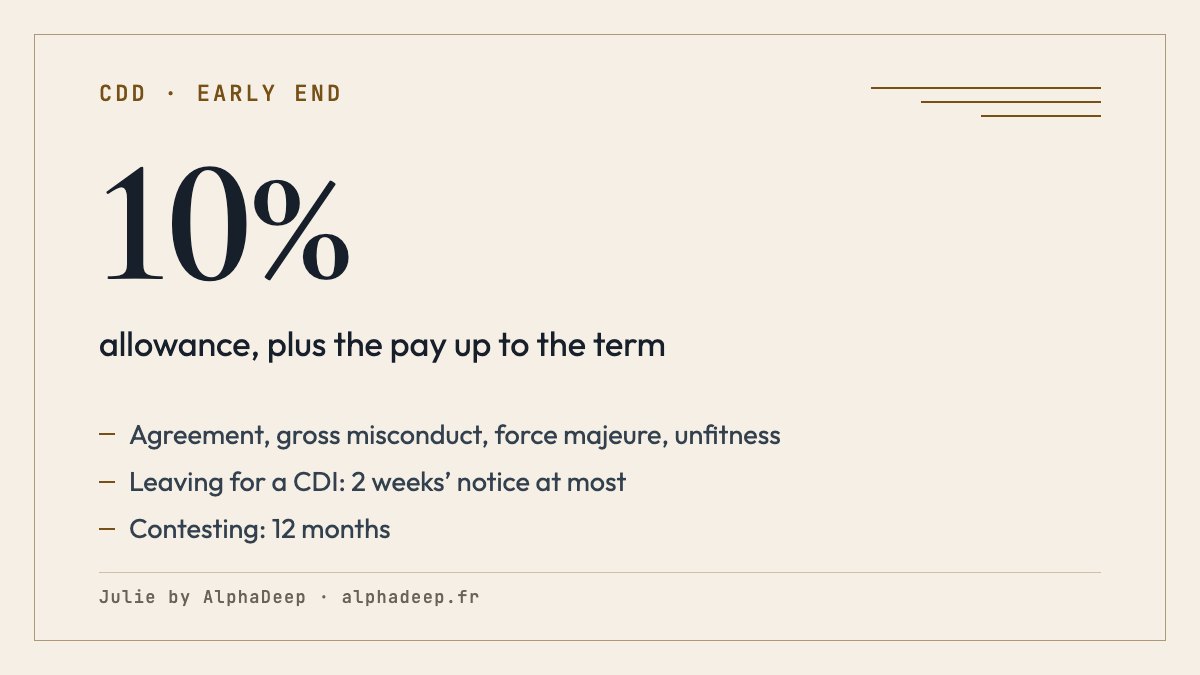
What does the employer owe if they end the CDD without a valid ground?
Damages at least equal to the pay you would have received up to the term, on top of the end-of-contract allowance (Labour Code, article L1243-4). The Cour de cassation calculates this allowance on the pay already received and on the pay still due up to the term (3 May 2018, no. 16-22.455).
This amount is a minimum: the court can compensate a wider harm if it is proved. Unemployment benefit received for the same period cannot be deducted from this minimum (Cour de cassation, 27 February 2001, no. 98-45.140).
Sources: C. trav. L1243-4 · Cass. soc. 16-22.455 · Cass. soc. 98-45.140
Which notice must you give if you leave for a CDI?
One day per week of the contract, up to two weeks, unless agreed otherwise with the employer (Labour Code, article L1243-2). For a CDD with a precise end date, the count is based on its total length, renewals included; without a precise end date, on the time already worked.
You must prove the permanent hiring, for example with the offer or the signed contract. In that case the end-of-contract allowance is not due, but the paid-leave allowance is (articles L1243-10 and L1242-16).
Sources: C. trav. L1243-2 · C. trav. L1243-10
Can an agreement to end the contract remove the end-of-contract allowance?
No. Ending by mutual agreement is not a settlement and cannot, whatever its terms, deprive the employee of the rights arising from the performance of the contract, including the end-of-contract allowance (Cour de cassation, 6 October 2015, no. 14-19.126). Have it recorded in writing, with its date.
Source: Cass. soc. 14-19.126
What does article L1243-1 of the Labour Code say about ending a CDD early?
The closed list of grounds that allow a CDD to end before its term.
Sauf accord des parties, le contrat de travail à durée déterminée ne peut être rompu avant l’échéance du terme qu’en cas de faute grave, de force majeure ou d’inaptitude constatée par le médecin du travail.
Lorsqu’il est conclu en application du 6° de l’article L. 1242-2, le contrat de travail à durée déterminée peut, en outre, être rompu par l’une ou l’autre partie, pour un motif réel et sérieux, dix-huit mois après sa conclusion puis à la date anniversaire de sa conclusion.
In English, briefly (our summary, not an official translation): Unless the parties agree, a fixed-term contract can be ended before its term only for gross misconduct, force majeure or unfitness certified by the occupational doctor. A fixed-term contract for a defined project, reserved for engineers and managers, can also be ended by either party for a real and serious reason eighteen months after it was signed, then on each anniversary of its signature. During the trial period, these rules do not apply (article L1242-11).
What do employees and employers ask about the end of a CDD?
How long is the trial period of a CDD?
At most one day per week of the contract, up to two weeks if the contract lasts 6 months or less, and one month beyond, unless a custom or an agreement provides for less (Labour Code, article L1242-10).
Is the company’s liquidation a case of force majeure?
No. The Cour de cassation holds that judicial liquidation, even when it leads to the company’s disappearance, does not allow a CDD to be ended before its term for force majeure (20 October 1993, no. 91-43.922).
Within which time limit can you contest the end of your CDD?
Within the 12 months following notification of the termination, before the employment tribunal (conseil de prud’hommes) (Labour Code, article L1471-1). A claim for unpaid wages has a time limit of 3 years.
Does refusing a CDI at the end of the CDD lose the allowance?
Yes, if the CDI offered is for the same or a similar job, with at least equivalent pay (Labour Code, article L1243-10). The employer makes the offer in writing and informs France Travail of the refusal within the month (articles L1243-11-1 and R1243-2).
What has changed for the end of fixed-term contracts since 2022?
The early end has not changed; the end of the contract and its exceptions have.
An employer who offers a CDI at the end of the CDD does so in writing and reports the employee’s refusal (law no. 2022-1598 of 21 December 2022, Labour Code, article L1243-11-1).
Source: C. trav. L1243-11-1
The CDI offer is made before the term, with time to consider it; the employer informs France Travail of the refusal within the month (decree no. 2023-1307 of 28 December 2023, article R1243-2).
Source: C. trav. L1243-11-1
A new CDD of at least 6 months, signed for the retraining period; like the other contracts of article L1242-3, it does not give the end-of-contract allowance, unless a more favourable agreement applies (law no. 2025-989 of 24 October 2025).
Source: C. trav. L1242-3
Which texts is this route finder for ending a CDD based on?
- Labour Code, article L1243-1 (cases of early termination)Légifrance, in French
- Labour Code, article L1243-2 (employee hired on a CDI, notice)Légifrance, in French
- Labour Code, articles L1243-3 and L1243-4 (damages)Légifrance, in French
- Labour Code, articles L1243-8 to L1243-10 and L1242-16 (end-of-contract allowance, paid leave)Légifrance, in French
- Labour Code, articles L1226-4-3 and L1226-20 (termination for unfitness)Légifrance, in French
- Cour de cassation, social chamber, 3 May 2018, no. 16-22.455Légifrance, in French
- Cour de cassation, social chamber, 6 October 2015, no. 14-19.126Légifrance, in French
- Cour de cassation, social chamber, 27 February 2001, no. 98-45.140Légifrance, in French
- Labour Code, articles L1243-11-1 and R1243-2 (CDI offer at the end of the CDD)Légifrance, in French
- Labour Code, article L1242-3 (CDD for the retraining period)Légifrance, in French
- End of a fixed-term contract (fiche F40)Service-public.fr, in French · checked by the publisher on 22 January 2024
Texts cited last checked: 25 September 2026