The checklist gridAudit grid · SAS articles
French SAS articles of association: the compulsory entries, the optional clauses and their limits, checked one by one
The articles of a French SAS set its organisation freely, within limits: form, name, registered office, purpose, capital and a term of 99 years at most (Commercial Code, article L210-2), how the president is appointed (L227-6), and collective decisions and their form (L227-9). A collective decision needs at least a majority of the votes cast (Cour de cassation, 15 November 2024).
Go to the tool: the checklist grid
Julie by AlphaDeep is an AI legal assistant for French law: it researches official references to help answer your questions (Légifrance, case law, service-public), analyses your documents and drafts your letters, for individuals and professionals alike.
General legal information with official references and dated checks. It is not personalised advice: for a decision that commits you, have your situation checked by a qualified professional.

Let’s look at your situation
Give the form, the number of partners, the clauses you are unsure about, or attach the articles.
Example questions
Your question carries over after signup. Maximum 400 characters. Avoid health data and names.
Which mistakes should you look for first in the articles?
Five defects to spot first, because they make a clause void or a decision open to challenge.
A majority set too low
A clause adopting a decision with less than a majority of the votes cast is deemed unwritten (Cass. ass. plén., 15 November 2024).
No rule for appointing the president
Every SAS has a president, appointed as the articles provide (article L227-6).
A lock-up of more than ten years
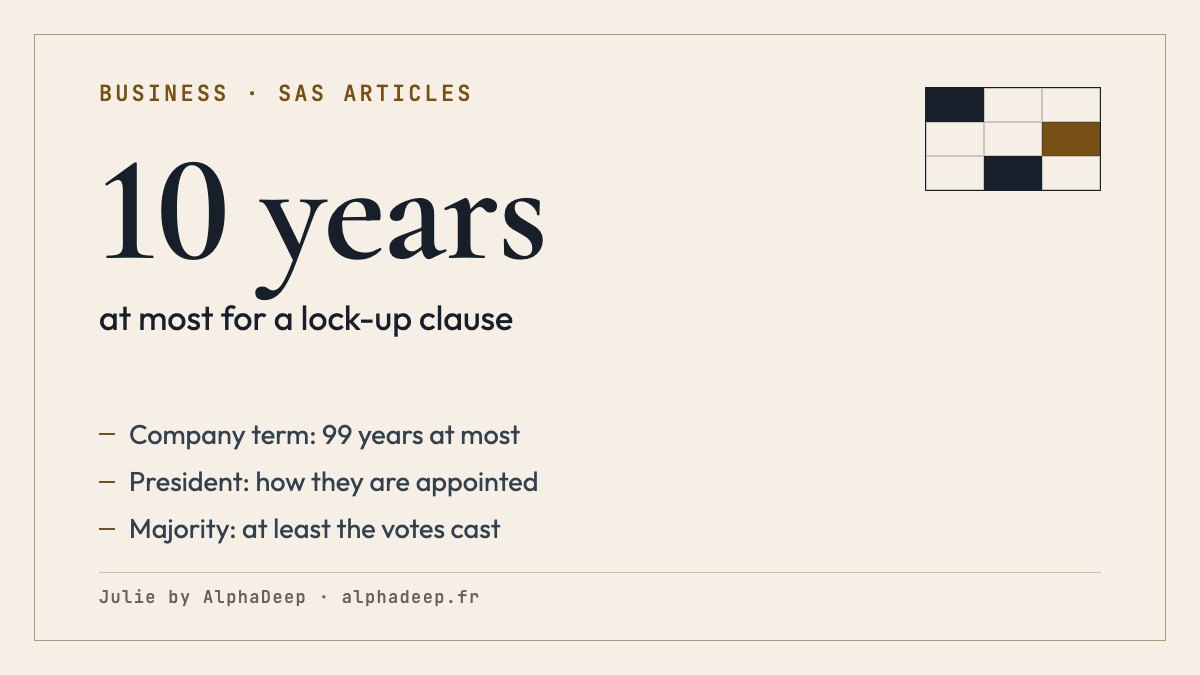
The articles cannot bar the transfer of shares for more than ten years (article L227-13).
Collective decisions handed to the president
Capital, merger, demerger, dissolution, conversion, auditors, annual accounts and profits stay with the partners (article L227-9).
Limits on powers presented as binding on others
Clauses limiting the president’s powers cannot be relied on against third parties (article L227-6).
What must the articles of a SAS contain?
The form, name, registered office, purpose, capital and term, 99 years at most (Commercial Code, article L210-2), each partner’s contribution and how the company works (Civil Code, article 1835).
For a company with shares, also the categories and form of the shares, contributions in kind, special benefits and the allocation of profit (article R224-2); for a SAS, how the president is appointed (article L227-6) and the collective decisions (article L227-9).
Sources: C. com. L210-2 · C. civ. 1835 · C. com. R224-2 · C. com. L227-6 · C. com. L227-9
Which decisions must stay collective?
Increasing, amortising or reducing capital, merger, demerger, dissolution, conversion, appointing statutory auditors, annual accounts and profits: the partners exercise these collectively, under the articles (article L227-9).
The freedom of the articles has a limit: a collective decision is only validly adopted with at least a majority of the votes cast, any contrary clause being deemed unwritten (Cass. ass. plén., 15 November 2024, no. 23-16.670).
Sources: C. com. L227-9 · Cass. ass. plén., 15 Nov. 2024
Which optional clauses exist, and how are they adopted?
Lock-up of the shares for ten years at most (article L227-13), approval of transfers (L227-14), exclusion of a partner (L227-16), change of control of a corporate partner (L227-17).
Lock-up and change of control need unanimity; approval and exclusion, a collective decision in the form the articles set (article L227-19). None applies while the company has a single partner (article L227-20).
Sources: C. com. L227-13 · C. com. L227-14 · C. com. L227-16 · C. com. L227-17 · C. com. L227-19 · C. com. L227-20
Do your articles pass the grid?
Give the form, what the articles contain, the majority rule, the optional clauses and the year’s figures: the grid sorts each clause into compliant, to correct or to check, and says whether a statutory auditor is compulsory. The example: a SAS with no rule for appointing the president, a one-third majority and a 12-year lock-up.
Fictional example · the articles grid
3 points to correct in the articles.
- Compliant points
- 6 of 10
- Points to correct
- 3
- Auditor thresholds exceeded
- 2 of 3
- Statutory auditor
- Compulsory
6 · Compliant3 · To correct1 · To check
| Clause or point checked | Compliant | To correct | To check |
|---|---|---|---|
| Form, name, office, purpose, capitalarticle L210-2 | Compliant | ||
| Term of 99 years at mostarticle L210-2 | Compliant | ||
| Each partner’s contributionCivil Code, article 1835 | Compliant | ||
| Appointment of the presidentarticle L227-6 | To correct | ||
| Collective decisionsarticle L227-9 | Compliant | ||
| Shares: number, categories, formarticle R224-2 | Compliant | ||
| Profit, reserves, liquidation surplusarticle R224-2, 7° | Compliant | ||
| Majority for collective decisionsCass. ass. plén., 15 November 2024 | To correct | ||
| Lock-up, 10 years at mostarticle L227-13 | To correct | ||
| Approval of share transfersarticles L227-14 and L227-19 | To check |
Indicative result: a clause that is present may still be badly worded; companies in a group have their own auditor thresholds, to check separately.
Which clauses are compulsory, and which optional?
The entries the law requires, then the optional clauses with their limit and how they are adopted.
| Clause | Status | Text |
|---|---|---|
| Form, name, registered office, purpose, capital | Compulsory | Article L210-2 |
| Term | Compulsory, 99 years at most | Article L210-2 |
| Each partner’s contribution, how it works | Compulsory | Civil Code, article 1835 |
| How the president is appointed | Compulsory | Article L227-6 |
| Collective decisions, form and conditions | Compulsory | Article L227-9 |
| Shares, profit, reserves, liquidation surplus | Compulsory | Article R224-2 |
| Lock-up of the shares | Optional, 10 years at most, unanimously | Articles L227-13 and L227-19 |
| Approval of transfers | Optional, collective decision under the articles | Articles L227-14 and L227-19 |
| Exclusion of a partner | Optional, collective decision under the articles | Articles L227-16 and L227-19 |
| Change of control of a partner | Optional, unanimously | Articles L227-17 and L227-19 |
| Nullity of decisions breaking the articles | Optional, since 1 October 2025 | Article L227-20-1 |
In a SASU, the clauses of articles L227-13 to L227-19 have no effect while there is a single partner (article L227-20).
Sources: C. com. L210-2 · C. civ. 1835 · C. com. L227-6 · C. com. L227-9 · C. com. R224-2 · C. com. L227-19 · C. com. L227-20-1 · C. com. L227-20
What does article L227-9 of the French Commercial Code say?
What is left to the articles, and the decisions that stay with the partners.
Les statuts déterminent les décisions qui doivent être prises collectivement par les associés dans les formes et conditions qu’ils prévoient.
Toutefois, les attributions dévolues aux assemblées générales extraordinaires et ordinaires des sociétés anonymes, en matière d’augmentation, d’amortissement ou de réduction de capital, de fusion, de scission, de dissolution, de transformation en une société d’une autre forme, de nomination de commissaires aux comptes, de comptes annuels et de bénéfices sont, dans les conditions prévues par les statuts, exercées collectivement par les associés.
In English, briefly (our summary, not an official translation): The articles decide which decisions the partners must take collectively, in the form and on the conditions they set. However, the powers held by the ordinary and extraordinary general meetings of public limited companies over increasing, amortising or reducing capital, merger, demerger, dissolution, conversion into another form, appointing statutory auditors, annual accounts and profits are exercised collectively by the partners, on the conditions the articles set. Our note: in a SASU, the single partner exercises these powers and approves the accounts within six months of the year end.
What do founders and partners of a SAS ask?
Must the president be named in the articles?
The text requires the conditions of appointment (article L227-6), not the name: the appointment can be in a separate document.
Do limits on the president’s powers bind third parties?
No: clauses in the articles limiting the president’s powers cannot be relied on against third parties (article L227-6).
When is a statutory auditor compulsory?
When the SAS exceeds two of three thresholds at year end: €5,000,000 balance sheet, €10,000,000 turnover excluding VAT, 50 employees on average (articles L227-9-1 and D221-5).
How are the articles amended?
Under the rules they set, respecting the collective decisions; failing that, unanimously, and a partner’s commitments can never be increased without their consent (Civil Code, article 1836).
Which texts do the articles of a SAS rest on?
- Commercial Code, article L210-2 (entries of the articles)Légifrance
- Civil Code, article 1835 (articles in writing)Légifrance
- Commercial Code, article R224-2 (contents of the articles)Légifrance
- Commercial Code, article L227-6 (president)Légifrance
- Commercial Code, article L227-9 (collective decisions)Légifrance
- Cour de cassation, plenary assembly, 15 November 2024, no. 23-16.670 (majority)Légifrance
- Commercial Code, article L227-13 (lock-up)Légifrance
- Commercial Code, article L227-14 (approval)Légifrance
- Commercial Code, article L227-16 (exclusion)Légifrance
- Commercial Code, article L227-17 (change of control)Légifrance
- Commercial Code, article L227-19 (adopting the clauses)Légifrance
- Commercial Code, article L227-20 (single partner)Légifrance
- Commercial Code, article L227-9-1 (statutory auditor)Légifrance
- Commercial Code, article D221-5 (thresholds)Légifrance
- Commercial Code, article L227-20-1 (nullity under the articles)Légifrance
- Civil Code, article 1836 (amending the articles)Légifrance
- Setting up a company: drafting and registering the articles (sheet F32232, in French)Service-public.fr · checked on 27 February 2026
Texts cited last checked: 27 September 2026