The route finderPartners and directors of small companies
Shareholder disputes in France: removing the manager, excluding a partner, challenging an abuse
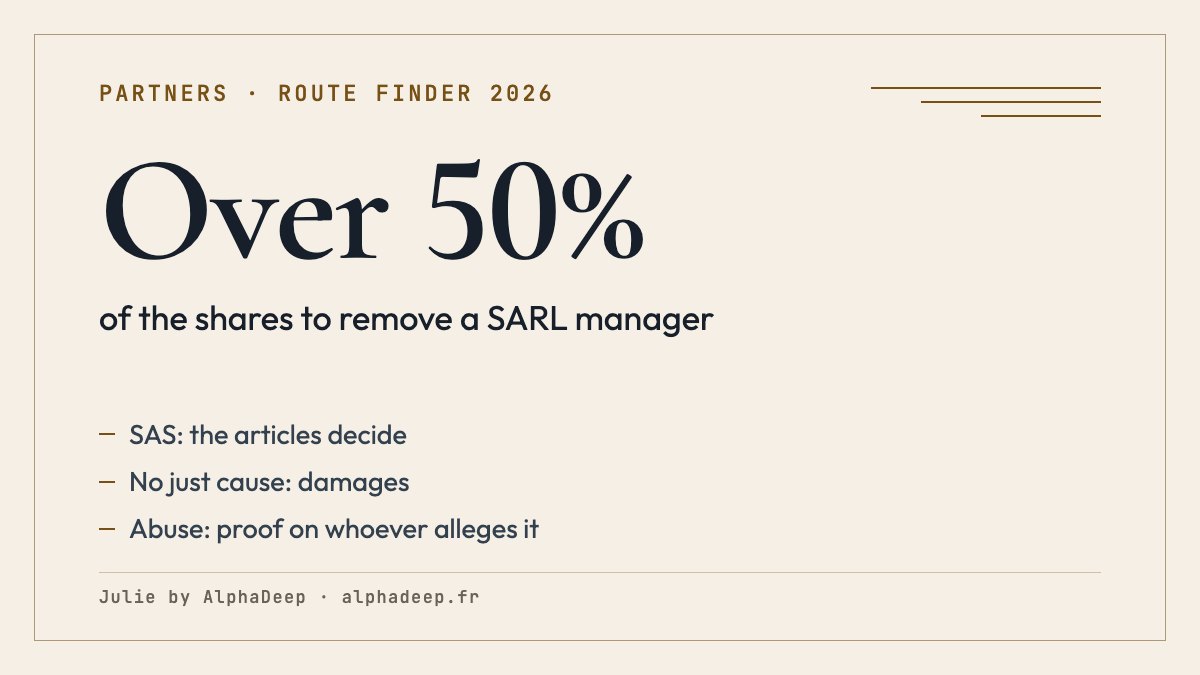
In a SARL, the manager can be removed by a decision of partners holding more than half of the shares, but a removal decided without just cause can give rise to damages (Commercial Code, article L223-25). In a SAS, the articles of association set the rules, including any exclusion of a shareholder (article L227-16). A decision contrary to the company’s interest, taken solely to favour the majority, is an abuse of majority.
Go to the tool: the route finder
Julie by AlphaDeep is an AI legal assistant for French law: it researches official references to help answer your questions (Légifrance, case law, service-public), analyses your documents and drafts your letters, for individuals and professionals alike.
General legal information with official references and dated checks. It is not personalised advice: for a decision that commits you, have your situation checked by a qualified professional.

Let’s look at your situation
Give the company form, the split of the capital and the point of deadlock.
Example questions
Your question carries over after signup. Maximum 400 characters. Avoid health data and names.
What changes between a SARL, a SAS and a SCI?
The law sets the rules for the SARL and the SCI; those of the SAS come almost entirely from the articles of association. Hence the need to reread the articles before any decision.
| Question | SARL | SAS | SCI |
|---|---|---|---|
| Who removes the director | Partners holding more than half of the shares, unless the articles require a larger majority | The body and the majority set by the articles | Partners holding more than half of the shares, unless the articles provide otherwise |
| Removal without just cause | Damages possible | Depending on the articles and the shareholders’ agreement | Damages possible |
| Removal by the court | For legitimate cause, at the request of any partner | No specific text: see the articles | For legitimate cause, at the request of any partner |
| Excluding a partner | No mechanism provided by law | Possible if a clause of the articles organises it | Only with a clause of the articles |
| Texts | Commercial Code, art. L223-25 and L223-29 | Commercial Code, art. L227-5 and L227-16 | Civil Code, art. 1851 |
| Competent court | Commercial court | Commercial court | Judicial court |
When the value is disputed, article 1843-4 expert valuation applies when legislation refers to it, or when the articles require a transfer or buyback with a price that is neither fixed nor determinable; a price disagreement alone is insufficient. The parties appoint the expert or, failing agreement, the court president does; the appointment decision has no appeal.
Sources: C. com. L223-25 · C. com. L227-16 · C. civ. 1851 · C. civ. 1843-4 · C. com. L227-18
Which rule applies to your dispute, and before which court?
Choose the company form and what you want to do: the route finder gives the applicable rule, the risk, the competent court and the documents to gather. The example is a SARL with two partners, where the majority partner wants to remove the minority manager.
Fictional example · dispute route finder
SARL or EURL · Remove the manager or the president
The rule
A decision of partners holding more than half of the shares, unless the articles require a larger majority (Commercial Code, articles L223-25 and L223-29).
The risk and the remedy
Without just cause, the manager can obtain damages. Without a majority, any partner can ask the court to remove the manager for legitimate cause.
The competent court
If there is a dispute: the commercial court of the registered office.
Documents to gather
- Up-to-date articles of association
- Split of the capital
- Notice and minutes of the meeting
- Documents establishing the just cause
The articles and the shareholders’ agreement often prevail over the default rules: read them before any decision.
Which remedies exist, from the most conciliatory to the most radical?
Five routes are open to partners in dispute; the first ones preserve the company, the last one ends it.
Negotiate or use a mediator
Mediation is a structured process in which a third party helps the parties reach an agreement (Code of Civil Procedure, article 1530). According to Service-public Entreprendre, it leads to an agreement in nearly 70% of cases.
Ask for a representative appointed by the court
Faced with an abusive deadlock, the court can appoint a representative to vote in the name of the defaulting partner, in the company’s interest (Cass. com., 9 March 1993, no. 91-14.685).
Have the abusive decision annulled
A decision taken against the company’s interest, to favour the majority to the detriment of the minority, can be annulled, with damages (Cass. com., 4 October 2011, no. 10-23.398).
Remove the director, or have the court remove them
By a decision of the partners, or by the court for legitimate cause at the request of any partner in a SARL and a SCI (Commercial Code, article L223-25; Civil Code, article 1851).
Ask for judicial dissolution
For just cause, in particular a disagreement that paralyses the running of the company (Civil Code, article 1844-7, 5°). The company disappears: it is the last resort.
When does a majority decision become an abuse of majority?
Two conditions must be met: a decision taken against the company’s interest, and solely to favour the members of the majority to the detriment of the minority. The Cour de cassation overturns judges who do not establish both elements (Cass. com., 4 October 2011, no. 10-23.398).
The burden of proof lies with the partner who alleges the abuse: the company does not have to show that its decision served its interest (Cass. com., 7 May 2025, no. 23-21.508, on the removal of a co-manager). Gather the minutes, the accounts and what the decision brings the majority.
Sources: Cass. com. 4 Oct. 2011 · Cass. com. 7 May 2025
What can you do about a minority partner who blocks everything?
The deadlock becomes an abuse of minority when the minority partner’s conduct prevents an operation essential to the company and is aimed solely at favouring their own interests to the detriment of the other partners (Cass. com., 13 March 2024, no. 22-13.764).
The court cannot vote in the partner’s place, but it can appoint a representative to attend a new meeting and vote in their name in the company’s interest, without harming their legitimate interest (Cass. com., 9 March 1993, no. 91-14.685).
Sources: Cass. com. 13 March 2024 · Cass. com. 9 March 1993
Can a SARL manager be removed without just cause?
Yes: partners holding more than half of the shares can remove the manager without giving a reason, unless the articles require a larger majority. But if the removal is decided without just cause, the manager can obtain damages (Commercial Code, article L223-25).
If the manager personally holds the majority, the other partners cannot reach it: any partner can then ask the court to remove the manager for legitimate cause. In every case, keep the facts and the documents on which the removal rests.
Source: C. com. L223-25
What does article L223-25 of the Commercial Code say about removing the manager?
Article L223-25 is the reference text for the SARL; the SCI follows a similar rule, in article 1851 of the Civil Code.
Le gérant peut être révoqué par décision des associés dans les conditions de l’article L. 223-29, à moins que les statuts prévoient une majorité plus forte. Si la révocation est décidée sans juste motif, elle peut donner lieu à des dommages et intérêts. En outre, le gérant est révocable par les tribunaux pour cause légitime, à la demande de tout associé.
In English, briefly (our summary, not an official translation): The manager can be removed by a decision of the partners under the conditions of article L. 223-29, unless the articles provide for a larger majority. If the removal is decided without just cause, it can give rise to damages. The courts can also remove the manager for legitimate cause, at the request of any partner. Article L223-29 requires partners holding more than half of the shares; an exception protects the manager of a press company, who can be removed only by three quarters of the capital.
Which questions come up before going to court?
Can a majority partner remove the manager alone?
In a SARL, yes, if they hold more than half of the shares and the articles do not require a larger majority (Commercial Code, articles L223-25 and L223-29). They must still follow the notice and the procedure provided, and bear the risk of damages if there is no just cause.
Can the court dissolve the company over a disagreement?
Yes, at a partner’s request, for just cause, in particular a disagreement that paralyses the running of the company (Civil Code, article 1844-7, 5°). A disagreement, even a sharp one, is not enough: the company must no longer be able to function.
Is mediation compulsory before going to court?
Not as a general rule, unless a clause of the articles or the shareholders’ agreement requires it: follow it if it exists. Once a case is filed, the court can also call the parties to an amicable settlement hearing held by another judge (Code of Civil Procedure, article 1532).
How is the price of an outgoing partner’s shares set?
When the value is disputed, article 1843-4 expert valuation applies when legislation refers to it, or when the articles require a transfer or buyback with a price that is neither fixed nor determinable; a price disagreement alone is insufficient. The parties appoint the expert or, failing agreement, the court president does; the appointment decision has no appeal. The expert follows applicable valuation rules in the articles or agreements.
Must a removed SCI manager leave the company?
No. Unless a clause provides otherwise, the removal does not dissolve the company, and a removed manager who is a partner remains one. Unless the articles provide otherwise, they can withdraw from the company (Civil Code, article 1851).
Which texts and rulings is this guide to disputes based on?
- Commercial Code, articles L223-25 and L223-29 (removal of the SARL manager, majority)Légifrance, in French
- Commercial Code, articles L227-5, L227-16 and L227-17 (management and exclusion in a SAS)Légifrance, in French
- Civil Code, articles 1833, 1843-4, 1844-7 and 1851Légifrance, in French
- Cour de cassation, commercial chamber, 4 October 2011, no. 10-23.398 (abuse of majority)Légifrance, case law, in French
- Cour de cassation, commercial chamber, 7 May 2025, no. 23-21.508 (proof of an abuse of majority)Légifrance, case law, in French
- Cour de cassation, commercial chamber, 13 March 2024, no. 22-13.764 (abuse of minority)Légifrance, case law, in French
- Cour de cassation, commercial chamber, 9 March 1993, no. 91-14.685 (representative appointed to vote)Légifrance, case law, in French
- Code of Civil Procedure, articles 1530 and 1532 (mediation, amicable settlement hearing)Légifrance, in French
- Contractual or out-of-court mediation (fiche F34631)Service-public.fr, Entreprendre, in French
- Civil Code, article 1843-4 (scope and procedure of expert valuation)Légifrance, in French
- Commercial Code, article L227-18 (transfer price in a SAS)Légifrance, in French
Texts cited last checked: 24 September 2026