The statement of sumsStatement · CFE
CFE in France in 2026, the business property contribution: the minimum base by turnover, the exemptions and a statement of your CFE
The CFE applies to taxable professional activities, even without premises, subject to exemptions. It ordinarily uses the rental value of property used two years earlier, with a local minimum base by turnover unless the minimum contribution is exempt (General Tax Code, article 1647 D). Outside special cases, none is due in the creation year; the following two years use a specific reference period and the first taxable base is halved.
Go to the tool: the statement of sums
Julie by AlphaDeep is an AI legal assistant for French law: it researches official references to help answer your questions (Légifrance, case law, service-public), analyses your documents and drafts your letters, for individuals and professionals alike.
General legal information with official references and dated checks. It is not personalised advice: for a decision that commits you, have your situation checked by a qualified professional.

Let’s look at your situation
Give your CFE notice, your 2024 turnover, the creation date and your premises.
Example questions
Your question carries over after signup. Maximum 400 characters. Avoid health data and names.
How much CFE for 2026?
Give your 2024 turnover excluding tax, the creation date, any premises, your commune’s minimum base if you know it and its rate: the statement estimates ordinary CFE and requires separate review for the two years after creation. The example: €18,000 of turnover, a business created in 2023, no premises, and a local rate of 25%.
Fictional example · the CFE statement
2026 CFE estimated between €62.50 and €298.50 depending on the base your commune voted.
- Minimum base of your bracket
- from €250.00 to €1,194.00
- Commune’s rate
- 25%
- Estimated CFE
- €298.50
- Balance due by
- 15 December 2026
- Top-up to the minimum basethe bracket’s ceiling, at least €250.00€1,194.00€1,194.00
Base applied€1,194.00
Ordinary calculation for a taxable activity created before 2024, outside Mayotte and special regimes. Indicative result: without exemptions tied to the activity or the area, or the additional tax for the chambers of commerce or trades.
Which minimum base for your turnover?
The commune sets the base within your bracket’s range; its rate then applies.
| Turnover excluding tax | Minimum base | Text |
|---|---|---|
| €5,000 or less | Exempt from the minimum contribution | Article 1647 D |
| Up to €10,000 | Between €250 and €597 | Article 1647 D |
| €10,001 to €32,600 | Between €250 and €1,194 | Article 1647 D |
| €32,601 to €100,000 | Between €250 and €2,509 | Article 1647 D |
| €100,001 to €250,000 | Between €250 and €4,183 | Article 1647 D |
| €250,001 to €500,000 | Between €250 and €5,974 | Article 1647 D |
| Over €500,000 | Between €250 and €7,769 | Article 1647 D |
With premises, the real base is their 2024 rental value; the minimum base only applies if it is higher (sheet F23547).
Sources: CGI, art. 1647 D · Entreprendre F23547 · Entreprendre F23999
What should you do, and by when?
Five steps, from creation to the cap.
Declare the creation
In the year of creation, the initial return 1447-C-SD goes to the business tax office by 31 December (sheet F23999).
Read the notice online
No notice comes by post: it is in the professional area of the tax website (sheet F23547).
Pay the instalment above €3,000
If the previous year’s CFE exceeded €3,000, a 50% instalment is usually paid between 26 May and 16 June (sheet F23547).
Pay the balance
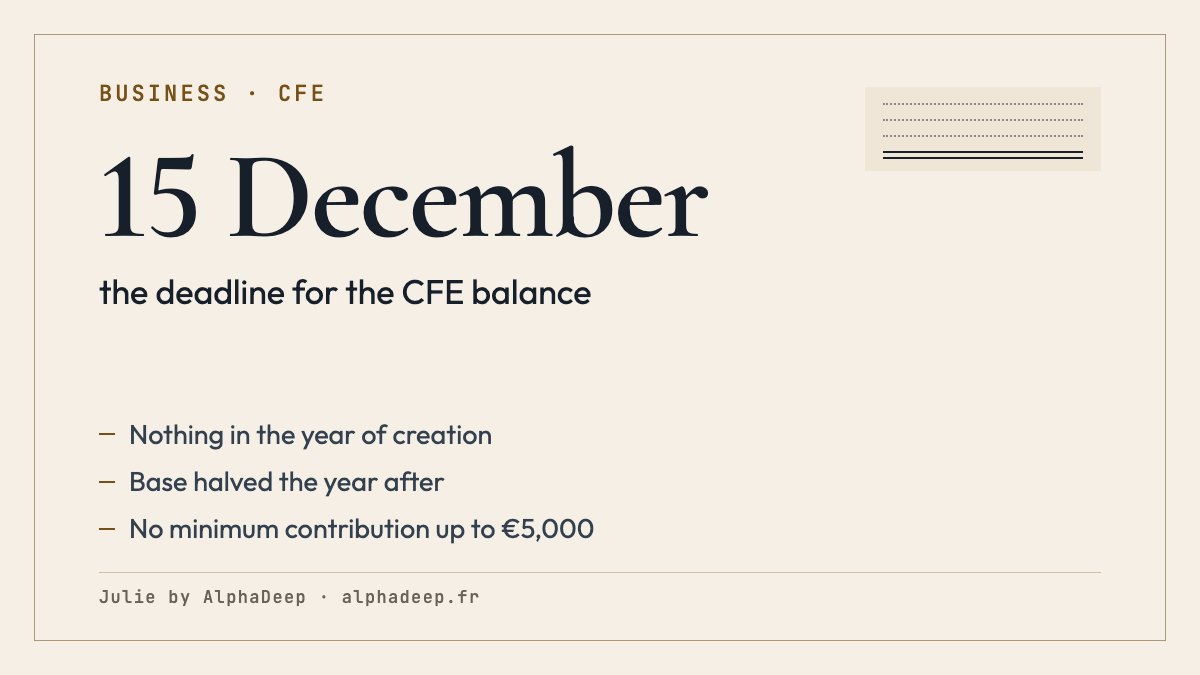
Usually by 15 December, by electronic means; a micro-entrepreneur pays the additional tax on the Urssaf site (sheets F23547 and F23999).
Ask for the cap
On request, within the claim period, the territorial economic contribution is capped at 1.531% of value added, without touching the minimum contribution (article 1647 B sexies).
Who has to pay the CFE?
Any person or company habitually carrying on a non-salaried professional activity, micro-entrepreneurs included, even at home or at clients’ premises (sheet F23547).
Without premises, a minimum contribution is set at the main establishment, often the home or the registered address (General Tax Code, article 1647 D).
Sources: Entreprendre F23547 · CGI, art. 1647 D
How is it worked out?
On the rental value of the property subject to property tax used for the business two years earlier: for 2026, the property of 2024 (article 1467; sheet F23547).
If that base is below the commune’s minimum base, the minimum base applies; the rate voted by the commune or intercommunal body then gives the amount (sheet F23547).
Sources: CGI, art. 1467 · Entreprendre F23547
Which exemptions for a new business?
No CFE in the year of creation, provided the 1447-C-SD return is sent before 31 December; the base is halved for the first year of taxation (article 1478; sheet F23999).
A turnover of €5,000 or less exempts from the minimum contribution, subject to the European de minimis aid rules (article 1647 D).
Sources: CGI, art. 1478 · Entreprendre F23999 · CGI, art. 1647 D
What do business owners in France ask about their CFE notice?
Is the CFE due without business premises?
Yes: a minimum contribution is set at the main establishment, unless turnover is €5,000 or less (article 1647 D).
Why do two communes give different CFE amounts?
Each commune votes its minimum base within the legal range and its rate: for the same turnover, the amount varies (sheet F23547).
Is the CFE due when the business stops?
Not for the remaining months after all activity in the establishment stops, except on a sale or transfer (article 1478).
Is the CFE the property tax?
No: property tax (taxe foncière) is owed by the property owner; the CFE is the business’s local tax on its activity (sheet F23547).
What does article 1478 of the French General Tax Code say?
The exempt year of creation and the halved base.
En cas de création d’un établissement autre que ceux mentionnés au III, la cotisation foncière des entreprises n’est pas due pour l’année de la création. Pour les deux années suivant celle de la création, la base d’imposition est calculée d’après les biens passibles de taxe foncière dont le redevable a disposé au 31 décembre de la première année d’activité. En cas de création d’établissement, la base du nouvel exploitant est réduite de moitié pour la première année d’imposition.
In English, briefly (our summary, not an official translation): When an establishment other than those in III is created, the CFE is not due for the year of creation. For the two years after the year of creation, the tax base is worked out from the property subject to property tax that the taxpayer had on 31 December of the first year of activity. When an establishment is created, the new operator’s base is halved for the first year of taxation. Our note: the minimum base and the exemption for turnovers of €5,000 or less are in article 1647 D.
Which texts does the CFE rest on?
- General Tax Code, article 1467 (CFE base)Légifrance
- General Tax Code, article 1478 (year of creation)Légifrance
- General Tax Code, article 1647 D (minimum base)Légifrance
- General Tax Code, article 1647 B sexies (cap)Légifrance
- Business property contribution (sheet F23547, in French)Entreprendre service-public · checked on 2 April 2026
- Must a micro-entrepreneur pay the CFE? (sheet F23999, in French)Entreprendre service-public · checked on 26 March 2026
Texts cited last checked: 27 September 2026