The statement of sumsStatement · Director’s dividends
Majority manager dividends in France: the 10% threshold of a SARL, the part subject to contributions and a statement of your distribution
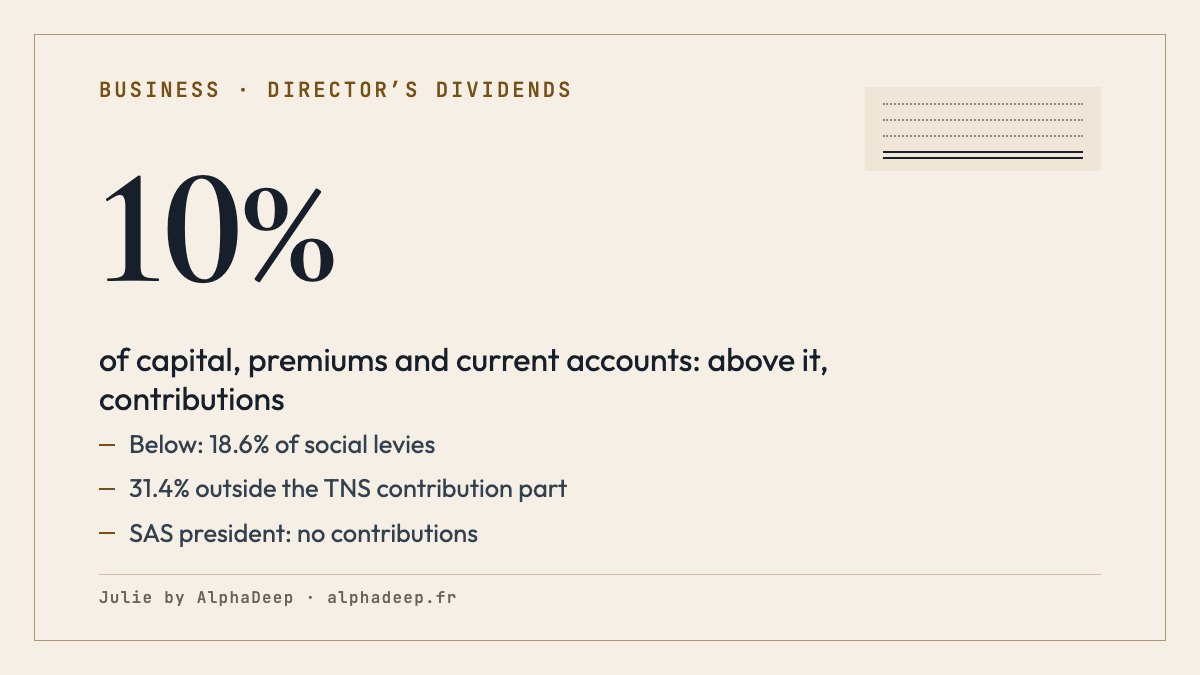
For a self-employed head of a French company paying corporation tax, such as the majority manager of a SARL, the part of the dividends above 10% of the share capital, issue premiums included, and of the shareholder current accounts held by them and their close family joins the contribution base (Social Security Code, article L136-3). The part below only bears social levies, 18.6% in 2026.
Go to the tool: the statement of sums
Julie by AlphaDeep is an AI legal assistant for French law: it researches official references to help answer your questions (Légifrance, case law, service-public), analyses your documents and drafts your letters, for individuals and professionals alike.
General legal information with official references and dated checks. It is not personalised advice: for a decision that commits you, have your situation checked by a qualified professional.

Let’s look at your situation
Give the company form, how the shares are split, the current account and the amount to distribute.
Example questions
Your question carries over after signup. Maximum 400 characters. Avoid health data and names.
Who pays contributions on their dividends?
Contributions on dividends depend on the director’s social status.
| Director | Part up to 10% | Part above 10% |
|---|---|---|
| Majority SARL manager, sole partner-manager of an EURL | Social levies of 18.6% | Self-employed contributions and CSG-CRDS |
| Minority or equal SARL manager | Social levies of 18.6% | Social levies of 18.6% |
| President of an SAS or SASU | Social levies of 18.6% | Social levies of 18.6% |
| Individual entrepreneur at corporation tax | Own reference amount: net profit or allocated assets | Self-employed contributions and CSG-CRDS |
| Income tax, in every case | 12.8% instalment unless valid dispensation, then final income tax | 12.8% instalment unless valid dispensation, then final income tax |
The minority or equal manager and the SAS president are treated as employees (sheets F36235 and F36007): the 10% rule, reserved for the self-employed, does not reach them.
Sources: CSS L136-3 · Entreprendre F36235 · Entreprendre F36007 · Entreprendre F32963
Which rates apply to dividends in 2026?
The threshold, the levies, the tax instalment and the allowance on the social base.
- Of the reference amount: above it, dividends join the contribution base
- 10%in force in 2026 · Social Security Code, article L136-3
- Social levies on dividends, of which 10.6% CSG
- 18.6%2026 · Service-public, sheet F2329
- Flat tax (PFU): 12.8% income tax and 18.6% levies
- 31.4%2026 · Entreprendre service-public, sheet F32963
- Allowance on the self-employed social base, with a floor and a ceiling
- 26%in force in 2026 · Social Security Code, article L136-3
Which part of your dividends bears contributions?
Choose your status and give the capital and premiums held by you and your close family, the average balance of your current accounts and the dividends distributed: the statement works out the 10% threshold, the part subject to contributions and the levies on the rest. The example: €20,000 of capital, €5,000 of premiums, a €15,000 current account and €25,000 of dividends.
Fictional example · the dividend statement
€21,000.00 of dividends join the self-employed contribution base.
- Reference amount
- €40,000.00
- 10% threshold
- €4,000.00
- Social levies of 18.6% under the threshold
- €744.00
- Income-tax instalment after any valid dispensation
- €3,200.00
- Dividends distributed to the householddirector, spouse and minor children€25,000.00€25,000.00
- Part under the 10% thresholdsocial levies only(€4,000.00)€21,000.00
Part subject to self-employed contributions€21,000.00
Dispensation only removes the instalment, not final income tax. Indicative result: the contributions depend on all your earned income, after the 26% allowance on the base, subject to its statutory floor and ceiling; your accountant confirms it.
How is the 10% threshold worked out?
The 10% threshold applies to a reference amount: the share capital, issue premiums included, held by the director, their spouse or Pacs partner and their minor children, plus the sums in their shareholder current accounts (Social Security Code, article L136-3).
Eligible capital includes fully paid cash contributions and in-kind contributions except intangible assets without a prior cash transaction or contribution-auditor valuation (R131-7). The current account counts at its average annual balance, and these amounts are assessed on the last day of the financial year before the distribution (article R131-7).
Sources: CSS L136-3 · CSS R131-7
What do you pay on the part above 10%?
The part above 10% joins the base for self-employed contributions and CSG-CRDS, like pay (articles L131-6 and L136-3).
That base gets a 26% allowance, with a floor and a ceiling set by decree (article L136-3, III); the contributions therefore depend on all your earned income.
Sources: CSS L131-6 · CSS L136-3
And on the part below the threshold?
The part below the threshold bears the social levies on capital income, 18.6% in 2026, like any shareholder’s dividends (sheet F32963; article L136-8).
Unless valid dispensation was requested by 30 November of the previous year (N−2 reference income below €50,000 single or €75,000 married/Pacs), a 12.8% income-tax instalment is withheld on payment from the gross dividends; they are then taxed under the PFU or, on option, under the scale after a 40% allowance (sheet F32963).
Sources: Entreprendre F32963 · CSS L136-8
What does article L136-3 of the French Social Security Code say?
The part of the dividends that joins the self-employed social base.
2° Sur la part des dividendes et des revenus mentionnés aux a et b de l’article 111, à l’article 111 bis et au 4° de l’article 124 du code général des impôts perçus par les travailleurs indépendants, leurs conjoints ou les partenaires auxquels ils sont liés par un pacte civil de solidarité ou leurs enfants mineurs non émancipés qui est supérieure à 10 % d’un montant de référence constitué du capital social, primes d’émission incluses, détenu en toute propriété ou en usufruit par ces mêmes personnes et des sommes inscrites dans leurs comptes courants d’associés.
III.-L’assiette résultant de l’application des I et II du présent article fait l’objet d’un abattement de 26 %.
In English, briefly (our summary, not an official translation): 2° On the part of the dividends and income referred to in a and b of article 111, article 111 bis and 4° of article 124 of the General Tax Code received by self-employed workers, their spouses or Pacs partners or their unemancipated minor children that exceeds 10% of a reference amount made up of the share capital, issue premiums included, held in full ownership or usufruct by the same people and of the sums in their shareholder current accounts. III. The base resulting from I and II of this article gets an allowance of 26%. Our note: the self-employed social security contributions rest on this same base (article L131-6).
What do French company heads ask before a distribution?
Is an SAS president concerned?
No: treated as an employee (sheet F36007), they are not self-employed; their dividends bear the 18.6% social levies, with no contributions.
Do the spouse’s dividends count?
Yes: those of the spouse or Pacs partner and of unemancipated minor children are added, like their capital and current accounts (article L136-3).
Should you take the current-account balance on the dividend date?
No: its average annual balance, the sum of each month’s average balances divided by the number of months in the financial year (article R131-7).
What is the flat tax on dividends in 2026?
For dividends subject to capital-income levies, 31.4% combines 12.8% income tax and 18.6% levies (F32963). This total does not describe the self-employed manager’s part above the 10% threshold, which bears earned-income contributions instead.
Which texts does the 10% rule rest on?
- Social Security Code, article L131-6 (self-employed contributions)Légifrance
- Social Security Code, article L136-3 (base and 10% threshold)Légifrance
- Social Security Code, article R131-7 (capital and current account counted)Légifrance
- Social Security Code, article L136-8 (CSG rates)Légifrance
- Tax on dividends received by shareholders (sheet F32963, in French)Entreprendre service-public · checked on 21 February 2026
- Social contributions in a SARL (sheet F36235, in French)Entreprendre service-public · checked on 21 February 2026
- Social contributions in an SAS (sheet F36007, in French)Entreprendre service-public · checked on 21 February 2026
- Social levies on property and investment income (sheet F2329, in French)Service-public · version of 30 June 2026, full text read on 30 September 2026
Texts cited last checked: 27 September 2026