The route finderSetting up a business · 2026
Choosing a business structure in France: EI, micro, EURL, SASU, SARL or SAS
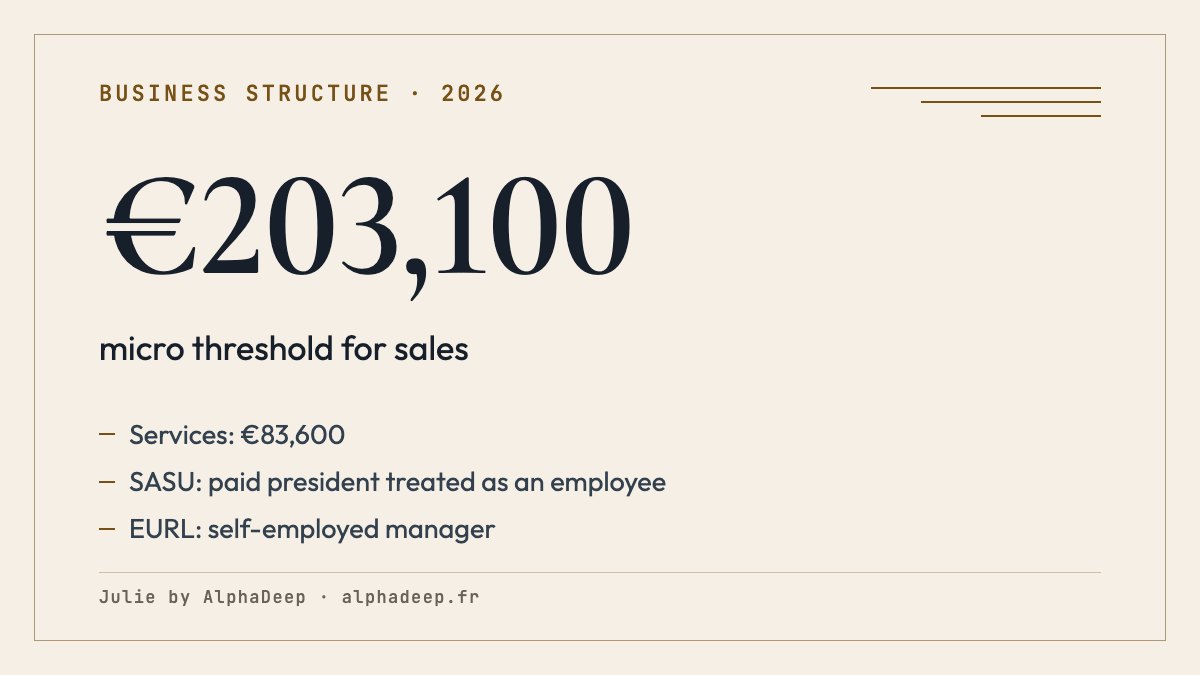
Choosing a sole trader, EURL, SASU, SARL or SAS depends on partners, taxation and the director’s social regime. In 2026, ordinary micro thresholds are €203,100 for sales and €83,600 for commercial or craft services (CGI 50-0). Accommodation, furnished letting and mixed activities have special rules. A yearly projection does not prove micro-regime exit; asset protection and employee-equivalent status also have conditions.
Go to the tool: the route finder
Julie by AlphaDeep is an AI legal assistant for French law: it researches official references to help answer your questions (Légifrance, case law, service-public), analyses your documents and drafts your letters, for individuals and professionals alike.
General legal information with official references and dated checks. It is not personalised advice: for a decision that commits you, have your situation checked by a qualified professional.

Let’s look at your situation
Describe your activity, your expected turnover and whether you are setting up alone.
Example questions
Your question carries over after signup. Maximum 400 characters. Avoid health data and names.
Which structure fits your project?
Say whether you are setting up alone or with partners, your activity, the expected turnover and your priority for the director: the route finder compares the possible forms on six criteria and flags the one that matches your answers. The example: a founder alone who sells goods and expects €60,000 of turnover. The result is indicative: confirm the ordinary-case conditions; a special case or unknown decisive fact prevents calculation.
Fictional example · business structure route finder
Sole trader under the micro regime: no capital, no articles, contributions calculated on the turnover received.
- Estimated social contributions, 12.3% of turnover
- €7,380 a year
| Criterion | Sole trader (EI), micro possibleYour case | EURL | SASU |
|---|---|---|---|
| Partners | You alone | A single partner | A single shareholder |
| Capital | None | Free; a fifth of cash contributions paid at creation, the rest within 5 years | Free; half of cash contributions paid at creation, the rest within 5 years |
| Liability | Professional estate, subject notably to security interests, waivers, fraud or serious breaches | Limited to contributions | Limited to contributions |
| Tax on profits | Income tax, micro or actual; corporate tax option | Income tax; corporate tax option | Corporate tax; income tax option limited to 5 financial years |
| Director’s social regime | Self-employed; micro-social scheme in a micro-enterprise | Self-employed | Treated as an employee if paid |
| Cost of setting up | €21.74 in trade; free in micro | €33.83 registration, €19.33 beneficial owners declaration and the legal notice | €33.83 registration, €19.33 beneficial owners declaration and the legal notice |
Indicative route finder for a commercial or craft activity; a regulated liberal profession has its own company forms.
Which figures matter when setting up a business in 2026?
Thresholds, costs and contributions published by Entreprendre Service Public and set by the codes.
| Point | 2026 figure | Text |
|---|---|---|
| Micro threshold, sales excluding furnished letting; accommodation needs a separate check | €203,100 of turnover excluding VAT | CGI 50-0 |
| Micro threshold, services | €83,600 | CGI 50-0 |
| Micro-entrepreneur contributions, sales | 12.3% of turnover received | CSS L613-7; F23844 |
| Setting up a commercial sole-trader business | €21.74; free in micro | Service-public F23844 |
| Registering a company | €33.83, plus €19.33 for beneficial owners and the legal notice | Service-public F23844 |
| Capital of a SARL or an EURL | Free; a fifth of cash contributions paid at creation, the rest within 5 years | C. com. L223-7 |
| Capital of a SAS or a SASU | Free; half of cash contributions paid at creation, the rest within 5 years | C. com. L225-3 and L227-1 |
| Provisional contributions of a self-employed person, first 2 years | 19% of the social security ceiling, that is €9,131 | Service-public F23844 |
| Charges of a director treated as an employee | About 60% of gross pay | Service-public F23844 |
The micro regime is lost only after 2 consecutive years above the threshold (service-public, fiche F32353).
Sources: CGI 50-0 · CSS L613-7 · Entreprendre Service Public F32353 · C. com. L223-7 · Entreprendre Service Public F23844
In which order should you settle the choice of structure?
Six questions, from the most structuring to the most technical.
Alone or with partners
Alone: sole trader, EURL or SASU; with partners: SARL, SAS, or SNC if the partners accept unlimited liability.
The expected turnover
Below €203,100 in sales or €83,600 in services, the micro regime remains open to the sole trader (General Tax Code, article 50-0).
Protecting your assets
A separate professional estate for the sole trader, losses limited to contributions in a company, except a personal guarantee or mismanagement.
The director’s social regime
Self-employed, with lower contributions, or treated as an employee, with the general scheme’s protection for about 60% in charges.
Taxing the profits
Income tax by default for the sole trader and the EURL, corporate tax for the SARL and the SAS, with restricted options.
Costs and formalities
Articles, capital, legal notice and filing of accounts for a company; lighter formalities for the sole trader.
Should you set up a company or stay a sole trader?
The sole trader works in their own name, with no capital or articles; the assets used for the activity form a professional estate separate from the personal estate (Commercial Code, article L526-22). The tax authorities and the Urssaf can still pursue both estates in case of fraudulent manoeuvres or serious and repeated breaches (article L526-24).
A company, an EURL or a SASU for a single partner, limits losses to the contributions (articles L223-1 and L227-1), at the cost of articles, a paid registration, a legal notice and accounts to approve then file every year, according to Entreprendre Service Public. The director remains liable for mismanagement or a personal guarantee.
Sources: C. com. L526-22 · C. com. L227-1 · Entreprendre Service Public F23844
Does the micro option change the choice of legal form?
The micro regime applies as long as the turnover excluding VAT of the previous year or the year before does not exceed €203,100 for ordinary sales excluding furnished letting, €83,600 for commercial or craft services; accommodation, furnished letting and mixed activities require a separate check (General Tax Code, article 50-0); it is lost only after 2 consecutive years above the threshold, according to Entreprendre Service Public.
Contributions are calculated each month or each quarter on the turnover received (Social Security Code, article L613-7): 12.3% for the sale of goods, nothing if turnover is zero, according to Entreprendre Service Public. The accounts come down to a receipts book, and registration is free, except for commercial agents. For declaration questions, use the micro-enterprise operations guide in French; the current comparison thresholds and their limits are stated above.
Sources: CGI 50-0 · CSS L613-7 · Entreprendre Service Public F23844 · Entreprendre Service Public F23961
SASU or EURL: which social regime for the director?
The president of a SASU or a SAS is treated as an employee: they contribute to the general scheme at about 60% of gross pay, pay nothing if they draw no pay, but have no right to unemployment insurance, according to Entreprendre Service Public. The SASU is subject to corporate tax, with an income tax option limited to 5 financial years; the EURL to income tax, with a corporate tax option.
The single-partner manager of an EURL and the majority manager of a SARL come under the social security scheme for the self-employed: for the first 2 years, their provisional contributions are calculated on 19% of the social security ceiling, that is €9,131 in 2026, with no payment during the first 90 days. A minority SARL manager is treated as an employee.
What does article L526-22 of the Commercial Code provide?
Article L526-22 is the text of the sole trader’s professional estate, created in 2022.
L’entrepreneur individuel est une personne physique qui exerce en son nom propre une ou plusieurs activités professionnelles indépendantes.
Les biens, droits, obligations et sûretés dont il est titulaire et qui sont utiles à son activité ou à ses activités professionnelles indépendantes constituent le patrimoine professionnel de l’entrepreneur individuel. […] Les éléments du patrimoine de l’entrepreneur individuel non compris dans le patrimoine professionnel constituent son patrimoine personnel.
In English, briefly (our summary, not an official translation): The sole trader is a natural person who carries on one or more independent professional activities in their own name. The property, rights, obligations and securities they hold that are used for their independent professional activity or activities make up the sole trader’s professional estate; the rest of their assets make up their personal estate. The lien of the tax authorities and social security bodies can extend to the personal estate in case of fraud or serious and repeated breaches (article L526-24).
What do founders ask before registering?
How much capital do you need for a SASU or an EURL?
The amount is free. At creation, at least half of the cash contributions must be paid up for a SAS or a SASU, a fifth for a SARL or an EURL, and the rest within 5 years (Commercial Code, articles L225-3, L227-1 and L223-7).
How much does setting up a business cost?
€21.74 for a commercial sole-trader business and nothing for a micro-enterprise; for a company, €33.83 of registration on the formalities portal, €19.33 for the beneficial owners declaration and the price of the legal notice (Entreprendre Service Public, fiche F23844).
Can you change structure later?
Yes: the legal form can be changed during the company’s life, according to Entreprendre Service Public, which details the questions to ask before turning a sole-trader business into a company.
Can a foreign national be a sole trader?
A national of a country outside the European Union, the European Economic Area and Switzerland must hold a residence permit that allows them to work under this status (Commercial Code, article L526-22).
What do the partners of an SNC risk?
They all have the status of trader and are liable without limit, jointly and severally, for the company’s debts, after a formal notice to the company has gone unheeded (Commercial Code, article L221-1).
Which texts are these comparisons based on?
- Commercial Code, article L526-22 (sole trader, professional estate)Légifrance, in French
- Commercial Code, articles L223-1, L227-1 and L526-24 (limited liability, lien)Légifrance, in French
- Commercial Code, articles L223-7 and L225-3 (paying up the capital)Légifrance, in French
- Choosing the legal form of your business (fiche F23844)Entreprendre Service Public, in French · checked by the publisher on 10 April 2026
- General Tax Code, article 50-0 (micro regime thresholds)Légifrance, in French
- Social Security Code, article L613-7 (micro-entrepreneur contributions)Légifrance, in French
- What happens to a micro-entrepreneur who exceeds the thresholds? (fiche F32353)Entreprendre Service Public, in French · checked by the publisher on 21 February 2026
- How to become a micro-entrepreneur (fiche F23961)Entreprendre Service Public, in French · checked by the publisher on 15 September 2025
- Commercial Code, article L221-1 (SNC partners)Légifrance, in French
- General Tax Code, article 1655 sexies (sole trader’s corporate tax option)Légifrance, in French
Texts cited last checked: 25 September 2026