The filing deskBusiness, association or personal websites
Legal notice on a French website: the compulsory list by status
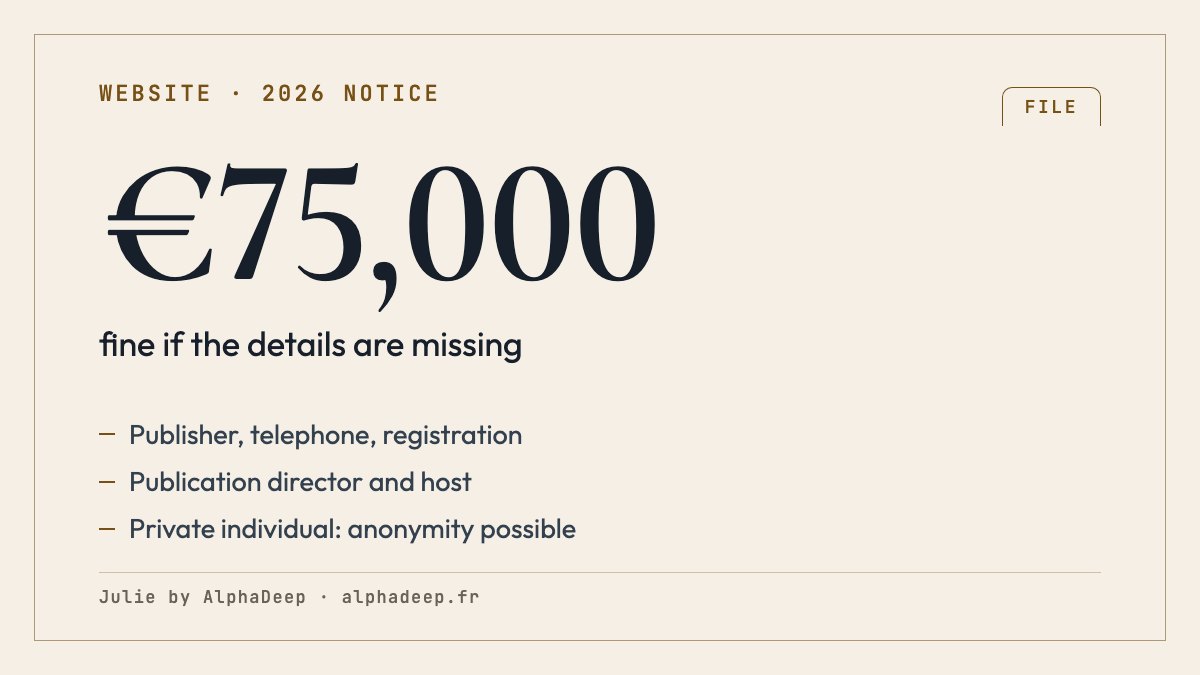
Since the law of 21 May 2024, article 1-1 of the law of 21 June 2004 on confidence in the digital economy (LCEN) sets the details a French website must show. A professional displays their name or company name, address, telephone, registration number if any, the publication director and the host. An individual can stay anonymous by giving their identity to the host. Leaving them out is punishable by one year’s imprisonment and a €75,000 fine.
Go to the tool: the filing desk
Julie by AlphaDeep is an AI legal assistant for French law: it researches official references to help answer your questions (Légifrance, case law, service-public), analyses your documents and drafts your letters, for individuals and professionals alike.
General legal information with official references and dated checks. It is not personalised advice: for a decision that commits you, have your situation checked by a qualified professional.

Let’s look at your situation
Give your status, your activity and whether the site sells online.
Example questions
Your question carries over after signup. Maximum 400 characters. Avoid health data and names.
Which details should you show depending on the publisher’s status?
The law distinguishes individuals from legal persons, then professionals from private individuals. The columns below apply this to the four usual situations.
| Detail | Private individual | Sole trader | Company | Association |
|---|---|---|---|---|
| Name or company name | Optional if anonymous | Name followed by "EI" (entrepreneur individuel) | Company name | Name of the association |
| Address | Home, unless anonymous | Home | Registered office | Registered office |
| Telephone | Yes, unless anonymous | Yes | Yes | Yes |
| Registration | No | RCS or trades register number, if registered | RCS, registry town and SIREN number | No |
| Share capital | No | No | Yes | No |
| Publication director | No if anonymous | The trader | The legal representative | The legal representative |
| Host | Name and address; telephone unless anonymous | Name, address, telephone | Name, address, telephone | Name, address, telephone |
| Data storage for publishing the service | As applicable, subject to the anonymity regime | Provider identity and address, if applicable | Provider identity and address, if applicable | Provider identity and address, if applicable |
| Online shop: email, VAT, mediator | Not applicable | Yes | Yes | Yes, if the association sells online |
A registered business adds on its website the RCS mention followed by the registry town, its identification number and its registered office (Commercial Code, article R123-237).
Sources: LCEN, art. 1-1 · LCEN, art. 19 · C. com. R123-237
Which block of details should you publish on your website?
Choose your status and fill in what you know: the block builds line by line, with brackets for what remains to be completed. The example is an SAS selling online to consumers.
Fictional example · legal notice to publish
Company: company name, capital, registered office, telephone, registration, publication director and host.
LEGAL NOTICE
Site publisher
[company name], SAS with a share capital of €[amount]
Registered office: [registered office address]
Telephone: [number]
Email: [email address]
Registration: RCS [registry town and SIREN number]
EU VAT number: [number]
Publication director: [name of the legal representative]
Host
[name, address and telephone of the host]
Consumer mediator
[name and contact details of the mediator], [address of its website]
Online shop: also add your general terms of sale and, for sales concluded online, the withdrawal function required since 19 June 2026.
This model is not exhaustive: add the identity and address of applicable providers storing data processed for publishing the service (LCEN, article 1-1, I, 5°).
What has changed for website legal notices since 2022?
Three texts changed what a publisher displays or offers on its site.
New sole trader status: the business name includes the trader’s name, preceded or followed by the words "entrepreneur individuel" or the initials "EI", and appears on business documents (Commercial Code, articles R526-27 and R123-237, decree no. 2022-725 of 28 April 2022).
Source: C. com. R123-237
Law no. 2024-449 of 21 May 2024 (article 48) moves the identification duties from article 6 to article 1-1 of the law of 21 June 2004, adds where relevant the identity of whoever stores the data processed for publishing the service, and places the penalties in article 1-2.
Source: LCEN, art. 1-1
For a contract concluded online with a consumer, the site provides, free of charge, a function for exercising the right of withdrawal before the period ends (Consumer Code, article L221-21, ordinance no. 2026-2 of 5 January 2026).
Source: C. conso. L221-21
Which details should you add when the site sells online?
A site offering goods or services at a distance, including through mere commercial communications, is e-commerce (article 14 of the law of 21 June 2004). It gives easy, direct and permanent access to its address, email, telephone, registration and, if it is liable for VAT, its individual identification number (article 19).
Towards consumers, add the details of the consumer mediator and the address of its website (Consumer Code, articles L616-1 and R616-1), the pre-contract information of the general terms of sale and, since 19 June 2026, the online withdrawal function (article L221-21).
Sources: LCEN, art. 19 · C. conso. L221-21
What does a website without a legal notice risk?
A publisher who is an individual, or the legal or de facto manager of a company, faces one year’s imprisonment and a €75,000 fine (article 1-2 of the law of 21 June 2004). The company faces a fine five times higher, a ban of up to five years on the activity concerned and publication or display of the decision.
On the website of a registered business, leaving out the RCS mention, the identification number or the registered office is a class 4 petty offence, up to €750 (Commercial Code, article R123-237; Criminal Code, article 131-13).
Sources: LCEN, art. 1-1 · C. com. R123-237 · C. pén. 131-38
Who must be named publication director?
Every website must have a publication director (article 93-2 of the law of 29 July 1982). For a legal person, it is the chair of the management board or board of directors, the manager or the legal representative, depending on its form; for an individual, it is that person.
The director must be of age and enjoy their civil rights; a minor aged 16 or over can, however, direct a publication produced on a voluntary basis. Requests for a right of reply are addressed to the director (article 1-1, III, of the law of 21 June 2004).
Sources: Law of 1982, art. 93-2 · LCEN, art. 1-1
What does article 1-1 of the law on confidence in the digital economy say?
Article 1-1 of the LCEN is the reference list since 23 May 2024; points 1° to 4° apply to every professional publisher.
I.-Les personnes dont l’activité est d’éditer un service de communication au public en ligne mettent à la disposition du public, dans un standard ouvert :
1° S’il s’agit de personnes physiques, leurs nom, prénoms, domicile et numéro de téléphone et, si elles sont assujetties aux formalités d’inscription au registre du commerce et des sociétés ou au registre national des entreprises en tant qu’entreprise du secteur des métiers et de l’artisanat, le numéro de leur inscription ;
2° S’il s’agit de personnes morales, leur dénomination ou leur raison sociale et leur siège social, leur numéro de téléphone et, s’il s’agit d’entreprises assujetties aux formalités d’inscription au registre du commerce et des sociétés ou au registre national des entreprises en tant qu’entreprise du secteur des métiers et de l’artisanat, le numéro de leur inscription, leur capital social et l’adresse de leur siège social ;
3° Le nom du directeur ou du codirecteur de la publication, au sens de l’article 93-2 de la loi n° 82-652 du 29 juillet 1982 sur la communication audiovisuelle et, le cas échéant, celui du responsable de la rédaction ;
4° Le nom, la dénomination ou la raison sociale, l’adresse et le numéro de téléphone du fournisseur de services d’hébergement ; (…)
II.-Les personnes éditant à titre non professionnel un service de communication au public en ligne peuvent ne tenir à la disposition du public, pour préserver leur anonymat, que le nom, la dénomination ou la raison sociale et l’adresse du fournisseur de services d’hébergement, sous réserve d’avoir communiqué à ce fournisseur les éléments d’identification personnelle mentionnés au I du présent article.
In English, briefly (our summary, not an official translation): People whose activity is publishing an online public communication service make available to the public, in an open standard: for individuals, their surname, first names, home address and telephone number and, if registered in the trade and companies register or the national business register as a trades and crafts business, their registration number; for legal persons, their company name, registered office and telephone number and, if registered, their registration number, share capital and registered office address; the name of the publication director within the meaning of article 93-2 of the law of 29 July 1982 and, where relevant, of the editor-in-chief; the name, company name, address and telephone number of the hosting provider. Under II, non-professional publishers can, to stay anonymous, show only the host’s name and address, provided they gave the host their identity. Point 5, not reproduced, covers those who store the data processed for publishing the service; the host is bound by professional secrecy on an anonymous publisher’s identity, except towards the judicial authority.
Which questions come up before putting a website online?
Must a private individual show their name on their website?
No, if they publish the site on a non-professional basis: they can show only the name and address of their host, provided they gave the host their identity (article 1-1, II, of the law of 21 June 2004). As soon as the site serves a professional activity, anonymity is no longer possible.
What is the difference between the legal notice, terms of use and terms of sale?
The legal notice identifies the publisher and the host: every site shows it. The general terms of sale carry the information owed to consumers before a purchase (Consumer Code, articles L111-1 and L221-5). The terms of use, optional for a showcase site, set the rules for using the site.
Where should the legal notice go on the site?
The law sets no place: it requires the information to be made available to the public in an open standard and, for an online shop, accessible in an easy, direct and permanent way (articles 1-1 and 19 of the law of 21 June 2004). The usual practice is a "Mentions légales" link in the footer of every page.
Must you show the EU VAT number?
Yes for an e-commerce site whose operator is liable for VAT and identified by an individual number (article 19, 4°, of the law of 21 June 2004). A business with no individual VAT identification number has nothing to show on this point.
Must you mention a consumer mediator?
Yes, as soon as you sell to consumers: the details of the mediator or mediators you come under, with the address of their website, appear visibly and legibly on your site, your general terms or your order forms (Consumer Code, articles L616-1 and R616-1).
Which texts set the details of a website’s legal notice?
- Law no. 2004-575 of 21 June 2004 on confidence in the digital economy, articles 1-1 and 1-2Légifrance, in French
- Law no. 2004-575 of 21 June 2004, articles 14 and 19 (e-commerce)Légifrance, in French
- Commercial Code, articles R123-237 and R526-27 (details of a registered business and of a sole trader)Légifrance, in French
- Law no. 82-652 of 29 July 1982, article 93-2 (publication director)Légifrance, in French
- Consumer Code, articles L111-1, L221-5, L221-21, L616-1 and R616-1Légifrance, in French
- Criminal Code, articles 131-13, 131-38 and 131-39 (fine amounts, penalties for legal persons)Légifrance, in French
Texts cited last checked: 24 September 2026