The calendarBusiness in difficulty · insolvency proceedings
Insolvency filing in France: the 45-day time limit, the filing and the date the court sets
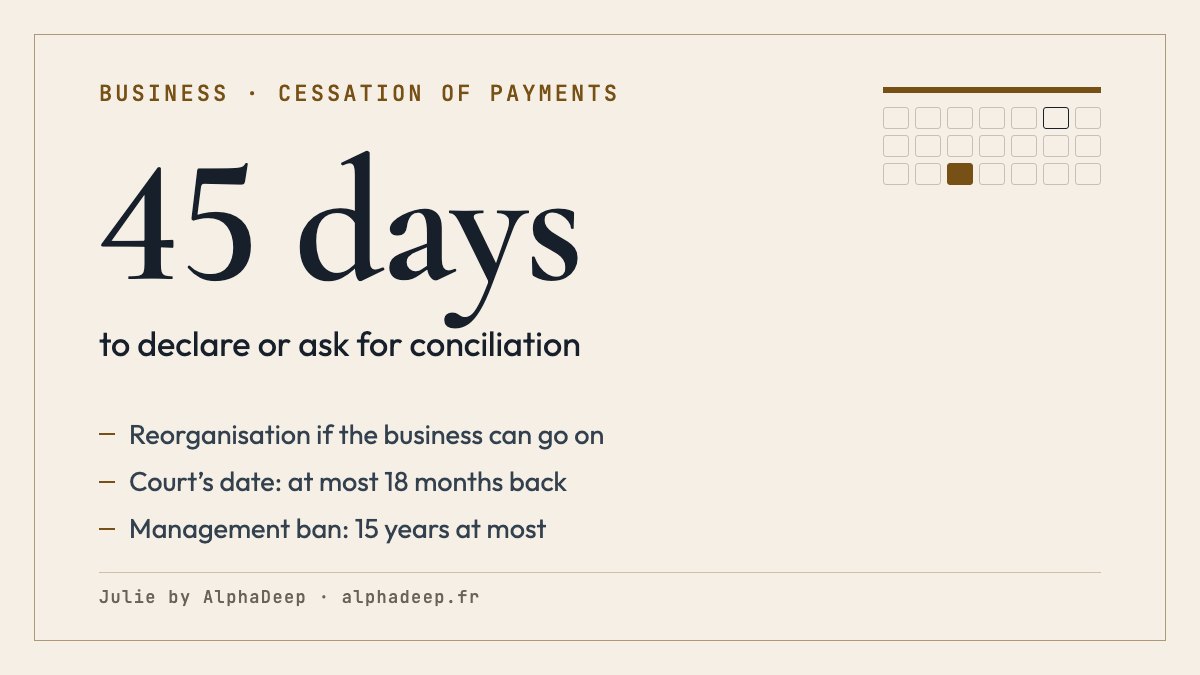
A French business is in cessation of payments (cessation des paiements) when its available assets no longer cover its due liabilities, taking credit reserves and agreed payment delays into account (Commercial Code, article L631-1). It must then ask the court registry for reorganisation or judicial liquidation within 45 days, unless it asks for a conciliation within that time (article L631-4). The court then fixes the cessation date, up to 18 months back.
Julie by AlphaDeep is an AI legal assistant for French law: it researches official references to help answer your questions (Légifrance, case law, service-public), analyses your documents and drafts your letters, for individuals and professionals alike.
General legal information with official references and dated checks. It is not personalised advice: for a decision that commits you, have your situation checked by a qualified professional.

Let’s look at your situation
Describe the cash position, the overdue debts and the activity, without the company’s name.
Example questions
Your question carries over after signup. Maximum 400 characters. Avoid health data and names.
When is a business in cessation of payments?
When it can no longer meet its due liabilities with its available assets (Commercial Code, article L631-1): due, certain and quantified debts whose payment creditors can demand immediately exceed its cash and what it can raise at once. A debtor who proves that credit reserves or delays granted by creditors allow it to pay is not in cessation of payments.
For a sole trader, this is assessed, where relevant, on the business estate alone. An asset the business cannot turn into cash at once, such as premises or equipment, is not part of the available assets.
Sources: C. com. L631-1 · Entreprendre Service Public F22352
Within which time limit must the cessation of payments be declared?
At the latest within the 45 days that follow the cessation of payments, unless the business has asked within that time for a conciliation (Commercial Code, articles L631-4 and L640-4). The time limit runs from the real date of the cessation, not from the judgment. For filing, an expiry on a Saturday, Sunday, public holiday or non-working day extends to the next working day (R662-1 and CPC article 642).
The request is filed at the court registry: the commercial court for a commercial or craft activity, the judicial court for a liberal or farming activity, and the economic activities court in 12 cities since 1 January 2025, according to Entreprendre Service Public. The regulated legal professions stay at the judicial court.
Sources: C. com. L631-4 · C. com. L640-1 · Entreprendre Service Public F22352 · C. com. L640-4 · C. com. R662-1 · CPC 642
Reorganisation or judicial liquidation: which should you ask for?
Judicial reorganisation (redressement judiciaire) aims to continue the business, keep jobs and pay off the liabilities (Commercial Code, article L631-1). Liquidation is opened only if reorganisation is manifestly impossible: it ends the business or sells the debtor’s assets (article L640-1).
The request states the procedure wanted, but the court opens one or the other, in the light of the business’s real situation.
Sources: C. com. L631-1 · C. com. L640-1
Which cessation of payments date does the court set?
The court fixes the date after asking for the debtor’s observations; failing that, the cessation of payments is deemed to have occurred on the day of the opening judgment (Commercial Code, article L631-8).
It can be moved back once or several times, but not more than 18 months before the judgment nor, except in case of fraud, before the final decision approving an amicable agreement. The administrator, judicial representative or public prosecutor requests a change within the year after the judgment. On conversion from safeguard, backdating uses the safeguard opening judgment, and the one-year request period starts on conversion.
Source: C. com. L631-8
Until when must you declare, and before which court?
Give the date of the cessation of payments, the activity and, if the court has already ruled, the date of the judgment: the calendar places the filing deadline, extended if needed, the court for the stated activity and a theoretical 18-month marker, to check for a prior approved agreement or conversion from safeguard. The example: a shop in cessation of payments on 10 January 2026, opening judgment on 30 April 2026.
Fictional example · cessation of payments calendar
Proceedings already open: the filing deadline was 24 February 2026 before the commercial court.
| M | T | W | T | F | S | S |
|---|---|---|---|---|---|---|
| 1 | 2 | 3 | 4 | 5 | 6 | |
| 7 | 8 | 9 | 10 | 11 | 12 | 13 |
| 14 | 15 | 16 | 17 | 18 | 19 | 20 |
| 21 | 22 | 23 | 24 | 25 | 26 | 27 |
| 28 | 29 | 30 | 31 |
| M | T | W | T | F | S | S |
|---|---|---|---|---|---|---|
| 1 | ||||||
| 2 | 3 | 4 | 5 | 6 | 7 | 8 |
| 9 | 10 | 11 | 12 | 13 | 14 | 15 |
| 16 | 17 | 18 | 19 | 20 | 21 | 22 |
| 23 | 24 | 25 | 26 | 27 | 28 |
| M | T | W | T | F | S | S |
|---|---|---|---|---|---|---|
| 1 | 2 | 3 | 4 | 5 | ||
| 6 | 7 | 8 | 9 | 10 | 11 | 12 |
| 13 | 14 | 15 | 16 | 17 | 18 | 19 |
| 20 | 21 | 22 | 23 | 24 | 25 | 26 |
| 27 | 28 | 29 | 30 |
- Theoretical marker: 18 months before judgment
- Cessation of payments
- Filing deadline, including extension
- Opening judgment
National public holidays are counted; check local holidays and other non-working days with the registry.
A conciliation request has its own condition: no more than 45 days of cessation, here 24 February 2026; do not automatically apply the filing extension to it.
Theoretical marker 18 months before judgment: 30 October 2024. This is not the earliest legally available date: except for fraud, a prior final approval of an agreement may limit backdating; conversion from safeguard uses the safeguard opening judgment. Check those situations and the judgment, which sets the date.
Cessation date to assess from the accounts; the court fixes the real date after hearing the debtor’s observations.
Which documents go with the request to open proceedings?
These are the main documents; check the full R631-1 list, including additions for status, the CSE, professional body or regulated installations. Only items 1°, 5°, 6°, 7° and 8° must date from the request or previous 7 days; the cash position must be under one month old. Date, sign and certify the documents; explain any missing or incomplete document. For liquidation, also attach evidence that reorganisation is manifestly impossible (R640-1).
- Document 1
Declaration of cessation of payments
Form Cerfa no. 10530, with the statement of due liabilities and available assets.
- Document 2
Annual accounts of the last financial year
And a cash position less than one month old.
- Document 3
Costed statement of claims and debts
With the creditors’ names and addresses, and the total owed to employees.
- Document 4
Employees and turnover
The number, names and addresses of the employees, and the turnover of the last financial year.
- Document 5
Securities, off-balance-sheet commitments, inventory
The statement of securities and off-balance-sheet commitments, and a summary inventory of the assets.
- Document 6
Sworn statement
No ad hoc mandate or conciliation in the previous 18 months, or their date and the authority that opened them.
Which time limits frame the cessation of payments?
From the first day of the cessation to any sanction on the manager.
| Time limit | Starting point | Text |
|---|---|---|
| 45 days to ask for reorganisation or liquidation | The cessation of payments | C. com. L631-4 and L640-4 |
| At most 45 days of cessation to obtain a conciliation | The cessation of payments | C. com. L611-4 |
| 4 months, reasoned extension to 5 months; longer if recording or approval requested in time | The appointment | C. com. L611-6 |
| At most 18 months of moving back the cessation date | The opening judgment, going back; check prior approval and conversion from safeguard | C. com. L631-8 |
| 1 year to ask for that date to be changed | The opening judgment; conversion if safeguard | C. com. L631-8 |
| At most 15 years of a management ban | If the court imposes it | C. com. L653-11 |
The management ban is not automatic: it targets a person who knowingly failed to ask for the proceedings to be opened within 45 days, without asking for a conciliation (Commercial Code, article L653-8).
Sources: C. com. L631-4 · C. com. L611-4 · Entreprendre Service Public F22295 · C. com. L631-8 · C. com. L653-8 · C. com. L640-4 · C. com. L653-11 · C. com. L611-6
What does article L631-4 of the Commercial Code say about the 45 days?
The text that obliges the debtor to act and provides the conciliation exception.
L’ouverture d’une procédure de redressement judiciaire doit être demandée par le débiteur au plus tard dans les quarante-cinq jours qui suivent la cessation des paiements s’il n’a pas, dans ce délai, demandé l’ouverture d’une procédure de conciliation.
In English, briefly (our summary, not an official translation): The debtor must ask for judicial reorganisation proceedings to be opened at the latest within the forty-five days that follow the cessation of payments, unless it has asked within that time for a conciliation. The same 45-day time limit applies to a request for judicial liquidation (article L640-4).
What do managers of struggling businesses ask?
Does asking for a conciliation avoid declaring the cessation of payments?
Yes, if the conciliation is requested within the 45 days: it is the exception provided by article L631-4 of the Commercial Code. The conciliator is appointed for up to 4 months, with a reasoned extension to 5 months; a request to record or approve the agreement made before expiry extends the mission and procedure until the decision (L611-6). The procedure stays confidential unless the agreement is approved.
Who must file the request at the registry?
The company’s legal representative, or the entrepreneur personally if working in their own name, at the registry of the competent court (Commercial Code, article R631-1).
What does a manager who files late risk?
The court can impose a management ban on a person who knowingly failed to ask for the opening within 45 days, without a conciliation; it sets the length, 15 years at most (Commercial Code, articles L653-8 and L653-11).
Can a farmer ask for a conciliation?
No: conciliation does not apply to farmers, who have their own procedure, the amicable settlement (règlement amiable), according to Entreprendre Service Public.
Which texts is this cessation of payments calendar based on?
- Commercial Code, article L631-1 (cessation of payments, judicial reorganisation)Légifrance, in French
- Commercial Code, article L631-4 (45-day time limit)Légifrance, in French
- Commercial Code, article L640-1 (conditions for judicial liquidation)Légifrance, in French
- Commercial Code, article L611-4 (conciliation)Légifrance, in French
- Commercial Code, article L631-8 (cessation of payments date)Légifrance, in French
- Commercial Code, article R631-1 (request to open proceedings and documents)Légifrance, in French
- Commercial Code, article L653-8 (grounds for a management ban)Légifrance, in French
- Commercial Code, article L640-4 (liquidation filing deadline)Légifrance, in French
- Commercial Code, article L653-11 (length of management ban)Légifrance, in French
- Commercial Code, article L611-6 (conciliator’s mission)Légifrance, in French
- Commercial Code, article R662-1 (procedural rules)Légifrance, in French
- Civil Procedure Code, article 642 (time limit extensions)Légifrance, in French
- Commercial Code, article R640-1 (liquidation documents)Légifrance, in French
- Declaration of cessation of payments, filing for insolvency (fiche F22352)Entreprendre Service Public, in French · checked by the publisher on 1 January 2025
- Conciliation procedure (fiche F22295)Entreprendre Service Public, in French · checked by the publisher on 1 January 2025
Texts cited last checked: 26 September 2026