Housing and property · Condominium · arrears
Unpaid condominium charges in France: the steps to recover the debt
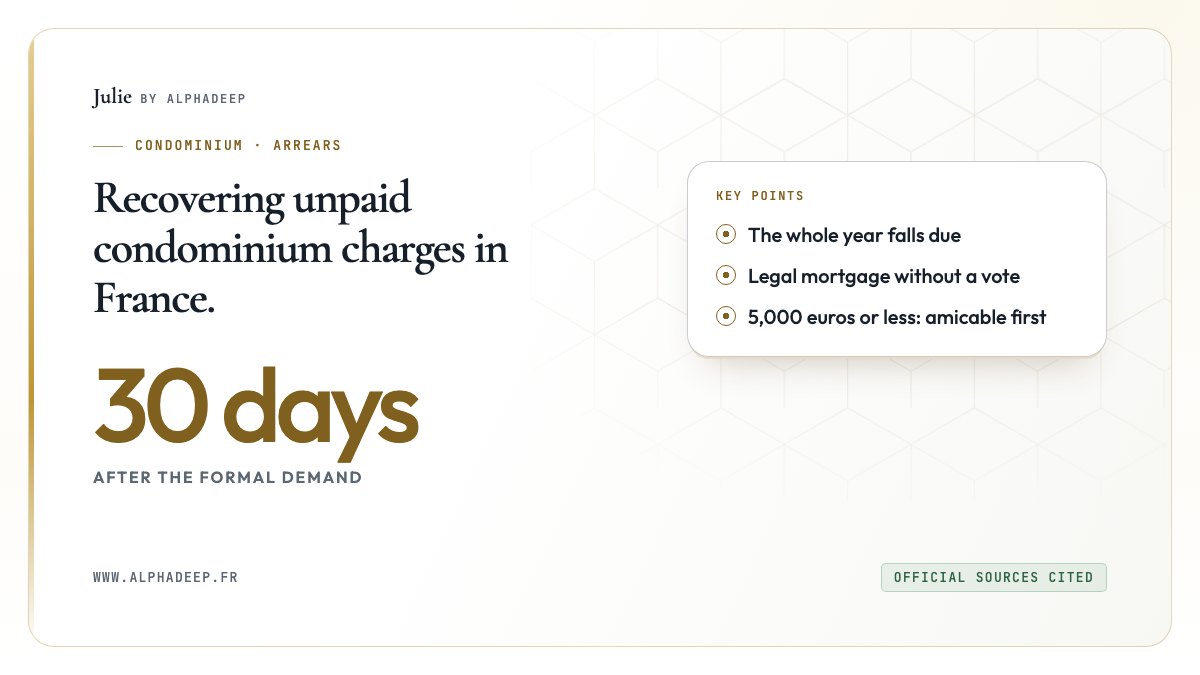
When a co-owner does not pay their provisions, the syndic sends a formal demand. Thirty days later with no payment, the rest of the year’s provisions and approved arrears fall due, and the syndicate can go to the tribunal judiciaire under the accelerated procedure (article 19-2 of the law of 10 July 1965). Necessary recovery costs are charged to the debtor. The syndicate also holds a legal mortgage on the unit.
- The whole year falls due
- Legal mortgage without a vote
- 5,000 euros or less: amicable first
- Official texts cited
- Sources checked on
- Drafted with AI assistance, our method
General legal information with official references and dated checks. It is not personalised advice: for a decision that commits you, have your situation checked by a qualified professional.
Julie by AlphaDeep
A co-owner keeps missing payments: I can work out what is now due and draft the formal demand.
3 free questions at signup. Avoid names and sensitive information.
What can you do when a co-owner does not pay?
The syndic acts without a meeting vote to recover a debt. After a call for funds goes unpaid, the syndic serves a formal demand; if it goes unanswered for thirty days, the year’s provisions not yet due, prior years’ arrears with approved accounts and works fund contributions all fall due at once.
The syndic can then register the syndicate’s legal mortgage on the lot and go to court for an enforceable order.
Décret n° 67-223 du 17 mars 1967, article 55Loi n° 65-557 du 10 juillet 1965, article 19-2Loi n° 65-557 du 10 juillet 1965, article 19
Which recovery steps come first, in order?
The recovery steps, from reminder to judgment, in the order the syndic takes them.
An unpaid call for funds
Budget provisions fall due on the first day of each quarter, unless another schedule was voted.
The formal demand
Electronically by default, by registered post if the co-owner asked for postal delivery. Interest at the legal rate runs from that date.
Décret n° 67-223 du 17 mars 1967, article 64Décret n° 67-223 du 17 mars 1967, article 64-1Décret n° 67-223 du 17 mars 1967, article 36
Thirty days without an answer
The rest of the year, approved arrears and works fund contributions fall due.
The legal mortgage
Registered by the syndic without a meeting vote, never for debts due more than five years.
The amicable attempt
For 5,000 euros or less: conciliation, mediation, a participatory procedure, or the small-claims procedure through a commissaire de justice.
Code de procédure civile, article 750-1Code des procédures civiles d’exécution, article L125-1Code des procédures civiles d’exécution, article R125-1
The court
The president of the civil court, under the accelerated procedure, orders the defaulting co-owner to pay.
Enforcement
Seizures need no vote; only seizure to sell the lot needs a meeting decision, in which the debtor does not vote.
Décret n° 67-223 du 17 mars 1967, article 55Loi n° 65-557 du 10 juillet 1965, article 19-2
What can you claim, and from when?
Enter the quarterly provision and the unpaid quarters: the tool works out the sums payable thirty days after the formal demand and the right court route.
Fictional example · sums payable
€2,025 becomes payable if the formal demand goes unanswered for thirty days. Under 5,000 euros, an amicable attempt or the small-claims procedure comes before court.
- Overdue provisions and works fund
- €950
- Future quarters brought forward
- €475
- Approved arrears
- €600
- Total payable
- €2,025
- Payable from
- 5 November 2026
Formal-demand and recovery costs are added, charged to the debtor alone, plus interest at the legal rate from the formal demand.
What must the formal demand say, and how is it sent?
No set form applies: it demands payment of the sums due, itemised, and starts both the thirty-day period and interest at the legal rate. Since 25 December 2025 it goes electronically, by registered e-mail or through a qualified trust provider; registered post with receipt is used only if the co-owner asked for postal delivery.
The period runs from the day after the electronic notice is sent, or the day after the letter is first presented at the home.
Décret n° 67-223 du 17 mars 1967, article 64Décret n° 67-223 du 17 mars 1967, article 64-1Décret n° 67-223 du 17 mars 1967, article 36Loi n° 65-557 du 10 juillet 1965, article 19-2
Must you try conciliation before suing over unpaid charges?
Yes, for a claim of 5,000 euros or less: on pain of inadmissibility, court action must follow an attempt at conciliation, mediation or a participatory procedure, unless there is a legitimate reason such as clear urgency. A failed small-claims procedure, run by a commissaire de justice over one month, also satisfies the rule.
Above 5,000 euros, the syndic goes straight to the president of the civil court.
Code de procédure civile, article 750-1Code des procédures civiles d’exécution, article L125-1Code des procédures civiles d’exécution, article R125-1Loi n° 65-557 du 10 juillet 1965, article 19-2
Which documents go into the recovery file?
- Document 1
The approved budget and accounts
Minutes of the meetings that voted the budget or works or approved the accounts: the judge checks them before ruling.
- Document 2
The calls for funds
Those left unpaid, with their due dates.
- Document 3
The co-owner’s statement
An extract of the individual account, separating provisions, arrears and costs.
- Document 4
The formal demand and proof of it
The provider’s electronic notice or the registered letter’s receipt.
- Document 5
Proof of costs
Formal demand, reminder and mortgage costs and commissaire de justice fees, charged to the debtor alone.
- Document 6
Proof of the amicable attempt
For 5,000 euros or less, unless an exception in the Code of Civil Procedure applies.
What does article 19-2 of the law of 10 July 1965 say?
A défaut du versement à sa date d’exigibilité d’une provision due au titre de l’article 14-1, et après mise en demeure restée infructueuse passé un délai de trente jours, les autres provisions non encore échues en application du même article 14-1 ainsi que les sommes restant dues appelées au titre des exercices précédents après approbation des comptes deviennent immédiatement exigibles.
In plain English: If a provision is not paid when due, and a formal demand is left unanswered for thirty days, the other provisions not yet due and the sums still owed for previous years after approval of the accounts become payable at once. The president of the civil court, under the accelerated procedure, then orders the defaulting co-owner to pay.
The same article applies these rules to works fund contributions and excludes the debtor’s vote when the meeting votes to seize the lot for sale.
What else do syndics and co-owners ask?
Who pays the cost of the formal demand and recovery?
The defaulting co-owner alone. Necessary costs incurred by the syndicate, including formal demand, reminder and mortgage costs from the formal demand onwards, and commissaire de justice fees, are charged to them. In the small-claims procedure, however, the costs stay with the creditor.
Loi n° 65-557 du 10 juillet 1965, article 10-1Code des procédures civiles d’exécution, article L125-1
How long does the syndicate have to act?
Five years from when the syndicate knew or should have known the facts, as for any personal claim between a co-owner and the syndicate. The legal mortgage can no longer be registered for debts due more than five years.
Loi n° 65-557 du 10 juillet 1965, article 42Code civil, article 2224Loi n° 65-557 du 10 juillet 1965, article 19
What happens when the debtor’s unit is sold?
Without the syndic’s certificate that the seller is up to date, the notary informs the syndic within fifteen days; the syndic can then object to the release of the price within fifteen days, stating the debt. The syndicate also holds a special legal mortgage on the sold lot for the current year and the previous four, with no registration needed.
Loi n° 65-557 du 10 juillet 1965, article 20Code civil, article 2402Code civil, article 2418
Can the syndicate register a mortgage on the debtor’s unit?
Yes. The syndicate’s claims are secured by a legal mortgage on the lot, which the syndic registers without a vote after a formal demand goes unanswered. The debtor can ask for its release by offering sufficient payment or an equivalent guarantee.
Which texts is this statement based on?
- Loi n° 65-557 du 10 juillet 1965, article 19-2Légifrance
- Loi n° 65-557 du 10 juillet 1965, article 14-1Légifrance
- Loi n° 65-557 du 10 juillet 1965, article 10-1Légifrance
- Loi n° 65-557 du 10 juillet 1965, article 19Légifrance
- Loi n° 65-557 du 10 juillet 1965, article 20Légifrance
- Loi n° 65-557 du 10 juillet 1965, article 42Légifrance
- Décret n° 67-223 du 17 mars 1967, article 55Légifrance
- Décret n° 67-223 du 17 mars 1967, article 64Légifrance
- Décret n° 67-223 du 17 mars 1967, article 64-1Légifrance
- Décret n° 67-223 du 17 mars 1967, article 36Légifrance
- Code civil, article 2224Légifrance
- Code civil, article 2402Légifrance
- Code civil, article 2418Légifrance
- Code de procédure civile, article 750-1Légifrance
- Code des procédures civiles d’exécution, article L125-1Légifrance
- Code des procédures civiles d’exécution, article R125-1Légifrance
Texts cited last checked: 17 October 2026