Housing and property · Condominium · works
Condominium works in France: calculating your share from the tantièmes
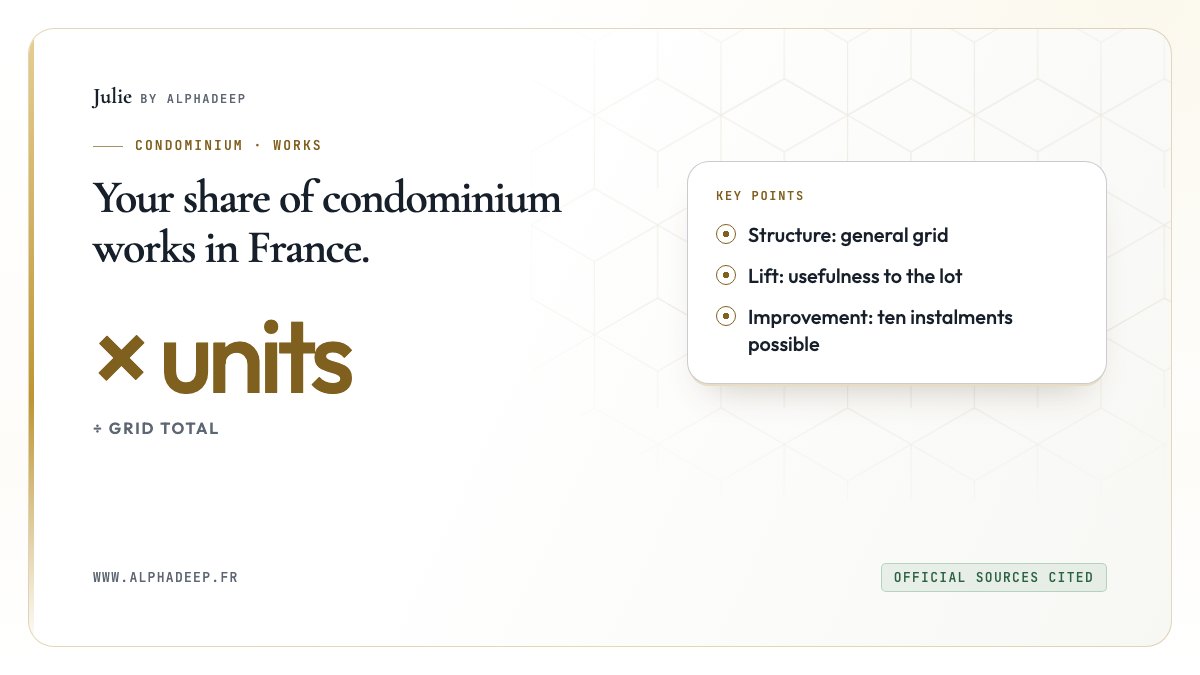
Your share of the works depends on what they are. Works to preserve and maintain the common parts are split by ownership shares (tantièmes), while works on equipment such as the lift follow each unit’s use of it (article 10 of the law of 10 July 1965). The sum is simple: cost × your tantièmes ÷ the grid total. For some improvement works, a co-owner who voted against can pay over ten yearly instalments.
- Official texts cited
- Sources checked on
- Drafted with AI assistance, our method
General legal information with official references and dated checks. It is not personalised advice: for a decision that commits you, have your situation checked by a qualified professional.
Julie by AlphaDeep
You received a call for works funds in your French building: I can recalculate your share with the right key.
3 free questions at signup. Avoid names and sensitive information.
How do you work out your share of a works call?
Multiply the cost voted by your lot’s units in the grid that applies, then divide by that grid’s total. The condominium rules set each lot’s share in each category of charges. A €48,000 façade job, 312 units out of 10,000: your share is €1,497.60.
Works sit outside the annual budget: their calls for funds fall due on the schedule voted by the meeting.
Loi n° 65-557 du 10 juillet 1965, article 10Loi n° 65-557 du 10 juillet 1965, article 14-1Décret n° 67-223 du 17 mars 1967, article 44
What is your share of these works?
Enter the cost, your units and each grid’s total: the tool works out your share per item and shows whether you can pay over ten years.
Fictional example · your share
Your share: €4,577.60, payable on the schedule of calls voted by the meeting.
- General share
- €1,497.60
- Special grid share
- €3,080
- Your share
- €4,577.60
Formula: cost × the lot’s units ÷ grid total. The grid that applies is in the condominium rules; for an improvement, the meeting sets the split.
General or special charges: which key for which works?
Conservation, upkeep and running costs of the common parts, such as façade or roof works, are split by the lots’ relative value: these are general charges. Works on a collective service or common equipment, such as the lift or heating, follow its objective usefulness to each lot: these are special charges.
For an improvement, the meeting itself sets the split, in proportion to each owner’s benefit. Collective works carried out on private parts are charged to the owner concerned alone.
Loi n° 65-557 du 10 juillet 1965, article 10Loi n° 65-557 du 10 juillet 1965, article 5Loi n° 65-557 du 10 juillet 1965, article 30Loi n° 65-557 du 10 juillet 1965, article 10-1
Do ground-floor owners pay for lift works?
Not necessarily. Usefulness means the equipment can be used: a ground-floor lot pays for the lift if it serves its cellar or parking, even if the owner never uses it. Its share varies with the floor and the surface served.
The condominium rules set the grid; if it is more than a quarter away from a lawful split, a revision claim is possible.
Service-public: condominium chargesLoi n° 65-557 du 10 juillet 1965, article 10Loi n° 65-557 du 10 juillet 1965, article 12
Which allocation key applies to which works?
| Works | Allocation key | Basis |
|---|---|---|
| Façade, roof, structural works | General charge units, by the lots’ relative value | 1965 Act, arts 10 and 5 |
| Lift, collective heating | Objective usefulness of the equipment for each lot, special grid | Art. 10 |
| Special common parts, such as one building or staircase | Only the co-owners concerned | Art. 10 |
| Improvement, new equipment | By the benefit to each owner, set by the meeting | Art. 30 |
| Collective works carried out on private parts | The owner of the lot concerned alone | Art. 10-1 |
| Works fund contribution | Like budget provisions, at least 5% of the budget a year | Art. 14-2-1 |
Loi n° 65-557 du 10 juillet 1965, article 10Loi n° 65-557 du 10 juillet 1965, article 5Loi n° 65-557 du 10 juillet 1965, article 30Loi n° 65-557 du 10 juillet 1965, article 10-1Loi n° 65-557 du 10 juillet 1965, article 14-2-1Service-public: condominium charges
What does article 10 of the law of 10 July 1965 say?
Les copropriétaires sont tenus de participer aux charges entraînées par les services collectifs et les éléments d’équipement commun en fonction de l’utilité objective que ces services et éléments présentent à l’égard de chaque lot, dès lors que ces charges ne sont pas individualisées. Ils sont tenus de participer aux charges relatives à la conservation, à l’entretien et à l’administration des parties communes, générales et spéciales, et de verser au fonds de travaux mentionné à l’article 14-2-1 la cotisation prévue au même article, proportionnellement aux valeurs relatives des parties privatives comprises dans leurs lots, telles que ces valeurs résultent des dispositions de l’article 5.
In plain English: Co-owners share the costs of collective services and common equipment according to each lot’s objective usefulness, and the costs of conserving, maintaining and running the common parts according to the relative values of their private parts. The condominium rules set each lot’s share in each category.
A lot’s share is therefore not the same in every category: one call for funds can involve two grids, and the category of works decides the key.
Who pays for works voted before a sale: seller or buyer?
Whoever owns the lot when the call falls due, seller or buyer, even if the works have not started. A different agreement in the sale deed binds only the seller and buyer, not the syndicate.
Sums paid into the works fund stay with the lot and are not refunded to the seller.
Décret n° 67-223 du 17 mars 1967, article 6-2Décret n° 67-223 du 17 mars 1967, article 6-3Service-public: charges and works in the year of sale
What else do co-owners ask?
Ownership tantièmes or charge tantièmes: what is the difference?
Ownership units measure each lot’s share of the common parts and set its votes at the meeting. Charge units set the lot’s share of costs, general and special. Both are in the condominium rules.
Service-public: ownership unitsLoi n° 65-557 du 10 juillet 1965, article 10
Can you pay your share of the works in instalments?
For an improvement, an owner who did not vote in favour can pay in ten equal annual instalments, by telling the syndic within two months of the minutes; interest at the legal rate is added if the syndicate took no loan. This does not apply to works required by law, and the balance falls due when the lot is sold.
When does a works call become payable?
On the date set by the meeting that voted the works. If a provision is left unpaid and a formal notice goes unanswered for thirty days, the provisions not yet due become payable at once.
Loi n° 65-557 du 10 juillet 1965, article 14-1Loi n° 65-557 du 10 juillet 1965, article 19-2
Can you challenge an unfair allocation key?
Yes, if your lot’s share exceeds by more than a quarter what a lawful split would give, or another lot’s is more than a quarter too low: the claim must be brought within five years of the rules being published, or two years from the lot’s first sale after that. Otherwise, changing the split needs unanimity, unless voted works make it necessary.
Loi n° 65-557 du 10 juillet 1965, article 12Loi n° 65-557 du 10 juillet 1965, article 11
Which texts is this calculator based on?
- Loi n° 65-557 du 10 juillet 1965, article 10Légifrance
- Loi n° 65-557 du 10 juillet 1965, article 5Légifrance
- Loi n° 65-557 du 10 juillet 1965, article 30Légifrance
- Loi n° 65-557 du 10 juillet 1965, article 33Légifrance
- Loi n° 65-557 du 10 juillet 1965, article 10-1Légifrance
- Loi n° 65-557 du 10 juillet 1965, article 11Légifrance
- Loi n° 65-557 du 10 juillet 1965, article 12Légifrance
- Loi n° 65-557 du 10 juillet 1965, article 14-1Légifrance
- Loi n° 65-557 du 10 juillet 1965, article 14-2-1Légifrance
- Loi n° 65-557 du 10 juillet 1965, article 19-2Légifrance
- Décret n° 67-223 du 17 mars 1967, article 6-2Légifrance
- Décret n° 67-223 du 17 mars 1967, article 6-3Légifrance
- Décret n° 67-223 du 17 mars 1967, article 44Légifrance
- Service-public: condominium chargesService-public.fr
- Service-public: ownership unitsService-public.fr
- Service-public: charges and works in the year of saleService-public.fr
Texts cited last checked: 17 October 2026