Housing and property · Condominium · meetings
Voting majorities at a French condominium general meeting: which article for which decision
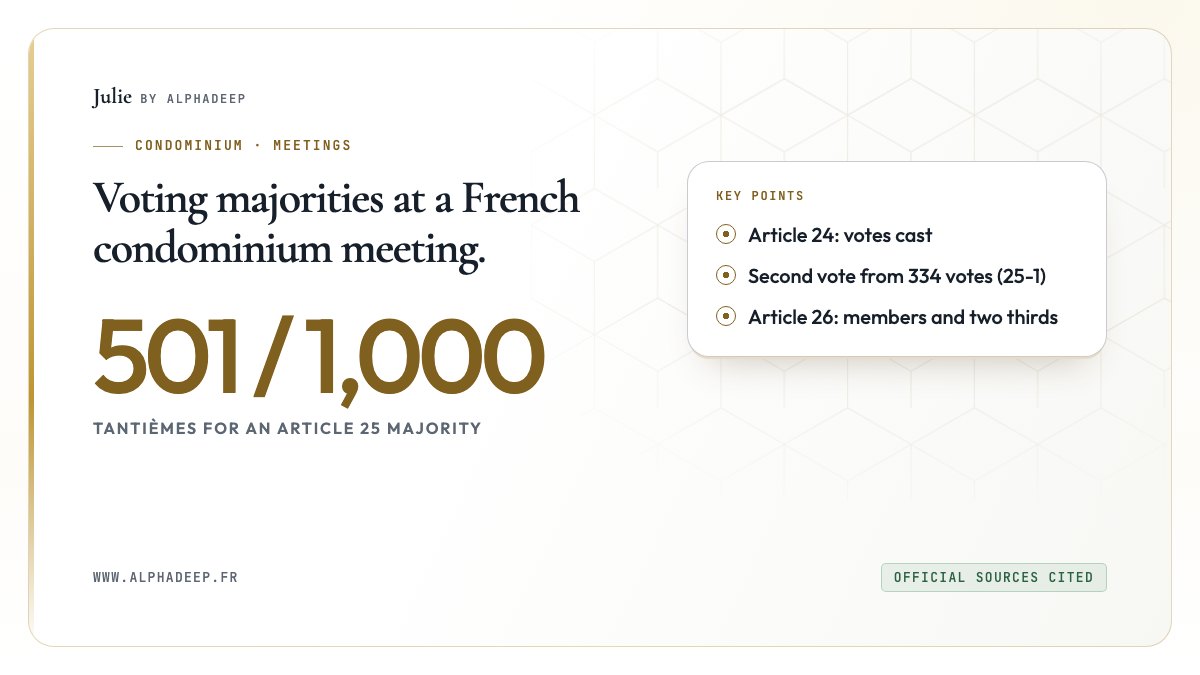
At a French condominium general meeting, the majority depends on the decision. Article 24 needs a majority of the votes cast. Article 25 needs a majority of all co-owners’ votes, with an immediate second vote if the proposal gets at least one third of the votes. Article 26 sets a double majority: a majority of members holding at least two thirds of the votes. Some decisions need unanimity.
- Official texts cited
- Sources checked on
- Drafted with AI assistance, our method
General legal information with official references and dated checks. It is not personalised advice: for a decision that commits you, have your situation checked by a qualified professional.
Julie by AlphaDeep
You are preparing or challenging a vote at a French condominium meeting: I can tell you which majority applies and whether the resolution passes.
3 free questions at signup. Avoid names and sensitive information.
Which majority does each decision need?
French law sets the majority by type of decision. Article 24 is the default rule: it applies unless another text requires more. Articles 25 and 26 list the weightier decisions, and a few decisions need unanimity. The meeting notice states the majority needed for each resolution.
Law no. 65-557 of 10 July 1965, article 24Law no. 65-557 of 10 July 1965, article 25Law no. 65-557 of 10 July 1965, article 26
Has your resolution passed?
Enter the tantièmes from the attendance sheet: the calculation applies the chosen article’s majority, then the second vote if the law allows one.
Fictional example · vote result
Rejected on the first vote, then passed on the immediate second vote (article 25-1).
- First vote
- Rejected
- Immediate second vote
- Passed
An estimate from the attendance sheet; the minutes and the building rules are what count.
How is each majority counted?
| Majority | How it is counted | Examples | Second vote |
|---|---|---|---|
| Article 24 | Majority of votes cast by members present, represented or voting by post | Works to preserve the building, approving the accounts | Does not apply |
| Article 25 | Majority of all co-owners’ votes | Appointing the syndic, energy-saving works | Yes, from one third of the votes (article 25-1) |
| Article 26 | Majority of members holding at least two thirds of the votes | Buying property, changing the rules on common parts | Yes, with half the members and one third of the votes (article 26-1) |
| Unanimity | Votes of all co-owners | Changing the charge split outside the cases allowed, the building’s use | No |
Law no. 65-557 of 10 July 1965, article 24Law no. 65-557 of 10 July 1965, article 25Law no. 65-557 of 10 July 1965, article 25-1Law no. 65-557 of 10 July 1965, article 26Law no. 65-557 of 10 July 1965, article 26-1Law no. 65-557 of 10 July 1965, article 11
How do you count an article 25 majority with tantièmes?
You compare the tantièmes in favour with the total tantièmes of the whole building, present or not. Out of 1,000 tantièmes you need more than 500. Absentees, abstentions and votes against therefore weigh the same: none of them brings the resolution closer to the threshold.
When does the article 25-1 second vote apply?
If a resolution misses the article 25 majority but gets at least one third of all co-owners’ votes, the same meeting votes again straight away by the article 24 majority. Out of 1,000 tantièmes, 334 votes in favour open this second vote.
For energy-saving works that miss even that third, a new meeting called within three months on an identical proposal can decide by the article 24 majority.
How does the article 26-1 second vote work?
If the article 26 double majority is missed, but half of the members present, represented or voting by post approved the proposal with at least one third of all co-owners’ votes, the same meeting votes again straight away by the article 25 majority.
What does article 25 of the law of 10 July 1965 say?
Ne sont adoptées qu’à la majorité des voix de tous les copropriétaires les décisions concernant : […] c) La désignation ou la révocation du ou des syndics et des membres du conseil syndical ; […] f) Les travaux d’économies d’énergie ou de réduction des émissions de gaz à effet de serre.
In plain English: Only a majority of all co-owners’ votes can decide, among other things, the appointment or dismissal of the syndic and council members (c) and energy-saving works (f).
The list continues with other decisions, such as authorising an owner’s private works on common parts or installing EV charging points. Everything else falls under article 24 unless another text says otherwise.
What else should you know about voting?
How are abstentions counted?
Under article 24, no: only votes cast count, and abstentions are left out. Under articles 25 and 26, the majority is worked out on all the building’s votes, so an abstention does not bring the resolution closer to the threshold.
Law no. 65-557 of 10 July 1965, article 24Law no. 65-557 of 10 July 1965, article 25
How many proxies can one person hold?
Three proxies at most. A proxy holder can take more if their own votes plus those of the owners they represent do not exceed 10% of the building’s votes.
Which decisions need unanimity?
Changing how charges are split, unless works or acts already voted make it necessary, and any decision affecting the building’s use or forcing an owner to change how their private parts may be used.
Law no. 65-557 of 10 July 1965, article 11Law no. 65-557 of 10 July 1965, article 26
Can you vote by post or remotely?
Yes. You can take part by video or another electronic means that identifies you, or vote before the meeting with the postal voting form attached to the notice.
Which texts is this register based on?
- Law no. 65-557 of 10 July 1965, article 24Légifrance
- Law no. 65-557 of 10 July 1965, article 25Légifrance
- Law no. 65-557 of 10 July 1965, article 25-1Légifrance
- Law no. 65-557 of 10 July 1965, article 26Légifrance
- Law no. 65-557 of 10 July 1965, article 26-1Légifrance
- Law no. 65-557 of 10 July 1965, article 22Légifrance
- Law no. 65-557 of 10 July 1965, article 17-1 ALégifrance
- Law no. 65-557 of 10 July 1965, article 11Légifrance
Texts cited last checked: 17 October 2026