Housing and property · Condominium · agenda
Adding a question to the agenda of a French condominium general meeting
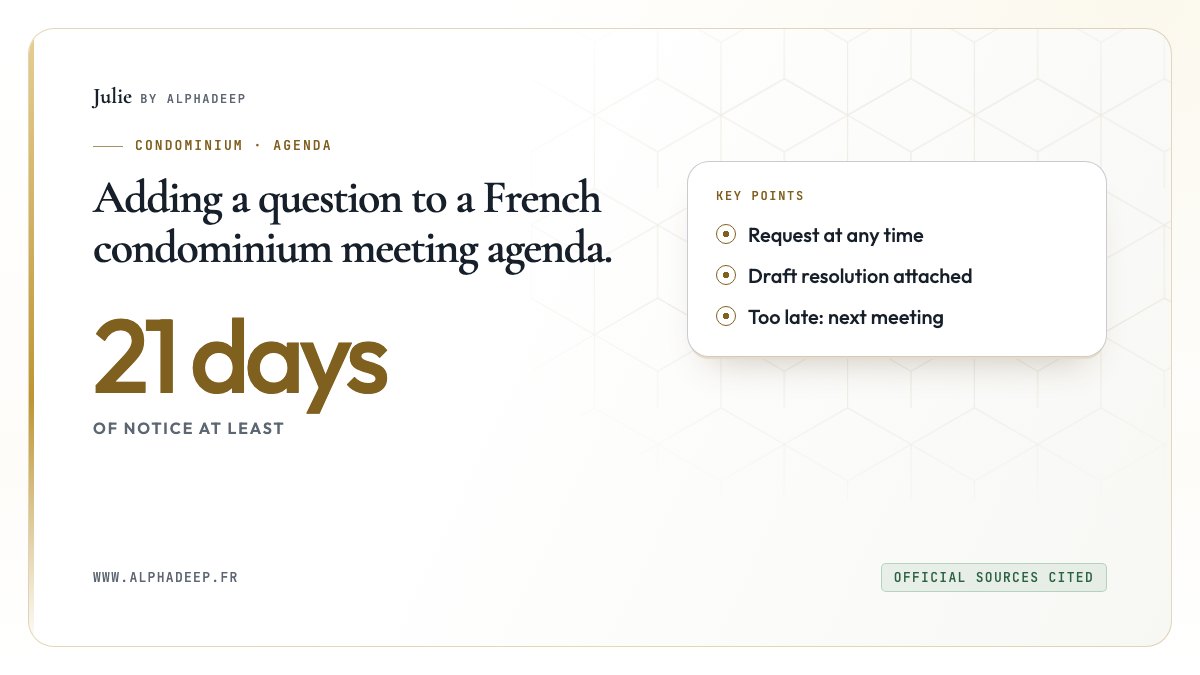
Any co-owner in a French condominium can ask the syndic at any time to add a question to the next general meeting’s agenda (article 10 of the decree of 17 March 1967). If the request arrives too late for the notice, sent at least 21 days before the meeting, the question goes to the following meeting. Where the decision requires it, attach a draft resolution: the meeting can only vote on listed questions.
- Official texts cited
- Sources checked on
- Drafted with AI assistance, our method
General legal information with official references and dated checks. It is not personalised advice: for a decision that commits you, have your situation checked by a qualified professional.
Julie by AlphaDeep
You want a question voted at the next meeting of your French building: I can draft the request to the syndic and the resolution.
3 free questions at signup. Avoid names and sensitive information.
Who can add a question to the agenda?
Any co-owner, or the council, at any time. They notify the syndic of the questions they want added, and the syndic puts them on the agenda of the next general meeting.
A question that only concerns your own rights or obligations can also be dealt with at a meeting called at your cost, at your request. Co-owners holding at least a quarter of the votes can even require a meeting to be called.
Décret n° 67-223 du 17 mars 1967, article 10Loi n° 65-557 du 10 juillet 1965, article 17-1 AADécret n° 67-223 du 17 mars 1967, article 8
How early must the request arrive for the next meeting?
There is no fixed deadline: the question goes on the next meeting’s agenda if the request arrives before the notices are sent, otherwise on the one after. Notice must go out at least twenty-one days before the meeting, or earlier if the condominium rules set a longer period.
The syndic must post the date of the next meeting and remind co-owners, in reasonable time, that they can add questions.
Décret n° 67-223 du 17 mars 1967, article 10Décret n° 67-223 du 17 mars 1967, article 9
What should your agenda request contain?
Fill in the fields: the request letter builds on the right, with the draft resolution or document your type of question needs.
Letter to the syndic (in French)
[prénom et nom], copropriétaire du lot n° [numéro]
À l’attention de [nom du syndic], syndic de la copropriété
Objet : demande d’inscription d’une question à l’ordre du jour
Madame, Monsieur,
En application de l’article 10 du décret n° 67-223 du 17 mars 1967, je vous demande d’inscrire à l’ordre du jour de la prochaine assemblée générale (date à préciser) la question suivante : [intitulé de la question].
Je joins le projet de résolution correspondant : « [texte soumis au vote] »
Si cette demande vous parvient trop tard pour cette assemblée, je vous remercie de l’inscrire à l’ordre du jour de la suivante, conformément au même article.
Je vous prie d’agréer, Madame, Monsieur, l’expression de mes salutations distinguées.
Fait le [date]. [prénom et nom]
Send it by registered e-mail, or by registered post if you opted for postal delivery: the date of receipt matters. French syndics work in French, so the letter stays in French.
What must you attach for each type of question?
| Type of question | What to attach | Basis |
|---|---|---|
| A decision on the budget, works, or a majority under articles 24, 25 or 26 | Draft resolution | Decree, art. 11 I 7° |
| Authorising the syndic to go to court | Draft resolution | Decree, art. 11 I 8° |
| Works at your cost on the common parts | A document setting out the location and scope of the works | Decree, art. 10; law, art. 25 b |
| A question about your own rights or obligations only | A draft resolution per question, meeting held at your cost | Law, art. 17-1 AA; decree, art. 8-1 |
| An information item | Nothing: discussion without a vote | Decree, art. 13 |
Décret n° 67-223 du 17 mars 1967, article 11Décret n° 67-223 du 17 mars 1967, article 10Loi n° 65-557 du 10 juillet 1965, article 25Loi n° 65-557 du 10 juillet 1965, article 17-1 AADécret n° 67-223 du 17 mars 1967, article 8-1Décret n° 67-223 du 17 mars 1967, article 13
Can the syndic refuse or rewrite your question?
No. The decree requires the syndic to put notified questions on the agenda, and the draft resolution you attach is sent out with the notice. Only requests that arrive too late can be held over, to the following meeting.
At a meeting held at your cost, the syndic only lists questions about your own rights and obligations.
Décret n° 67-223 du 17 mars 1967, article 10Décret n° 67-223 du 17 mars 1967, article 11
Which time limits and thresholds matter?
- Formal notice to the syndic left unanswered
- 8 days
- before the council president calls the meeting · 1967 decree, art. 8
What does article 10 of the decree of 17 March 1967 say?
A tout moment, un ou plusieurs copropriétaires, ou le conseil syndical, peuvent notifier au syndic la ou les questions dont ils demandent qu’elles soient inscrites à l’ordre du jour d’une assemblée générale. Le syndic porte ces questions à l’ordre du jour de la convocation de la prochaine assemblée générale. Toutefois, si la ou les questions notifiées ne peuvent être inscrites à cette assemblée compte tenu de la date de réception de la demande par le syndic, elles le sont à l’assemblée suivante.
In plain English: At any time, one or more co-owners, or the council, can notify the syndic of questions they want added to a general meeting agenda. The syndic adds them to the notice of the next meeting; if they cannot be added because of when the request was received, they go on the following meeting.
The draft resolution you attach is then sent to the co-owners at the latest with the agenda, so the meeting can vote validly.
What else do co-owners ask?
Must the request go by registered letter?
Notifications go electronically, by registered e-mail or a qualified provider; registered post with receipt is kept for co-owners who asked for postal delivery. Either way, keep proof of the date of receipt.
Loi n° 65-557 du 10 juillet 1965, article 42-1Décret n° 67-223 du 17 mars 1967, article 64Décret n° 67-223 du 17 mars 1967, article 64-1
Can you add an item on the day of the meeting?
Not for a decision. The meeting can only decide validly on questions on the agenda that were properly notified; it can discuss other questions, but cannot settle them.
How do you ask for works at your own cost on common parts?
Ask for the question to be added with a draft resolution and a document setting out the location and scope of the works. The authorisation is voted by a majority of all co-owners’ votes.
Décret n° 67-223 du 17 mars 1967, article 10Loi n° 65-557 du 10 juillet 1965, article 25
Is a decision on an item not on the agenda valid?
No. A decision on a question not on the agenda is not valid. A co-owner who opposed it or was absent can challenge it within two months of being notified of the minutes.
Décret n° 67-223 du 17 mars 1967, article 13Loi n° 65-557 du 10 juillet 1965, article 42
Which texts is this model based on?
- Décret n° 67-223 du 17 mars 1967, article 10Légifrance
- Décret n° 67-223 du 17 mars 1967, article 9Légifrance
- Décret n° 67-223 du 17 mars 1967, article 11Légifrance
- Décret n° 67-223 du 17 mars 1967, article 13Légifrance
- Décret n° 67-223 du 17 mars 1967, article 8Légifrance
- Décret n° 67-223 du 17 mars 1967, article 8-1Légifrance
- Loi n° 65-557 du 10 juillet 1965, article 17-1 AALégifrance
- Loi n° 65-557 du 10 juillet 1965, article 42-1Légifrance
- Décret n° 67-223 du 17 mars 1967, article 64-1Légifrance
- Loi n° 65-557 du 10 juillet 1965, article 25Légifrance
- Loi n° 65-557 du 10 juillet 1965, article 42Légifrance
- Décret n° 67-223 du 17 mars 1967, article 64Légifrance
Texts cited last checked: 17 October 2026