The statement of sumsStatement · Rental income
French rental income tax: micro-foncier or the real regime, the €15,000 threshold, the rental deficit and a statement of both regimes
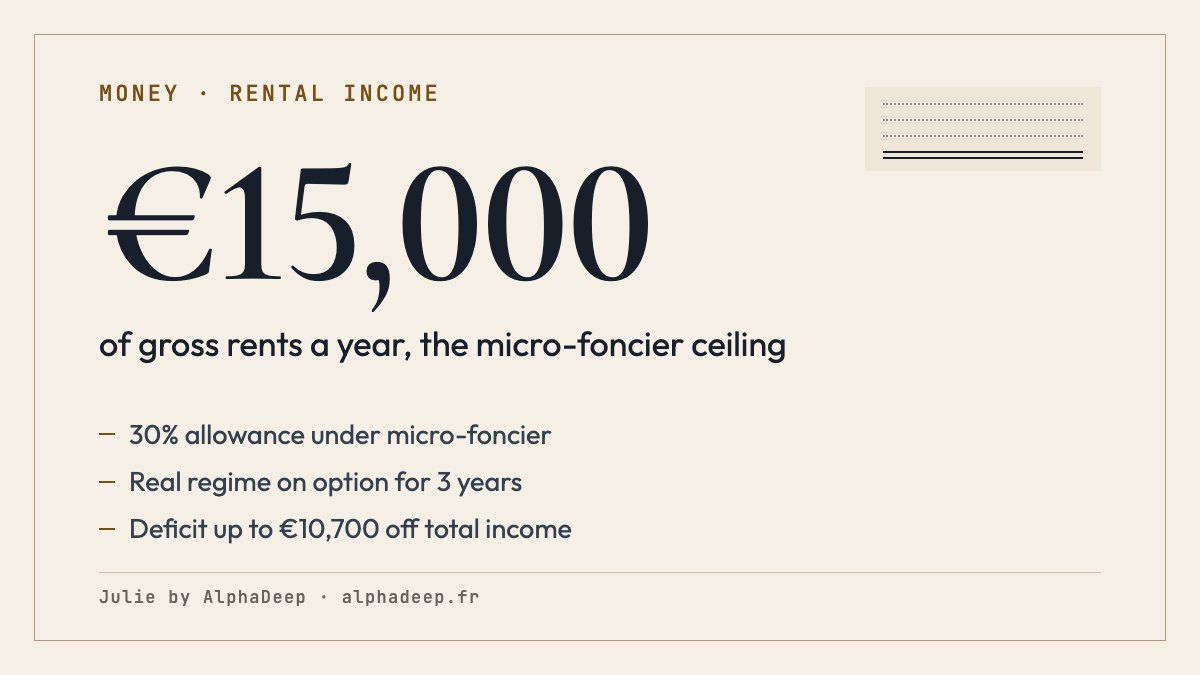
Rents from an unfurnished letting in France are property income (revenus fonciers). Up to €15,000 of gross rents a year for the whole household, micro-foncier takes off a 30% allowance, with no expense deducted (General Tax Code, article 32). The real regime deducts expenses and loan interest: it is compulsory above the threshold, and optional below it, for 3 years. A deficit can reduce total income by up to €10,700.
Go to the tool: the statement of sums
Julie by AlphaDeep is an AI legal assistant for French law: it researches official references to help answer your questions (Légifrance, case law, service-public), analyses your documents and drafts your letters, for individuals and professionals alike.
General legal information with official references and dated checks. It is not personalised advice: for a decision that commits you, have your situation checked by a qualified professional.

Let’s look at your situation
Give the year’s rents, your expenses, your loan interest and the works carried out.
Example questions
Your question carries over after signup. Maximum 400 characters. Avoid health data and names.
Which regime costs you less this year?
Give your gross rents, your expenses excluding interest, your loan interest and your marginal income-tax rate: the statement works out the taxable income under both regimes, splits any deficit and estimates the tax and social levies. The example: €12,000 of rents, €5,000 of expenses and €1,000 of interest, with a marginal rate of 30%.
Fictional example · the statement of both regimes
The real regime costs €1,132.80 less this year, but the option binds you for 3 years.
- Tax and levies under micro-foncier
- €3,964.80
- Tax and levies under the real regime
- €2,832.00
- Cheaper regime
- real regime
- Gross rentsservice charges excluded€12,000.00€12,000.00
- 30% allowancecovers all expenses(€3,600.00)€8,400.00
Taxable income under micro-foncier€8,400.00
- Rents receivedthe year’s receipts€12,000.00€12,000.00
- Expenses excluding interestproperty tax, insurance, works(€5,000.00)€7,000.00
- Loan intereston the loan financing the property(€1,000.00)€6,000.00
Net property income under the real regime€6,000.00
Indicative result: tax at the marginal rate plus 17.2% of social levies, without the micro-foncier exclusions or the raised limit for energy works.
Micro-foncier or real regime: what changes?
The threshold, the calculation, the expenses, the deficit and the return.
| Point | Micro-foncier | Real regime |
|---|---|---|
| Access | Household gross rents up to €15,000 a year | Compulsory above, optional below |
| Calculation | Flat 30% allowance | Rents minus actual expenses and interest |
| Expenses and works | Not deductible, covered by the allowance | Deductible, with evidence |
| Deficit | Impossible | Up to €10,700 off total income, the rest over 10 years |
| Return | Gross amount on the income tax return | Form 2044 |
| Commitment | Each year, while under the threshold | Option irrevocable for 3 years |
| Social levies | 17.2% of the income after the allowance | 17.2% of the net income |
Some situations exclude micro-foncier even under €15,000: historic monuments, bare ownership, some depreciation or deduction schemes (General Tax Code, article 32).
Sources: CGI, art. 32 · Service-public F1991 · CGI, art. 156 · impots.gouv.fr
When does micro-foncier apply?
Automatically, if the whole household’s gross rents do not exceed €15,000 over the year, save exclusions: taxable income is the gross less 30% (General Tax Code, article 32).
You declare the gross amount, with no allowance, on the income tax return; expenses and works are not deducted (sheet F1991).
Sources: CGI, art. 32 · Service-public F1991
When is the real regime better?
When your deductible expenses and loan interest exceed 30% of the rents: property tax, insurance, management fees, upkeep, improvement works (sheet F1991).
You opt by filing form 2044; the option covers all the household’s property income and stays irrevocable for 3 years (CGI article 32).
Sources: Service-public F1991 · CGI, art. 32
How does a rental deficit work?
The part of the deficit from expenses other than loan interest comes off total income, up to €10,700 a year; the rest, and the interest part, carries forward against property income for the next 10 years (CGI article 156).
The limit rises up to €21,400 for energy renovation works that move the home from class E, F or G to A, B, C or D by 31 December 2027; the deduction is clawed back if the property stops being let within 3 years (sheet F1991).
Sources: CGI, art. 156 · Service-public F1991
Which figures matter for your 2026 rents?
The threshold, the allowance, the deficit cap and the social levies.
- Maximum annual household gross rents for micro-foncier
- €15,000in force in 2026 · General Tax Code, article 32
- Flat allowance under micro-foncier
- 30%in force in 2026 · General Tax Code, article 32
- Deficit that can come off total income each year
- €10,700in force in 2026 · General Tax Code, article 156
- Social levies on the net income of an unfurnished letting
- 17.2%sheet checked on 15 April 2026 · Service-public, sheet F1991
What does article 32 of the French General Tax Code say?
The micro-foncier threshold, its allowance and the option for the real regime.
1. Par dérogation aux dispositions de l’article 31, lorsque le montant du revenu brut annuel défini aux articles 29 et 30 n’excède pas 15 000 €, le revenu imposable correspondant est fixé à une somme égale au montant de ce revenu brut diminué d’un abattement de 30 %.
2. Les dispositions du 1 s’appliquent à l’ensemble des revenus fonciers perçus par le foyer fiscal.
4. Les contribuables qui souhaitent renoncer au bénéfice des dispositions du 1 peuvent opter pour la détermination de leur revenu net foncier dans les conditions prévues aux articles 28 et 31. L’option est exercée pour une période de trois ans dans le délai prévu pour le dépôt de la déclaration mentionnée à l’article 170 de la première année au titre de laquelle elle s’applique. Irrévocable durant cette période, elle est valable tant que le contribuable reste de manière continue dans le champ d’application du 1.
In English, briefly (our summary, not an official translation): 1. By way of exception to article 31, when the annual gross income defined in articles 29 and 30 does not exceed €15,000, the taxable income is set at that gross income less an allowance of 30%. 2. Point 1 applies to all the property income of the tax household. 4. Taxpayers who wish to give up point 1 can opt to have their net property income worked out under articles 28 and 31. The option is made for three years, within the deadline for the return in article 170 for the first year it applies. Irrevocable during that period, it stays valid as long as the taxpayer remains continuously within point 1. Our note: net property income under the real regime is gross income minus the costs of the property (CGI article 28).
What do landlords letting unfurnished in France ask?
Is the €15,000 threshold per property?
No: it covers all the tax household’s property income (CGI article 32).
Can you go back to micro-foncier after opting?
Not before the end of the 3 years: the option for the real regime is irrevocable during that period (CGI article 32).
Do social levies apply to gross rents?
No: to net income, after the 30% allowance under micro-foncier or after expenses under the real regime, at 17.2% for an unfurnished letting (impots.gouv.fr).
Is a furnished letting property income?
No: it is taxed as industrial and commercial profits (BIC), with social levies of 18.6% (impots.gouv.fr).
Which texts does the tax on rents rest on?
- General Tax Code, article 28 (net property income)Légifrance
- General Tax Code, article 32 (micro-foncier)Légifrance
- General Tax Code, article 156 (rental deficit)Légifrance
- Income tax on rents from an unfurnished letting (sheet F1991, in French)Service-public.fr · checked on 15 April 2026
- Letting a property: do I pay social levies? (in French)impots.gouv.fr · page modified on 17 July 2026
Texts cited last checked: 27 September 2026