The deadline registerIndividual taxpayers
Correcting a French tax return or making a claim: fixing an error within the time limits
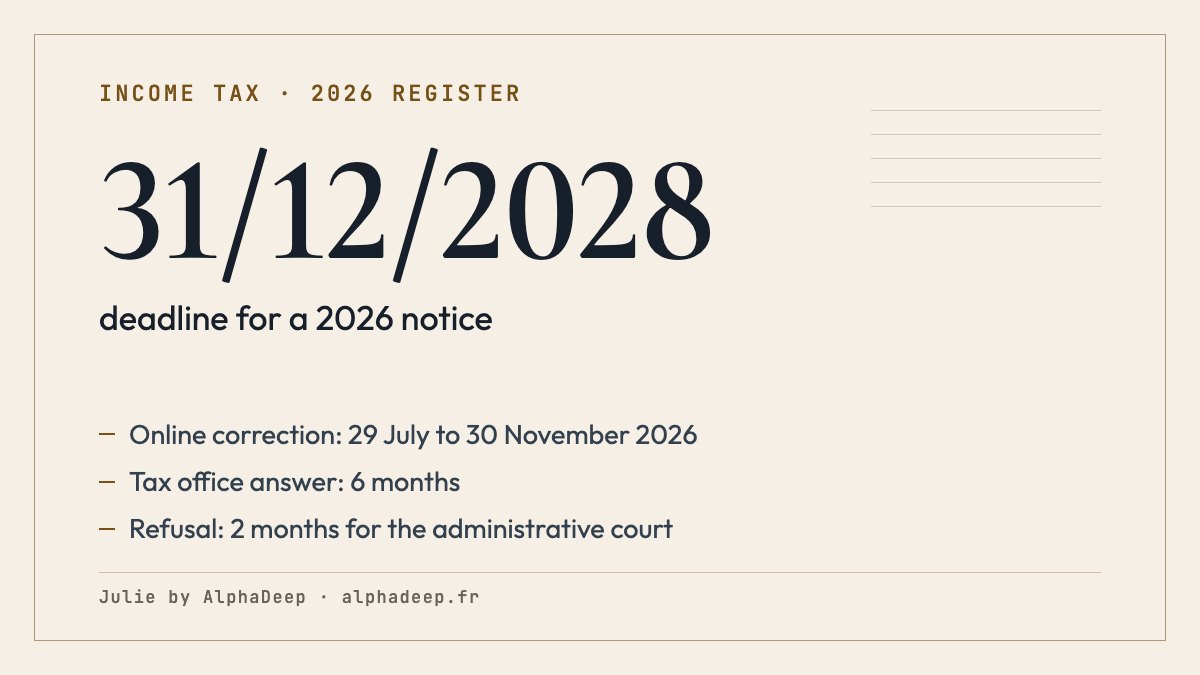
For an error in French income tax, there are two routes. The online service to correct your return is open in 2026 from 29 July to 30 November. After that, a claim (réclamation) remains possible until 31 December of the second year after the tax is put into collection (Book of Tax Procedures, article R*196-1): a notice issued in 2026 can be challenged until 31 December 2028. The tax office answers within 6 months in principle.
Go to the tool: the deadline register
Julie by AlphaDeep is an AI legal assistant for French law: it researches official references to help answer your questions (Légifrance, case law, service-public), analyses your documents and drafts your letters, for individuals and professionals alike.
General legal information with official references and dated checks. It is not personalised advice: for a decision that commits you, have your situation checked by a qualified professional.

Let’s look at your situation
Give the tax, the year of the notice and the nature of the error.
Example questions
Your question carries over after signup. Maximum 400 characters. Avoid health data and names.
Which route corrects your French tax, and by which date?
Choose the tax, the year shown on the notice and which way the error goes: the route finder gives the route, online correction, claim or corrected return, and the deadline. The example is an income tax notice received in 2026 where actual expenses (frais réels) were left out.
Fictional example · tax route finder
Correct the return online until 30 November 2026; after that, a claim is possible until 31 December 2028.
Days left: to be calculated
The online service to correct your return opens
Last day to correct the return online
Claim deadline: article R*196-1 of the Book of Tax Procedures
- A claim does not suspend payment, unless it expressly asks for a stay and states the amount.
- The tax office answers within 6 months in principle; a refusal is challenged before the administrative court within 2 months.
Dates set by the texts and by impots.gouv.fr for the 2026 campaign. The year the tax was put into collection is shown on the tax notice.
Should you correct the return or make a claim?
While the service is open, from 29 July to 30 November 2026 for the return on 2025 income, correct it online: according to impots.gouv.fr, a corrected notice arrives within about 3 weeks in most cases. From 1 December 2026, you need to file a claim.
The claim is filed in your online tax account (espace Finances publiques) through the secure messaging service: "Écrire", then "Réclamation, contestation", then "impôt sur le revenu". A letter on plain paper, with the notice references and the supporting documents, is also accepted.
Sources: impots.gouv.fr, challenging a notice · Service-public F33885
How is the time limit for a claim worked out?
For income tax, the claim must be filed by 31 December of the second year after the tax is put into collection: a 2026 notice can be challenged until 31 December 2028 (Book of Tax Procedures, article R*196-1). The time limit can also run from the payment of the tax or from the event that gives rise to the claim.
For property tax and housing tax, the time limit is one year shorter: 31 December of the following year (article R*196-2). A challenge to the withholding tax itself (prélèvement à la source) is filed by the last day of February of the year after the income is paid (article R*196-1-1).
Sources: LPF R*196-1 · LPF R*196-1-1 and R*196-2
Does a claim suspend payment of the tax?
No. A claim does not exempt you from paying, unless you expressly ask in the claim for a stay of payment (sursis de paiement), stating the amount or the basis of the reduction sought (Book of Tax Procedures, article L277).
According to impots.gouv.fr, guarantees such as a bank guarantee can be required if the amount challenged exceeds €4,500. The stay covers the challenged part of the tax and the related penalties, until the final decision.
Sources: LPF L277 · impots.gouv.fr, challenging a notice
What changes for French tax claims in 2026 and 2027?
Three dates frame the current campaign and the next one, including a rewrite of the text on time limits on 30 July 2026.
The online service to correct your return opens for 2025 income, until 30 November 2026, according to impots.gouv.fr.
Decree no. 2026-692 of 27 July 2026 removes the shorter time limit, to 31 December of the following year, that applied in particular to a new notice correcting a mailing error or to tax charged wrongly or twice: these cases now follow the general time limit of article R*196-1.
Sources: LPF R*196-1 · Decree 2026-692
Which claim time limit applies to each French tax?
The time limit runs from the date the tax is put into collection, shown on the notice, and always ends on a 31 December, except for withholding tax, which is challenged before the end of February.
| Tax | Deadline | Example | Text |
|---|---|---|---|
| Income tax | 31 December of the 2nd year after the tax is put into collection | 2026 notice: 31 December 2028 | LPF, art. R*196-1 |
| Tax paid without a notice | 31 December of the 2nd year after payment | Paid in 2026: 31 December 2028 | LPF, art. R*196-1 b |
| New event giving rise to the claim | 31 December of the 2nd year after the event | A court decision does not count as an event | LPF, art. R*196-1 c |
| Withholding tax | Last day of February of the year after the income is paid | 2026 income: 28 February 2027 | LPF, art. R*196-1-1 |
| Property tax, housing tax | 31 December of the year after the tax is put into collection | 2026 notice: 31 December 2027 | LPF, art. R*196-2 |
After a claim, the tax office decides within 6 months, extendable by 3 months if it tells you (article R*198-10). A properly notified refusal starts the 2-month period to bring the claim to the administrative court. After 6 months without an answer, you can go to court without waiting; that silence alone does not start the 2-month period (article R*199-1).
Sources: LPF R*196-1 · LPF R*196-1-1 and R*196-2 · LPF R*198-10
What does article R*196-1 of the Book of Tax Procedures say?
Article R*196-1 is the text setting the time limit for income tax claims, in its wording in force since 30 July 2026.
Pour être recevables, les réclamations relatives aux impôts autres que les impôts directs locaux et les taxes annexes à ces impôts, doivent être présentées à l’administration au plus tard le 31 décembre de la deuxième année suivant celle, selon le cas :
a) De la mise en recouvrement du rôle ou de la notification d’un avis de mise en recouvrement ;
b) Du versement de l’impôt contesté lorsque cet impôt n’a pas donné lieu à l’établissement d’un rôle ou à la notification d’un avis de mise en recouvrement ;
c) De la réalisation de l’événement qui motive la réclamation. Ne constitue pas un tel événement une décision juridictionnelle ou un avis mentionné aux troisième et cinquième alinéas de l’article L. 190.
In English, briefly (our summary, not an official translation): To be admissible, claims about taxes other than local direct taxes must reach the tax authorities by 31 December of the second year after, as the case may be: (a) the tax is put into collection or a collection notice is served; (b) the tax is paid, when no assessment or collection notice was issued; (c) the event giving rise to the claim occurs, a court decision not counting as such an event. For an income tax notice, what counts is the year the tax was put into collection, printed on the notice, not the year of the income.
What else should you know before challenging your French tax?
Does an error in my favour expose me to a penalty?
The missing tax is due with late-payment interest of 0.20% a month (General Tax Code, article 1727). Corrected spontaneously before any audit, a good-faith error has this interest halved, 1.2% a year instead of 2.4%, according to impots.gouv.fr; once an audit has begun, the reduction falls to 30%.
How do you file the claim?
Through the secure messaging of your online tax account, under "Réclamation, contestation", or by letter to the office shown on the notice. State the tax, the year, the notice references and the amount challenged, and attach the supporting documents, for example the invoices for actual expenses.
What if the claim is rejected?
The refusal must give reasons (article R*198-10). You have 2 months from receiving it to go to the administrative court for the place of taxation (article R*199-1). With no answer 6 months after the claim, you can go to the court without waiting.
Remission or claim: what is the difference?
A claim challenges a tax that was calculated wrongly. A request for remission (remise gracieuse) asks for a reduction of a correct tax you cannot pay because of hardship or poverty (Book of Tax Procedures, article L247). According to impots.gouv.fr, the tax office answers within 2 months, 4 for a complex file; its silence means rejection.
Which texts set these time limits for tax claims?
- Book of Tax Procedures, article R*196-1 (version in force since 30 July 2026)Légifrance, in French
- Book of Tax Procedures, articles R*196-1-1 and R*196-2 (withholding tax, local taxes)Légifrance, in French
- Book of Tax Procedures, articles R*198-10 and R*199-1 (the tax office’s answer, the court)Légifrance, in French
- Book of Tax Procedures, article L277 (stay of payment)Légifrance, in French
- General Tax Code, article 1727 (late-payment interest, version in force until 31 December 2026)Légifrance, in French
- Book of Tax Procedures, article L247 (remission, version in force until 31 December 2026)Légifrance, in French
- How can I challenge my income tax and social contributions notice?French tax authorities (DGFiP), impots.gouv.fr, in French
- The right to make a mistake in tax mattersFrench tax authorities (DGFiP), impots.gouv.fr, in French
- Income tax: how do you correct your return? (fiche F33885)Service-public.fr, in French
- Decree no. 2026-692 of 27 July 2026, article 1Légifrance, Journal officiel, in French
- Tax claims and court appeals (fiche F110)Service-public.fr, in French
Texts cited last checked: 24 September 2026