The gaugeInheritance · small estate
Small estate in France without a notary: the €5,965 limit, the heirs’ attestation, the bank accounts and the funeral
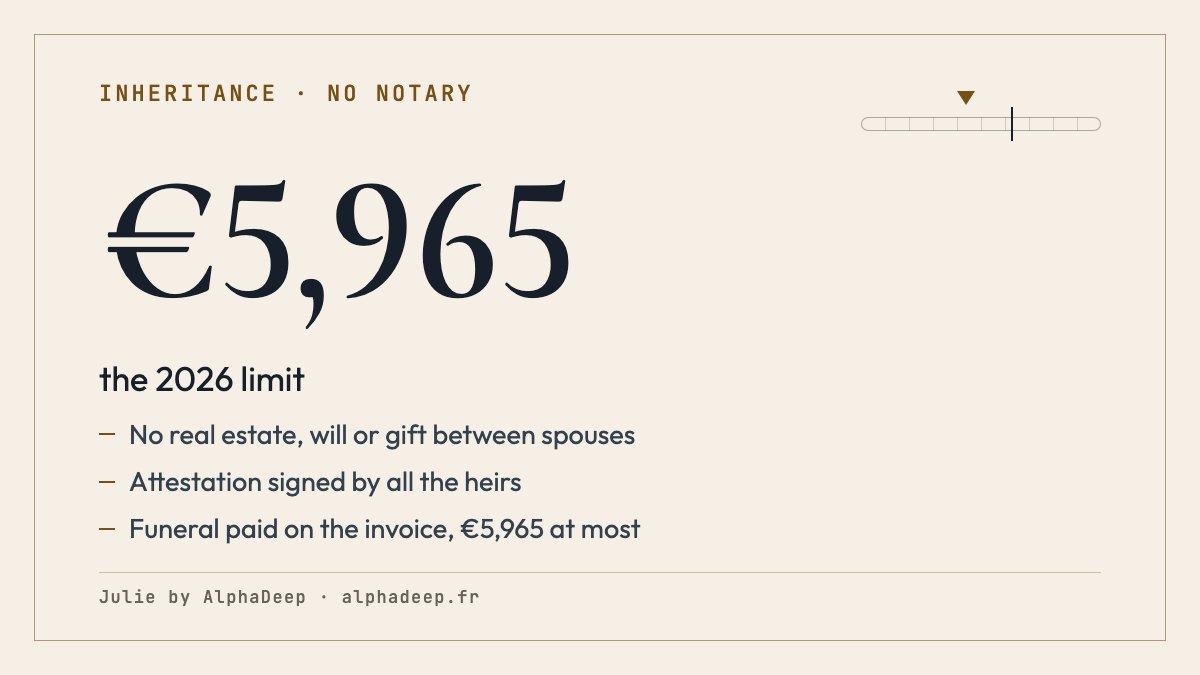
A French estate can be settled without a notary if it is worth less than €5,965, with no real estate, will or gift between spouses (service-public fiche F1295). An attestation signed by all the heirs then proves their status and lets the bank close the deceased’s accounts, if it holds less than €5,965 (article L312-1-4 of the Monetary and Financial Code). This limit applies since 1 January 2026.
Julie by AlphaDeep is an AI legal assistant for French law: it researches official references to help answer your questions (Légifrance, case law, service-public), analyses your documents and drafts your letters, for individuals and professionals alike.
General legal information with official references and dated checks. It is not personalised advice: for a decision that commits you, have your situation checked by a qualified professional.

Let’s look at your situation
Say what the estate contains, the deceased’s banks and who the heirs are.
Example questions
Your question carries over after signup. Maximum 400 characters. Avoid health data and names.
Can you settle the estate without a notary?
Give the value of the estate, what the bank holds, the funeral invoice and the situation: the gauge places the estate against the €5,965 limit and says what the bank can do. The example: €4,200 in a single account and €3,100 of funeral costs.
Fictional example · small-estate gauge
An estate of €4,200.00, under the €5,965 limit: the attestation of all the heirs is enough.
- 2026 limit
- €5,965.00
- Account closure by the bank
- Possible with the attestation
- Funeral payable from the accounts
- €3,100.00
- €5,965€5,965 limit since 1 January 2026
Closing the accounts also needs each bank to hold less than €5,965 in total. The funeral is paid on the invoice, within the balance, without the attestation of all the heirs.
When can a French estate be settled without a notary?
A notary is required if the estate includes real estate, for the real-estate attestation, if it is worth €5,965 or more, for the deed of heirship (acte de notoriété), or if there is a will or a gift between spouses (fiche F1295).
Outside these cases, the heirs prove their status by an attestation they all sign (fiche F12697). Being recognised as an heir is not the same as accepting the estate.
Sources: Service-public F1295 · Service-public F12697
What must the heirs’ attestation contain?
All the heirs declare in it that there is no will and no other heir, no marriage contract, that they authorise the bearer to receive the account balances or close the accounts, and that no lawsuit or dispute is pending on who the heirs are or what the estate contains (Monetary and Financial Code, article L312-1-4).
To close the accounts, it must also state that the estate includes no real estate.
Source: CMF L312-1-4
How do you release the deceased’s bank accounts?
A direct-line heir who proves their status can have the accounts closed and the sums paid out when the total held by the bank is under €5,965; they can also have urgent protective acts paid, on invoices, a funeral order form or tax notices, within the same limit and the balance (article L312-1-4; arrêté of 3 December 2024).
Above €5,965 held by the bank, a deed of heirship drawn up by a notary is needed (Civil Code, article 730-1; fiche F12697).
Sources: CMF L312-1-4 · Arrêté 03/12/2024, art. 1 · C. civ. 730-1 · Service-public F12697
Can the funeral be paid from the deceased’s money?
Yes: the person entitled to arrange the funeral gets the deceased’s payment accounts debited, on the funeral invoice, within the balance and €5,965 (Monetary and Financial Code, article L312-1-4; arrêté of 3 December 2024).
This route does not need the attestation of all the heirs: the invoice is enough, at each bank that holds the accounts.
Sources: CMF L312-1-4 · Arrêté 03/12/2024, art. 1
Which documents go to the bank with the attestation?
The list in article L312-1-4 of the Monetary and Financial Code, for the heir presenting the attestation.
- Document 1
The attestation signed by all the heirs
With the statements on no will, no other heir, no marriage contract, no dispute and no real estate.
- Document 2
Your birth certificate extract
That of the heir taking the step.
- Document 3
The deceased’s birth certificate extract and full copy of the death certificate
And, if they were married at death, an extract of their marriage certificate.
- Document 4
The birth certificate extracts of each heir
Those of everyone named in the attestation.
- Document 5
The certificate that no last wishes are registered
Issued by the central register of last wishes: €18 from mainland France, €16.28 from an overseas département, €15 from abroad.
What does the €5,965 limit allow in 2026?
Three banking operations share the same limit, and a fourth rule decides on the notary.
| Operation | Limit | Who | Document |
|---|---|---|---|
| Pay the funeral from the deceased’s accounts | €5,965 and the balance | The person arranging the funeral | Funeral invoice |
| Pay urgent protective acts | €5,965 and the balance | A direct-line heir | Invoices, order form, tax notices |
| Close the accounts and receive the sums | Less than €5,965 held by the bank | A direct-line heir | Attestation by all heirs |
| Do without a notary | Estate under €5,965, with no real estate, will or gift between spouses | The heirs | Attestation by all heirs |
Above that, the deed of heirship costs €57.69 excluding VAT at the notary, so €69.23 including VAT, before formality fees and registration duties (fiche F12697).
Sources: CMF L312-1-4 · Arrêté 03/12/2024, art. 1 · Service-public F1295 · Service-public F12697
What changed for small estates in 2026?
The limit is revalued every year in line with consumer prices, excluding tobacco.
The arrêté of 3 December 2024 sets the three amounts of article L312-1-4 at €5,910.
Source: Arrêté 03/12/2024, art. 1
The three amounts rise to €5,965: funeral, protective acts and account closure (article 1 of the arrêté of 3 December 2024).
Source: Arrêté 03/12/2024, art. 1
What does article L312-1-4 of the Monetary and Financial Code say?
The text that opens the deceased’s accounts without a notary, up to a limit.
2° Obtenir la clôture des comptes du défunt et le versement des sommes y figurant, dès lors que le montant total des sommes détenues par l’établissement est inférieur à un montant fixé par arrêté du ministre chargé de l’économie.
Pour l’application des 1° et 2°, l’héritier justifie de sa qualité d’héritier auprès de l’établissement de crédit teneur desdits comptes soit par la production d’un acte de notoriété, soit par la production d’une attestation signée de l’ensemble des héritiers […].
In English, briefly (our summary, not an official translation): A direct-line heir can obtain the closure of the deceased’s accounts and payment of the sums in them when the total held by the institution is below an amount set by ministerial order. For this, the heir proves their status to the bank either with a deed of heirship or with an attestation signed by all the heirs. The amount set by the arrêté of 3 December 2024 is €5,965 since 1 January 2026.
What do heirs of a small estate ask?
Is a notary needed if the estate includes a home?
Yes, whatever the amount: the notary draws up the real-estate attestation (fiche F1295).
What does a deed of heirship cost?
€57.69 excluding VAT, so €69.23 including VAT, plus possible formality fees and registration duties; the notary can give a written estimate (fiche F12697).
Does proving you are an heir mean accepting the estate?
No: the attestation or the deed of heirship proves heir status, not acceptance of the estate (fiche F12697).
How do you find out whether the deceased left a will?
By querying the central register of last wishes, which issues a certificate that nothing is registered: €18 from mainland France (fiche F12697).
Which texts is this small-estate gauge based on?
- Monetary and Financial Code, article L312-1-4 (the deceased’s accounts)Légifrance, in French
- Arrêté of 3 December 2024, article 1 (the €5,965 amount)Légifrance, in French
- Civil Code, article 730-1 (deed of heirship)Légifrance, in French
- Is a notary required for an estate? (fiche F1295)Service-public.fr, in French · checked by the publisher on 1 January 2026
- Proving you are an heir: attestation or deed of heirship (fiche F12697)Service-public.fr, in French · checked by the publisher on 1 January 2026
Texts cited last checked: 26 September 2026