Family and couples · Separation · mortgage
Removing your ex from a joint French mortgage after separating
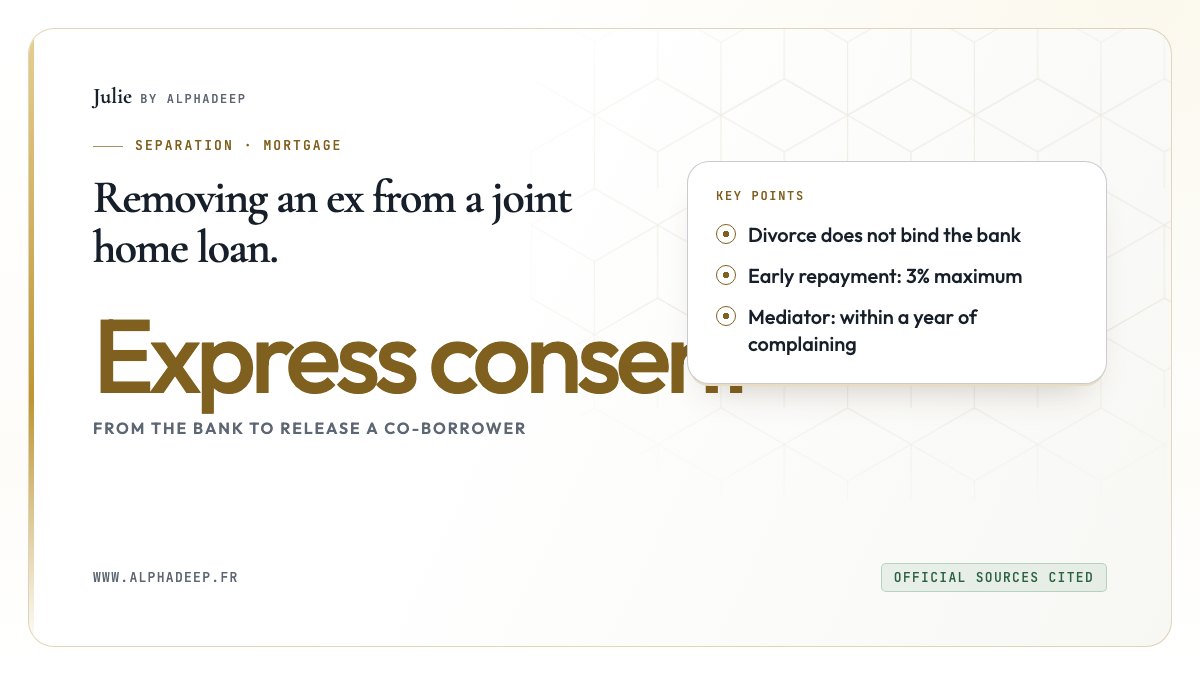
Divorce or ending a PACS does not end a co-borrower’s commitment in France: each borrower stays liable for the whole debt until the bank releases them (articles 1310 and 1313 of the Civil Code). Release requires the bank’s express agreement (article 1327-2), and the bank checks that the remaining borrower can repay alone. A divorce judgment does not bind the bank.
- Official texts cited
- Sources checked on
- Drafted with AI assistance, our method
General legal information with official references and dated checks. It is not personalised advice: for a decision that commits you, have your situation checked by a qualified professional.
Julie by AlphaDeep
You want off a joint French mortgage after separating: I can prepare the request to the bank with you.
3 free questions at signup. Avoid names and sensitive information.
Does divorce end a co-borrower’s commitment in France?
No. Co-borrowers are usually jointly and severally liable: each owes the whole debt, and the bank can claim payment from whichever it chooses. Neither the separation, nor the divorce judgment, nor an agreement between you changes that tie with the bank.
Only the bank’s express consent releases the departing co-borrower for the future. Otherwise they remain liable to pay.
Code civil, article 1313Code civil, article 1327-2Service-public: co-borrowers after divorce or separation
Can you ask for release before the divorce is final?
Yes. Nothing stops you asking as soon as you separate: the bank mainly assesses whether the remaining borrower can repay alone. In practice, the release is often settled at the same time as dividing the property or buying out the other’s share at the notary.
What should a request to release a co-borrower contain?
Enter your situation and what you are offering: the letter builds as you go, ready to copy and adapt.
Your letter to the bank
Subject: request to release a co-borrower from home loan no. [loan number]
Dear Sir or Madam,
My former partner and I are jointly and severally liable for home loan no. [loan number] taken out with [bank name]. Our divorce is under way or has been granted.
I am keeping the home and wish to repay the loan alone. I ask you to consent expressly to releasing my former partner from the loan for the future, as article 1327-2 of the French Civil Code provides.
My income allows me to meet the repayments alone: please find attached my last three payslips and my latest tax notice.
Please send me your answer in writing and, if you do not agree, the solutions you could consider.
Yours faithfully,
Attached: divorce judgment or agreement, or PACS dissolution as the case may be; loan schedule; proof of income.
The bank does not have to agree. Keep a copy of the letter and the reply: you will need them for a complaint or the mediator.
What can you offer if the bank refuses?
If the bank refuses, here are the options, from the least costly to the heaviest.
Strengthen the file
Recent income, available savings, a new split of expenses: a refusal often comes down to repayment capacity judged too low.
Offer extra security
A relative’s guarantee or a pledge over savings can make up for a borrower leaving the loan.
Complain in writing, then go to the banking mediator
Free. The mediator only examines the dispute after a written complaint to the bank, and must be contacted within a year of it.
Code de la consommation, article L612-2Service-public: the banking mediator
Have another bank buy out the loan
The new loan is in the remaining borrower’s name alone. The early repayment charge on the old loan is capped at six months’ interest and 3% of the capital outstanding.
Sell the home and repay the loan
The price repays the bank, with the same capped charge, and the balance is divided according to your rights.
Can the bank change the rate or loan terms?
The loan contract does not change by itself. The bank does not have to agree to the release and may make its consent depend on an amendment, which can change some terms: read it before signing and compare it with a buy-out by another bank.
Who pays the instalments between separation and sale or buyout?
Until the bank consents, each of you remains liable to it for the whole debt. Between yourselves, each owes only their share: whoever pays more has a claim against the other.
During divorce proceedings, the judge can name the spouse who pays all or part of the debts in the meantime.
Code civil, article 1313Code civil, article 1317Code civil, article 255
What does article 1327-2 of the Civil Code say?
Si le créancier y consent expressément, le débiteur originaire est libéré pour l’avenir. A défaut, et sauf clause contraire, il est tenu solidairement au paiement de la dette.
In plain English: If the creditor expressly consents, the original debtor is released for the future. Otherwise, unless a clause says so, they remain jointly liable for the debt.
What else do people ask?
Can a divorce judgment force the bank to release my ex?
No. The judgment governs relations between the spouses, not the commitment made to the bank: releasing a debtor requires the creditor’s express consent.
Code civil, article 1327-2Service-public: co-borrowers after divorce or separation
Can unmarried partners ask for release too?
Yes, in the same way: unmarried co-borrowers remain bound by the loan contract, and only the bank can release the one who leaves.
What does a release cost?
French law sets no fee: the bank may charge for amending the loan. Ask for the amount in writing. Buying out the other’s share at the notary has its own costs.
Can another bank take over the loan in one name?
Yes. A new loan in the name of the person keeping the home replaces the old one. The charge owed to the old bank is capped at six months’ interest and 3% of the capital outstanding.
Which texts is this guide based on?
- Code civil, article 1327-2Légifrance
- Code civil, article 1327Légifrance
- Code civil, article 1313Légifrance
- Code civil, article 1317Légifrance
- Code civil, article 1310Légifrance
- Code civil, article 255Légifrance
- Code de la consommation, article R313-25Légifrance
- Code de la consommation, article L612-2Légifrance
- Service-public: co-borrowers after divorce or separationService-public.fr
- Service-public: the banking mediatorService-public.fr
Texts cited last checked: 17 October 2026