Employment law · End of contract · documents
The French employment certificate (certificat de travail): what it must say, when it is due and what to do if it is refused
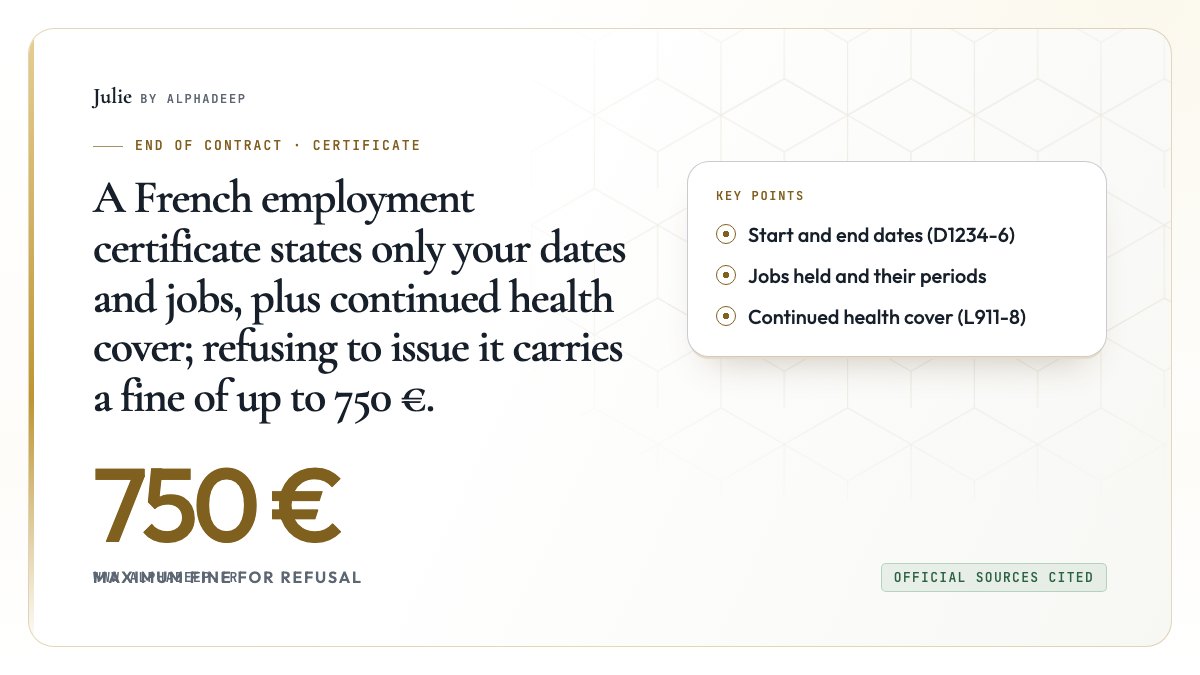
Under French law, your employer must give you a certificat de travail when the contract ends, whatever the reason (Labour Code, article L1234-19). It states only your start and end dates and the nature and periods of the jobs you held (article D1234-6), plus the continuation of your health and prévoyance cover (Social Security Code, article L911-8). Failing to issue it carries a fine of up to 750 €, and the labour court can order it in summary proceedings.
- Official texts cited
- Sources checked on
- Drafted with AI assistance, our method
General legal information with official references and dated checks. It is not personalised advice: for a decision that commits you, have your situation checked by a qualified professional.
Julie by AlphaDeep
You are leaving a job in France and are still waiting for your certificat de travail, or it looks incomplete: I can check the mentions with you and draft the request to your employer.
3 free questions at signup. Avoid names and sensitive information.
What must a French employment certificate contain?
A French employment certificate (certificat de travail) contains only two sets of entries: your start and end dates, and the nature of each job you held with the periods during which you held it. That is the closed list in article D1234-6 of the Labour Code (Code du travail), to which article L1234-19 refers.
A third entry comes from another code: your employer must state on the certificate that your company health and protection cover (mutuelle et prévoyance) continues free of charge, under article L911-8 of the Social Security Code (Code de la sécurité sociale). The company’s name, address and signature and your own name are customary but not required by the text. If your contract was transferred to a new employer, the start date is the date you were hired by the first one.
Everything else falls outside the list. According to the French administration’s guide (Service-public, checked on 12 March 2026), discriminatory or harmful wording and any mention of a non-compete clause are forbidden.
- Start date and end date (D1234-6, 1°)
- Nature of each job and its period (D1234-6, 2°)
- Continued health and protection cover (L911-8, 6°, Social Security Code)
Code du travail : article L1234-19Code du travail : article D1234-6Code de la sécurité sociale : article L911-8Service-public, Entreprendre : « Certificat de travail » (guide F87, in French, checked on 12 March 2026)
Does the certificate have to mention continued health cover?
Yes, the certificate must state that your company health and protection cover continues, under article L911-8, 6°, of the French Social Security Code. Many templates still link this entry to article D1234-6, but the two paragraphs of that article that required it were repealed on 1 January 2015; the duty now sits in the Social Security Code.
Continued cover (portabilité) is free and has three conditions: the company has collective cover, your contract ends in a way that gives you a right to unemployment benefit, and you were not dismissed for gross misconduct of the most serious kind (faute lourde). It lasts as long as your unemployment benefit, capped at the length of your last contract and at 12 months. Your employer must also tell the insurer that your contract has ended. If the entry is missing and you meet the conditions, ask for a corrected certificate and contact the insurer directly.
Code de la sécurité sociale : article L911-8Code du travail : article D1234-6
Is your French employment certificate complete?
Tick what your certificat de travail shows: the checker compares it with the list in article D1234-6 of the Labour Code and with article L911-8 of the Social Security Code, flags missing entries and wording to remove, and points to summary proceedings if nothing was issued. It checks a document; it does not decide a dispute.
Fictional example · Check of your French employment certificate
Entry missing if you meet the conditions. Article L911-8, 6°, of the Social Security Code requires the employer to state on the certificate that health and protection cover continues free of charge. Ask for a completed certificate and contact the company’s insurer.
- Certificate due from
- 2026-09-30
- Mandatory entries present
- 2
- Ask in writing for a corrected certificate, naming each entry that is missing or must be removed.
- Enclose your contract, amendments and payslips, which prove the dates and positions.
- Also check the France Travail certificate and the final pay statement, which are separate documents.
This checker compares your certificate with article D1234-6 of the Labour Code and article L911-8 of the Social Security Code. It does not replace a professional review if the matter goes to court.
What do articles L1234-19 and D1234-6 of the French Labour Code say?
A l'expiration du contrat de travail, l'employeur délivre au salarié un certificat dont le contenu est déterminé par voie réglementaire.
In plain English: Every employee in France must receive an employment certificate when the contract ends, whatever the reason for leaving. The statute sets the duty; a decree, article D1234-6, sets the content: start and end dates, and the nature and periods of the jobs held.
The continuation of health and protection cover is added by article L911-8, 6°, of the Social Security Code.
Must your employer send the certificate, or do you have to collect it?
Your employer does not have to post the certificate to you: French law treats it as a document to be collected by the employee (document quérable), which the employer must keep available for you at the workplace. The French administration’s guide states this rule (Service-public, checked on 12 March 2026).
The certificate is due when the contract ends, which means at the end of the notice period. If your employer released you from working your notice, it is due on the date that notice would have ended. If you have moved away or cannot travel, ask in writing for it to be sent, by registered letter (lettre recommandée) or by dated email. That request also proves, later, that you asked for the document and when.
Service-public, Entreprendre : « Certificat de travail » (guide F87, in French, checked on 12 March 2026)Code du travail : article L1234-19
What can you do if your employer refuses or delays the certificate?
If your employer refuses or delays, first demand the certificate by registered letter, then apply to the summary-proceedings panel of the labour court (formation de référé du conseil de prud’hommes), which can order the employer to hand it over. Because the duty to issue a certificate at the end of a contract cannot seriously be disputed, article R1455-7 of the Labour Code allows the summary judge to order the employer to perform it.
Article R1455-6 also lets the judge stop a clearly unlawful situation, even if the employer disputes the claim. You can also ask the labour court for damages if the missing or late certificate caused you a loss, such as a delayed job start or delayed benefits. Describe that loss and bring documents to prove it.
Refusing is also a minor criminal offence: under article R1238-3 of the Labour Code, failing to issue the certificate carries a fourth-class fine of up to 750 € (article 131-13 of the Criminal Code), and up to 3 750 € for a company, since fines for legal entities are five times higher (article 131-41).
Code du travail : article R1455-7Code du travail : article R1455-6Service-public, Entreprendre : « Certificat de travail » (guide F87, in French, checked on 12 March 2026)Code du travail : article R1238-3Code pénal : article 131-13Code pénal : article 131-41
What does an employer risk by not issuing the certificate?
Failing to issue the certificate is a minor criminal offence. The amounts below are legal maximums that a criminal court may impose, not automatic penalties.
- Maximum fine for an employer who is an individual (fourth-class offence)
- 750 €
- Criminal Code in force since 2005 · Code pénal, article 131-13, 4°, and Code du travail, article R1238-3
- Maximum fine for an employer that is a company (five times the individual amount)
- 3 750 €
- Criminal Code in force since 1994 · Code pénal, article 131-41
- Fine stated by the French administration for not providing the certificate
- 750 €
- Guide checked on 12 March 2026 · Service-public, Entreprendre, guide F87 « Certificat de travail »
Which mentions are mandatory, allowed or forbidden?
| Mention | Status | Source |
|---|---|---|
| Start date and end date | Mandatory | Labour Code, article D1234-6, 1° |
| Nature of each job held and its periods | Mandatory | Labour Code, article D1234-6, 2° |
| Continued free health and protection cover | Mandatory when the employee qualifies | Social Security Code, article L911-8, 6° |
| Employer’s name, address and signature; employee’s name | Optional, customary | Service-public, guide F87 |
| Performance review, reason for leaving | Outside the legal list; refuse it if you did not ask for it | Labour Code, article D1234-6 (« exclusivement ») |
| Non-compete clause | Forbidden | Service-public, guide F87 |
| Discriminatory wording or wording that could harm the employee | Forbidden | Service-public, guide F87 |
Continued cover used to be listed in paragraphs 3° and 4° of article D1234-6, repealed since 1 January 2015.
Code du travail : article D1234-6Code de la sécurité sociale : article L911-8Service-public, Entreprendre : « Certificat de travail » (guide F87, in French, checked on 12 March 2026)
Employment certificate, France Travail certificate, final pay statement: what is the difference?
These are three separate documents your employer hands over when the contract ends: the employment certificate proves your jobs and dates, the France Travail certificate (attestation France Travail) supports your unemployment benefit claim, and the final pay statement (solde de tout compte) lists the sums paid to you.
The France Travail certificate comes from article R1234-9 of the Labour Code: your employer gives it to you when the contract ends and sends it without delay to France Travail, the public employment service, electronically if the company has at least eleven employees. The final pay statement, under article L1234-20, lists the amounts paid on termination. Once you sign the receipt, you have six months to challenge it; after that it releases the employer for the amounts it lists.
None of these documents replaces the others. Check all three, and do not sign the final pay receipt before checking the amounts.
Code du travail : article L1234-19Code du travail : article R1234-9Code du travail : article L1234-20
What else do people ask about the French employment certificate?
Is a certificate due after a resignation or a rupture conventionnelle?
Yes, a French employment certificate is due after a resignation or a negotiated termination (rupture conventionnelle), just as after a dismissal. Article L1234-19 of the Labour Code requires it at the end of every employment contract, and the French administration confirms it is issued whatever the way the contract ended. It is due at the end of the notice period, even if the notice is not worked.
Code du travail : article L1234-19Service-public, Entreprendre : « Certificat de travail » (guide F87, in French, checked on 12 March 2026)
Can a French employment certificate include a reference or performance review?
No, a French employment certificate is not a reference: article D1234-6 of the Labour Code says it contains only your dates and the jobs you held. If your employer adds a review or a reason for leaving that you did not ask for, ask for a certificate limited to the legal entries. A reference letter, if you want one, is a separate document.
Do you get a certificate at the end of a fixed-term or temp contract?
Yes, a French employment certificate is due at the end of a fixed-term contract (CDD) or a temporary assignment (mission d’intérim), just as for a permanent contract. The French administration states the employer issues it whatever the type of contract. For temp work, your employer is the temporary work agency, so the agency issues the certificate, not the company where you worked.
Code du travail : article L1234-19Service-public, Entreprendre : « Certificat de travail » (guide F87, in French, checked on 12 March 2026)
Can you claim damages for a certificate handed over late?
Yes, the French labour court can award damages for a certificate handed over late or never issued, provided this caused you a loss. The French administration notes that a missing or late certificate can harm the employee. Bring evidence of the loss, such as a job offer you could not take up or unemployment benefit paid late.
You worked in Switzerland and live in France: which certificate rules apply?
If you worked in Switzerland under a Swiss contract, your work certificate follows article 330a of the Swiss Code of Obligations, not the French Labour Code. You may ask for it at any time, and it covers the quality of your work and your conduct unless you ask for a simple version. The Swiss Federal Supreme Court allows ten years to claim or correct it (ATF 147 III 78). Within Switzerland, article 34 of the Swiss Civil Procedure Code lets you sue where you usually worked.
Code des obligations (CO), art. 330a (in French)Code de procédure civile (CPC), art. 34 (in French)Federal Supreme Court, ATF 147 III 78 (in French)
Which French texts back this guide to the employment certificate?
- Code du travail : article L1234-19République française / DILA : Légifrance
- Code du travail : article D1234-6République française / DILA : Légifrance
- Code de la sécurité sociale : article L911-8République française / DILA : Légifrance
- Service-public, Entreprendre : « Certificat de travail » (guide F87, in French, checked on 12 March 2026)French Directorate of Legal and Administrative Information (DILA)
- Code du travail : article R1455-7République française / DILA : Légifrance
- Code du travail : article R1238-3République française / DILA : Légifrance
- Code pénal : article 131-13République française / DILA : Légifrance
- Code pénal : article 131-41République française / DILA : Légifrance
- Code du travail : article R1234-9République française / DILA : Légifrance
- Code du travail : article L1234-20République française / DILA : Légifrance
- Code du travail : article R1455-6République française / DILA : Légifrance
- Code des obligations (CO), art. 330a (in French)Swiss Confederation, Fedlex
- Code de procédure civile (CPC), art. 34 (in French)Swiss Confederation, Fedlex
- Federal Supreme Court, ATF 147 III 78 (in French)Swiss Federal Supreme Court
Texts cited last checked: 30 October 2026