Employment law · Dismissal · compensation
Unfair dismissal compensation in France: how the Macron scale works
If a French labour court finds your dismissal had no real and serious cause and reinstatement is refused, compensation follows the Macron scale in article L1235-3 of the Labour Code: at most 1 month of gross salary in the first year, up to 20 months from 29 years’ service, with a 3-month minimum from 2 years (lower minimums under 11 employees). A void dismissal escapes the scale: 6 months minimum.
- Official texts cited
- Sources checked on
- Drafted with AI assistance, our method
General legal information with official references and dated checks. It is not personalised advice: for a decision that commits you, have your situation checked by a qualified professional.
Julie by AlphaDeep
You think your dismissal in France was unfair: tell me your length of service, the headcount and your salary, and I will place the award on the Macron scale and check whether a nullity case lifts the cap.
3 free questions at signup. Avoid names and sensitive information.
How many months of salary for unfair dismissal in France?
For a dismissal without real and serious cause (licenciement sans cause réelle et sérieuse) in France, compensation runs from at most 1 month of gross salary in the first year of service to at most 20 months from 29 years, with a 3-month minimum from 2 years in a company of 11 employees or more. This is the Macron scale (barème Macron) in article L1235-3 of the French Labour Code (Code du travail).
It applies only if the labour court (conseil de prud’hommes) finds the dismissal unjustified and either side refuses the reinstatement the judge may propose. The judge then sets the amount between the minimum and maximum of your line, counted in full years of service. According to article L1235-3, the maximum rises by about one month a year up to 10 years (10 months), then more slowly, usually half a month a year, up to 20 months.
Example: with 7 years’ service and €2,600 gross a month, the range is 3 months (€7,800) to 8 months (€20,800).
Is the scale different in a company with fewer than 11 employees?
Yes, but only the minimums: in a company that usually employs fewer than 11 people, article L1235-3 sets lower floors up to 10 years of service, while the maximums stay those of the general scale.
The reduced minimums are 0.5 month of gross salary for 1 and 2 years of service, 1 month for 3 and 4 years, 1.5 months for 5 and 6 years, 2 months for 7 and 8 years and 2.5 months for 9 and 10 years. Beyond 10 years that table stops, so the general 3-month minimum applies.
The ceiling does not drop: an employee of an 8-person firm with 7 years’ service can receive up to 8 months, as in a large company. Only the bottom of the range changes (2 months instead of 3).
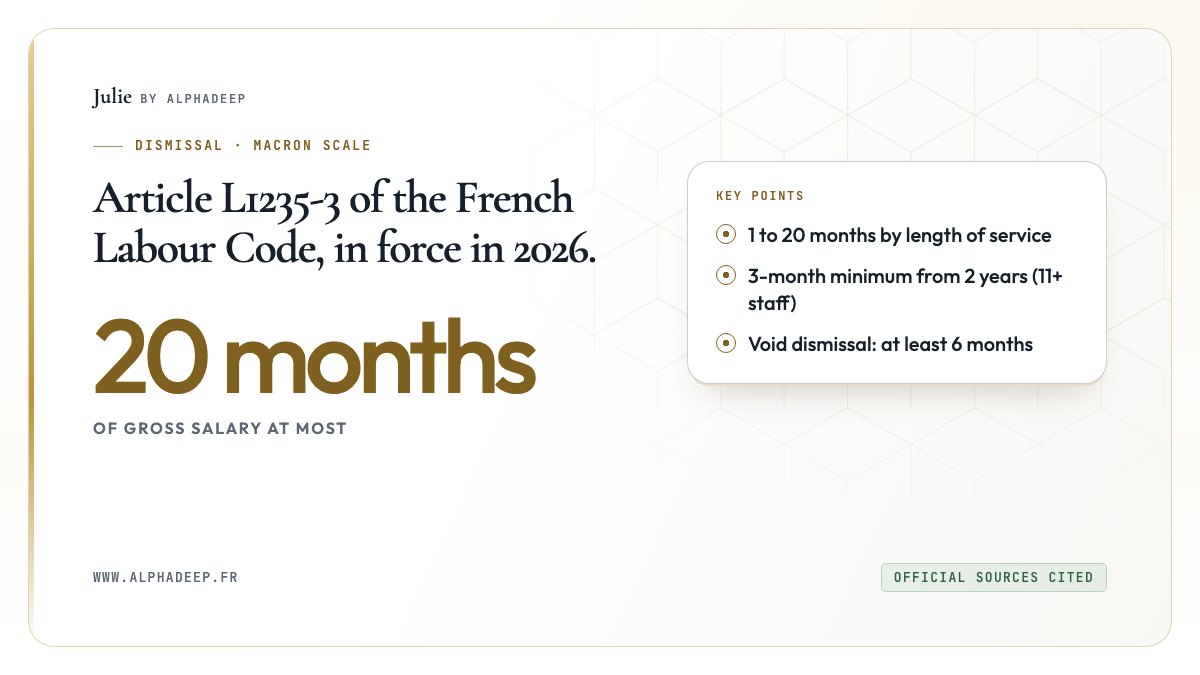
Which figures frame the Macron scale?
Five figures frame any unfair dismissal claim in France, all set by the Labour Code.
- Maximum award, reached at 29 years of service
- 20 months
- in force in 2026 · French Labour Code, article L1235-3
- Minimum award from 2 years of service (11 employees or more)
- 3 months
- in force in 2026 · French Labour Code, article L1235-3
- Minimum for a void dismissal, with no ceiling
- 6 months
- in force in 2026 · French Labour Code, article L1235-3-1
- Time limit to challenge the dismissal, from notification
- 12 months
- in force in 2026 · French Labour Code, article L1471-1
- Unemployment benefit the employer may have to repay to France Travail, at most
- 6 months
- in force in 2026 · French Labour Code, article L1235-4
What range of compensation matches your seniority?
Enter the type of dismissal, your length of service, the headcount and your gross salary: the worksheet reads the article L1235-3 table and shows the range in euros. It applies the scale; it does not tell you whether a French judge will find the dismissal unjustified.
Fictional example · Your range on the Macron scale
If the judge finds no real and serious cause and reinstatement is refused, the award falls inside this range (article L1235-3) and cannot exceed the maximum unless the dismissal is void. Statutory severance pay comes on top.
- Scale minimum (3 months of gross salary)
- €7,800.00
- Scale maximum
- €20,800.00
- Statutory severance pay (article L1234-9)
- On top, from 8 months’ service, except gross misconduct
- Indicative deadline to file with the labour court (12 months)
- 2027-09-15
- File with the labour court (conseil de prud’hommes) before 2027-09-15: claims about the dismissal are time-barred 12 months after notification (article L1471-1).
- Reread the dismissal letter: the grounds it states set the limits of the dispute (article L1235-2).
- Work out your statutory severance pay separately; it comes on top of this range (articles L1234-9 and R1234-2).
- Compare any settlement or conciliation offer with this range before you sign.
Legal range based on the gross salary you enter. The final amount depends on the judge’s assessment and on proof that the dismissal lacked real and serious cause.
When does the Macron scale not apply?
The Macron scale does not apply when the judge finds the dismissal void (licenciement nul) on one of the six grounds of article L1235-3-1 of the French Labour Code; compensation is then at least the last six months of salary, with no ceiling.
The six grounds are:
- breach of a fundamental freedom;
- moral or sexual harassment;
- discriminatory dismissal;
- dismissal after a court action on equal treatment of women and men, or after reporting crimes or offences;
- dismissal of an employee representative because of their mandate;
- breach of the protection linked to maternity, paternity, or a work accident or occupational disease (articles L1225-71 and L1226-13).
French Labour Code: article L1235-3-1French Labour Code: article L1152-3
What are the minimum and maximum awards by seniority?
| Seniority (full years) | Minimum, 11 employees or more | Minimum, under 11 employees | Maximum |
|---|---|---|---|
| Under 1 year | Not applicable | Not applicable | 1 month |
| 1 year | 1 month | 0.5 month | 2 months |
| 2 years | 3 months | 0.5 month | 3.5 months |
| 5 years | 3 months | 1.5 months | 6 months |
| 10 years | 3 months | 2.5 months | 10 months |
| 15 years | 3 months | 3 months (general scale) | 13 months |
| 20 years | 3 months | 3 months (general scale) | 15.5 months |
| 29 years or more | 3 months | 3 months (general scale) | 20 months |
The table for companies with fewer than 11 employees stops at 10 years of service; beyond that, the general minimum applies. Every other year is in the article quoted below and in the calculator.
What does article L1235-3 of the French Labour Code say?
Si le licenciement d'un salarié survient pour une cause qui n'est pas réelle et sérieuse, le juge peut proposer la réintégration du salarié dans l'entreprise, avec maintien de ses avantages acquis.
Si l'une ou l'autre des parties refuse cette réintégration, le juge octroie au salarié une indemnité à la charge de l'employeur, dont le montant est compris entre les montants minimaux et maximaux fixés dans le tableau ci-dessous.
[…]
Cette indemnité est cumulable, le cas échéant, avec les indemnités prévues aux articles L. 1235-12, L. 1235-13 et L. 1235-15, dans la limite des montants maximaux prévus au présent article.
In plain English: If the dismissal has no real and serious cause, the judge may propose reinstatement. If either side refuses, the judge awards compensation between the minimum and maximum of the table for your length of service. The award can be combined with some other indemnities, within the maximum.
The full year-by-year table is in the calculator and the table above.
Can a French judge award more than the Macron scale maximum?
No: a French judge cannot exceed the scale maximum because of the employee’s personal situation. In a ruling of 11 May 2022 (no. 21-14.490), the social chamber of the Cour de cassation, France’s highest civil court, held article L1235-3 compatible with article 10 of ILO Convention no. 158 and overturned a decision that had awarded more than the cap.
The judge weighs your actual situation (age, difficulty finding work, family responsibilities) to place the amount inside the range, and must explain the amount awarded (article L1235-1). Only a nullity case under article L1235-3-1 lifts the cap. Within the maximums, the award can also be combined with some specific indemnities under articles L1235-12, L1235-13 and L1235-15.
Cour de cassation, social chamber, 11 May 2022, no. 21-14.490French Labour Code: article L1235-1French Labour Code: article L1235-3-1French Labour Code (Code du travail): article L1235-3
Do you receive statutory severance pay on top of the award?
Yes: statutory severance pay (indemnité légale de licenciement) is due from 8 months’ uninterrupted service, except for gross misconduct (faute grave), and the Macron scale award comes on top if the dismissal is found to lack real and serious cause.
Article L1235-3 lets the judge take into account severance paid on termination when setting the award, except the statutory severance pay of article L1234-9, which therefore does not reduce it. According to article R1234-2, statutory severance pay is at least a quarter of a month’s salary per year up to 10 years, then a third of a month per year beyond.
With 7 years’ service and €2,600 gross, the minimum statutory severance pay is €4,550 (7 × €650), added to the €7,800 to €20,800 range. A more generous amount under a collective agreement (convention collective) replaces the statutory one.
French Labour Code: article L1234-9French Labour Code (Code du travail): article L1235-3French Labour Code: article R1234-2
What else do people ask about the Macron scale?
Is the Macron scale calculated on gross or net salary?
The Macron scale is calculated on gross salary: article L1235-3 of the French Labour Code expresses the minimum and maximum in months of gross salary. Statutory severance pay is also based on gross pay before the dismissal (article L1234-9). Use your gross monthly salary, including regular bonuses, not the net amount paid into your account.
French Labour Code (Code du travail): article L1235-3French Labour Code: article L1234-9
How long do you have to challenge a dismissal in France?
In France, you have 12 months from the notification of the dismissal to bring a claim about it before the labour court (article L1471-1 of the Labour Code). This limit does not apply to claims based on discrimination, moral harassment or sexual harassment, which the same article excludes, nor to claims for unpaid salary.
Will your employer have to repay the unemployment benefit you received?
Usually yes. When a French court finds a dismissal without real and serious cause, or void for harassment or discrimination, it orders the employer to repay France Travail (the public employment service) some or all of the unemployment benefit paid between the dismissal and the judgment, up to six months of benefit (article L1235-4). This is a separate order in favour of the agencies, not a deduction from your award.
Does proven harassment always set the Macron scale aside?
Not always. The Macron scale is set aside when the judge finds the dismissal void for moral or sexual harassment, meaning the dismissal breached the harassment rules (articles L1235-3-1 and L1152-3 of the French Labour Code). Compensation is then at least six months of salary. If the judge only finds that the dismissal lacked real and serious cause, the scale applies.
French Labour Code: article L1235-3-1French Labour Code: article L1152-3
You work in Switzerland but live in France: does the Macron scale apply?
Usually not. Under Swiss private international law (article 121 of the Federal Act on Private International Law), an employment contract is governed by the law of the country where the work is habitually done, unless the parties chose the law of the employee’s residence. Swiss law has no Macron scale: the indemnity for abusive dismissal is capped at six months of salary (article 336a of the Code of Obligations).
Swiss Federal Act on Private International Law (PILA), art. 121 (in French)Swiss Code of Obligations, art. 336a (in French)
Which French texts back this calculation?
- French Labour Code (Code du travail): article L1235-3French Republic / DILA: Légifrance
- French Labour Code: article L1235-3-1French Republic / DILA: Légifrance
- French Labour Code: article L1152-3French Republic / DILA: Légifrance
- Cour de cassation, social chamber, 11 May 2022, no. 21-14.490French Republic / DILA: Légifrance
- French Labour Code: article L1235-1French Republic / DILA: Légifrance
- French Labour Code: article L1234-9French Republic / DILA: Légifrance
- French Labour Code: article R1234-2French Republic / DILA: Légifrance
- French Labour Code: article L1471-1French Republic / DILA: Légifrance
- French Labour Code: article L1235-4French Republic / DILA: Légifrance
- Swiss Federal Act on Private International Law (PILA), art. 121 (in French)Swiss Confederation: Fedlex
- Swiss Code of Obligations, art. 336a (in French)Swiss Confederation: Fedlex
Texts cited last checked: 30 October 2026