Housing and property · Housing · rent
Defects and repairs in a French rental: getting a rent reduction without withholding rent
Under French law, a tenant may not simply stop paying rent because the home has defects: only a home made uninhabitable can justify suspending payment. The safe route is a written formal notice, then, with no answer within two months, the departmental conciliation commission or the judge directly, who can reduce or suspend the rent (law of 6 July 1989, article 20-1). Urgent works lasting more than 21 days also give a rent reduction (Civil Code, article 1724).
- Official texts cited
- Sources checked on
- Drafted with AI assistance, our method
General legal information with official references and dated checks. It is not personalised advice: for a decision that commits you, have your situation checked by a qualified professional.
Julie by AlphaDeep
Your French rental has a defect or long works: I can tell you whether a rent reduction is possible, which route applies, and draft the formal notice in French.
3 free questions at signup. Avoid names and sensitive information.
Can you stop paying rent in France until the landlord carries out repairs?
No: a tenant in France may not stop paying rent on their own because the landlord has not carried out repairs. Article 7 of the law of 6 July 1989 requires the tenant to pay the rent on the agreed dates, and the official site Service-public.fr states that a tenant must never stop paying all or part of the rent for this reason.
The Civil Code (Code civil) does let one party refuse to perform when the other fails to perform, but only if that failure is sufficiently serious (article 1219, the withholding performance defence or exception d’inexécution), and an advance suspension must be notified promptly (article 1220). In practice this means a home that has become impossible to live in, and a judge decides afterwards whether the failure was serious enough. If not, the rent you held back is still owed and you are in arrears.
The safe route is the reverse: keep paying, send a written formal notice (mise en demeure), then ask the judge to reduce or suspend the rent, a power article 20-1 of the 1989 law gives the judge.
Law no. 89-462 of 6 July 1989: article 7, in FrenchService-public.fr: Logement à louer décent (F2042), checked 21 March 2025, in FrenchFrench Civil Code (Code civil): article 1219 (withholding performance), in FrenchFrench Civil Code: article 1220 (anticipatory suspension), in FrenchLaw no. 89-462 of 6 July 1989: article 20-1, in French
What does article 20-1 of the law of 6 July 1989 say?
Si le logement loué ne satisfait pas aux dispositions des premier et deuxième alinéas de l'article 6, le locataire peut demander au propriétaire sa mise en conformité sans qu'il soit porté atteinte à la validité du contrat en cours. A défaut d'accord entre les parties ou à défaut de réponse du propriétaire dans un délai de deux mois, la commission départementale de conciliation peut être saisie et rendre un avis dans les conditions fixées à l'article 20. La saisine de la commission ou la remise de son avis ne constitue pas un préalable à la saisine du juge par l'une ou l'autre des parties.
[…]
Le juge saisi par l'une ou l'autre des parties détermine, le cas échéant, la nature des travaux à réaliser et le délai de leur exécution. Il peut réduire le montant du loyer ou suspendre, avec ou sans consignation, son paiement et la durée du bail jusqu'à l'exécution de ces travaux. Le juge transmet au représentant de l'Etat dans le département l'ordonnance ou le jugement constatant que le logement loué ne satisfait pas aux dispositions des premier et deuxième alinéas de l'article 6.
In plain English: If the home is substandard, the tenant first asks the landlord to bring it up to standard, and the lease continues. With no agreement or answer within two months, the optional commission can be asked for an opinion. Only the judge can order works, reduce the rent or suspend its payment.
Paragraph 2 of the same article adds that a CAF or MSA notice to the landlord counts as the tenant’s request.
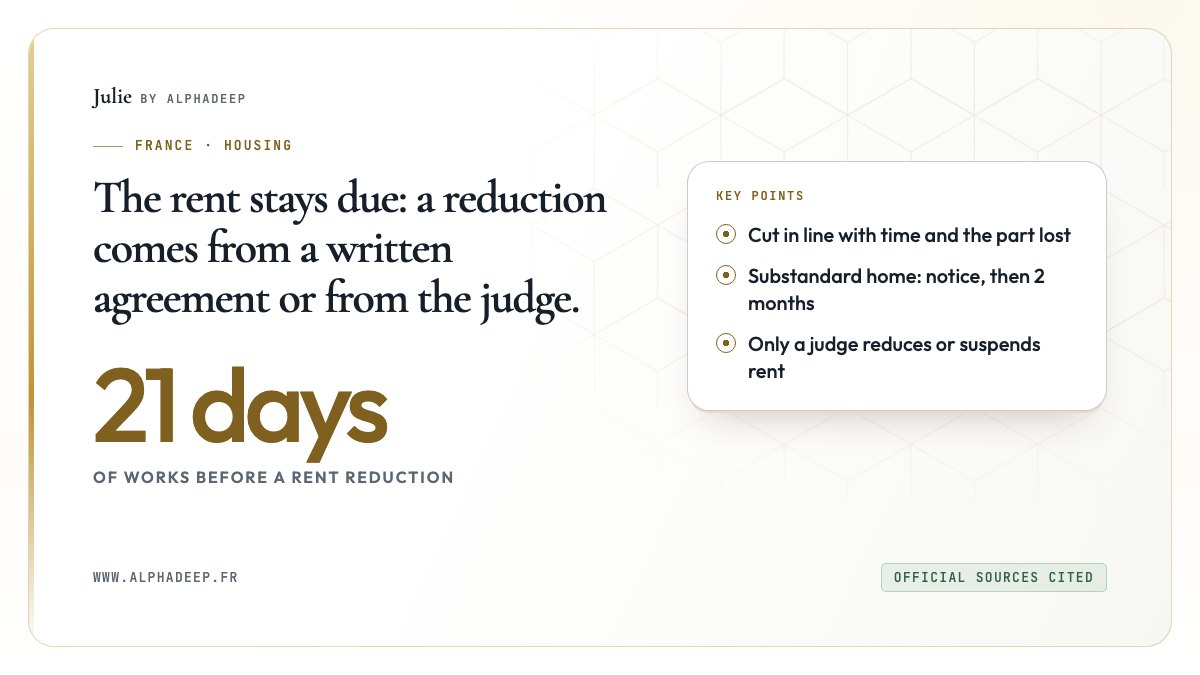
Which deadlines and thresholds frame a rent reduction in France?
The figures set by the texts and restated by the French administration.
- Length of urgent works beyond which the rent is reduced
- 21 days
- In force · French Civil Code, article 1724
- Wait with no answer to the formal notice before the commission or judge (substandard home)
- 2 months
- Page checked 21 March 2025 · Service-public.fr, page F2042
- Maximum time for the departmental conciliation commission’s opinion
- 2 months
- Page checked 3 May 2024 · Service-public.fr, page F1216
- Minimum main room in a decent home (or 20 m³)
- 9 m², 2.20 m
- Since 1 July 2021 · Decree no. 2002-120 of 30 January 2002, article 4
- Energy classes allowed for a decent home in mainland France
- A to F
- Since 1 January 2025 (A to E from 2028, A to D from 2034) · Law no. 89-462 of 6 July 1989, article 6
Which defects are the landlord’s job and which are yours?
The landlord is responsible for anything that makes the home substandard or unfit for use, and for every repair other than the tenant’s minor repairs (réparations locatives); the tenant handles routine upkeep and small repairs. The Civil Code requires the landlord to provide a decent home (logement décent), keep it fit for its use and guarantee quiet enjoyment (article 1719), and to carry out all necessary repairs during the lease other than the tenant’s minor repairs (article 1720).
The 1989 law makes the tenant responsible for routine upkeep of the home and fittings, small repairs and the minor repairs listed by decree, unless they result from wear and tear, poor workmanship, a construction defect, an accident or force majeure (article 7, d). A decent home must have, among other things, a heating system able to heat it normally, hot and cold water and an indoor bathroom (decree of 30 January 2002, article 3), and a main room of at least 9 m² (article 4).
- Broken boiler, leaking roof, windows that no longer close: landlord.
- Seals, light bulbs, the yearly servicing set in the lease, small wear repairs: tenant, unless caused by age or poor workmanship.
French Civil Code: article 1719, in FrenchFrench Civil Code: article 1720, in FrenchLaw no. 89-462 of 6 July 1989: article 7, in FrenchLaw no. 89-462 of 6 July 1989: article 6, in FrenchDecree no. 2002-120 of 30 January 2002: article 3 (equipment), in FrenchDecree no. 2002-120 of 30 January 2002: article 4 (floor area), in French
How do you ask for a reduction: formal notice, commission or judge?
Start with a registered letter with proof of delivery listing each defect and asking for the work; if the landlord refuses or does not answer, a formal notice (mise en demeure) starts a 2-month period, after which you can go to the departmental conciliation commission (commission départementale de conciliation) or straight to the judge. For a substandard home, this two-month period is set by article 20-1 of the law of 6 July 1989.
The commission is optional and free. It has equal numbers of landlord and tenant representatives and gives its opinion within 2 months of the referral (article 20 of the 1989 law). According to Service-public.fr, you refer a case by registered letter, by a printable form or online, depending on the département, enclosing the lease and supporting documents. Its opinion can be sent to the judge but is not a precondition: you can go directly to the local judge for tenancy disputes (juge des contentieux de la protection) at the court for the area where the home is.
Service-public.fr: Logement à louer décent (F2042), checked 21 March 2025, in FrenchLaw no. 89-462 of 6 July 1989: article 20-1, in FrenchService-public.fr: Dans quel cas saisir la commission départementale de conciliation (F1216), checked 3 May 2024, in FrenchLaw no. 89-462 of 6 July 1989: article 20, in French
What can a French judge order for a defective or substandard rental?
A French judge (juge des contentieux de la protection) can decide which works must be done and by when, reduce the rent, or suspend payment of the rent, with or without paying it into a blocked account (consignation), and suspend the running of the lease until the works are done (article 20-1 of the law of 6 July 1989). The judge then sends the ruling that finds the home substandard to the prefect.
The judge can also award damages: the landlord must compensate the loss caused by defects that prevent use of the home, even defects the landlord did not know about (article 1721 of the Civil Code). For urgent works lasting more than 21 days, the judge applies the proportional reduction of article 1724.
There is no official scale. The judge weighs how serious the defect is, which part of the home it affects and for how long. Your file matters more than any percentage found online: dated letters, photos, reports, quotes and the landlord’s replies.
Law no. 89-462 of 6 July 1989: article 20-1, in FrenchFrench Civil Code: article 1721, in FrenchFrench Civil Code: article 1724, in FrenchService-public.fr: Logement à louer décent (F2042), checked 21 March 2025, in French
Works, poor upkeep, substandard home: which route for which problem?
| Situation | What you can obtain | Steps | Text |
|---|---|---|---|
| Urgent works lasting more than 21 days | Rent reduced in proportion to time and the part lost | Written request, then the judge if no agreement | Civil Code, art. 1724, para. 2 |
| Works making the home uninhabitable | Ending the lease | Request to the landlord, then the judge | Civil Code, art. 1724, para. 3 |
| Landlord repair not carried out | Works carried out, compensation for the loss suffered | Formal notice, optional commission, judge | Civil Code, arts. 1719, 1720 and 1721 |
| Substandard (non-decent) home | Works ordered, rent reduced or suspended by the judge | Formal notice, 2 months, optional commission, judge | Law of 6 July 1989, arts. 6 and 20-1 |
| Substandard home found by the CAF or MSA | Benefit held back by the payer; rent paid minus the benefit is not arrears | Payer’s finding notified to the landlord | CCH, art. L843-1; 1989 law, art. 7 |
| Routine upkeep, small repairs | Nothing: these stay with you | Do them, unless due to age or poor workmanship | Law of 6 July 1989, art. 7, d |
In every case the rent remains due until an agreement or a judge’s decision reduces it.
French Civil Code: article 1724, in FrenchFrench Civil Code: article 1719, in FrenchFrench Civil Code: article 1720, in FrenchFrench Civil Code: article 1721, in FrenchLaw no. 89-462 of 6 July 1989: article 20-1, in FrenchFrench Construction and Housing Code (CCH): article L843-1, in FrenchLaw no. 89-462 of 6 July 1989: article 7, in French
How much can you get for works lasting more than 21 days?
Two modes. For urgent works, the worksheet computes the proportional reduction of article 1724 from your own figures. For a defect or substandard home, it dates the steps. It sets no rate and does not predict what a judge will decide.
Fictional example · Your estimate and next steps
Beyond 21 days, the rent is reduced in proportion to the time and to the part of the home you lost (Civil Code, article 1724). The article sets no rate or method: ask in writing for the amount below and, failing agreement, go to the judge.
- Estimated reduction for the works period
- €315.00
- Keep paying the full rent unless a judge decides otherwise.
- Write to the landlord by registered letter: dates of the works, rooms lost and the €315.00 you claim.
- Without agreement, go to the local judge for tenancy disputes with the lease and your evidence.
Straight-line calculation from your figures: rent × share lost × days ÷ monthly basis. It prepares a claim; the final amount depends on an agreement or the judge.
Mould and damp: a defect of the home or a lack of ventilation?
Mould is the landlord’s responsibility when it comes from the building or from inadequate ventilation, and the tenant’s when it results from the tenant failing to carry out routine upkeep. The decree of 30 January 2002 requires the home to keep out water infiltration and rising damp, and its openings and ventilation devices to remove humidity in a way suited to normal occupation (article 2, points 1 and 6).
The tenant, for their part, owes routine upkeep of the home and of the fittings listed in the lease (article 7, d, of the 1989 law). The dispute therefore turns on evidence: where does the water come from, and does the ventilation work?
- Dated photos of the stains and of the air vents, room by room.
- Humidity readings over several weeks with normal heating and airing.
- Your written reports to the landlord and the replies.
- If possible, a technical opinion on the cause (leak, thermal bridge, broken mechanical ventilation).
Decree no. 2002-120 of 30 January 2002: article 2 (safety, health, ventilation), in FrenchLaw no. 89-462 of 6 July 1989: article 7, in FrenchService-public.fr: Logement à louer décent (F2042), checked 21 March 2025, in French
What else do tenants in France ask before claiming a rent reduction?
Can the CAF stop paying your housing benefit to the landlord for a substandard home?
Yes. When the CAF or MSA (the bodies paying housing benefit) finds that a home is not decent, it holds back the housing benefit for a maximum period set by regulation and notifies the landlord. The tenant then pays the rent minus the benefit, and this partial payment cannot be used to end the lease (French Construction and Housing Code, article L843-1; law of 6 July 1989, article 7).
French Construction and Housing Code (CCH): article L843-1, in FrenchLaw no. 89-462 of 6 July 1989: article 7, in French
Is the departmental conciliation commission free to use?
Yes, the French departmental conciliation commission works free of charge. Referral is optional for disputes about decency and repairs. It gives its opinion within 2 months of the referral at the latest, and either party may send that opinion to the judge.
Service-public.fr: Dans quel cas saisir la commission départementale de conciliation (F1216), checked 3 May 2024, in FrenchLaw no. 89-462 of 6 July 1989: article 20, in French
Can you claim damages for the disruption you have already suffered?
Yes. Under French law the landlord guarantees the tenant against defects that prevent use of the home, even unknown ones, and must compensate the resulting loss (Civil Code, article 1721). This past loss of quiet enjoyment (trouble de jouissance) is assessed by the judge on evidence: how long, which rooms, costs incurred, belongings damaged.
French Civil Code: article 1721, in FrenchFrench Civil Code: article 1719, in French
Renting in Geneva or Vaud instead: how do the Swiss rules differ?
In Switzerland the Code of Obligations applies, not French law. The rent reduction is proportional and runs from the moment the landlord learned of the defect until it is removed (CO, art. 259d). A tenant may pay future rents into an office designated by the canton after setting a written deadline and announcing it in writing (art. 259g), then must bring the claims before the conciliation authority within 30 days of the first rent paid in, or that money goes to the landlord (art. 259h).
Swiss Code of Obligations (CO): art. 259d, in FrenchSwiss Code of Obligations (CO): art. 259g, in FrenchSwiss Code of Obligations (CO): art. 259h, in French
Which French texts back the rent reduction and the judge’s powers?
- French Civil Code (Code civil): article 1219 (withholding performance), in FrenchFrench Republic / DILA: Légifrance
- French Civil Code: article 1220 (anticipatory suspension), in FrenchFrench Republic / DILA: Légifrance
- Service-public.fr: Logement à louer décent (F2042), checked 21 March 2025, in FrenchDirectorate of Legal and Administrative Information (DILA)
- Law no. 89-462 of 6 July 1989: article 20-1, in FrenchFrench Republic / DILA: Légifrance
- French Civil Code: article 1719, in FrenchFrench Republic / DILA: Légifrance
- French Civil Code: article 1720, in FrenchFrench Republic / DILA: Légifrance
- Law no. 89-462 of 6 July 1989: article 6, in FrenchFrench Republic / DILA: Légifrance
- Law no. 89-462 of 6 July 1989: article 7, in FrenchFrench Republic / DILA: Légifrance
- Decree no. 2002-120 of 30 January 2002: article 3 (equipment), in FrenchFrench Republic / DILA: Légifrance
- Decree no. 2002-120 of 30 January 2002: article 4 (floor area), in FrenchFrench Republic / DILA: Légifrance
- Service-public.fr: Dans quel cas saisir la commission départementale de conciliation (F1216), checked 3 May 2024, in FrenchDirectorate of Legal and Administrative Information (DILA)
- Law no. 89-462 of 6 July 1989: article 20, in FrenchFrench Republic / DILA: Légifrance
- French Civil Code: article 1721, in FrenchFrench Republic / DILA: Légifrance
- French Civil Code: article 1724, in FrenchFrench Republic / DILA: Légifrance
- Decree no. 2002-120 of 30 January 2002: article 2 (safety, health, ventilation), in FrenchFrench Republic / DILA: Légifrance
- French Construction and Housing Code (CCH): article L843-1, in FrenchFrench Republic / DILA: Légifrance
- Swiss Code of Obligations (CO): art. 259d, in FrenchSwiss Confederation: Fedlex
- Swiss Code of Obligations (CO): art. 259g, in FrenchSwiss Confederation: Fedlex
- Swiss Code of Obligations (CO): art. 259h, in FrenchSwiss Confederation: Fedlex
Texts cited last checked: 30 October 2026