Housing and property · Housing · notice to quit
Landlord notice to quit in France: the allowed grounds, the notice period and how to challenge it
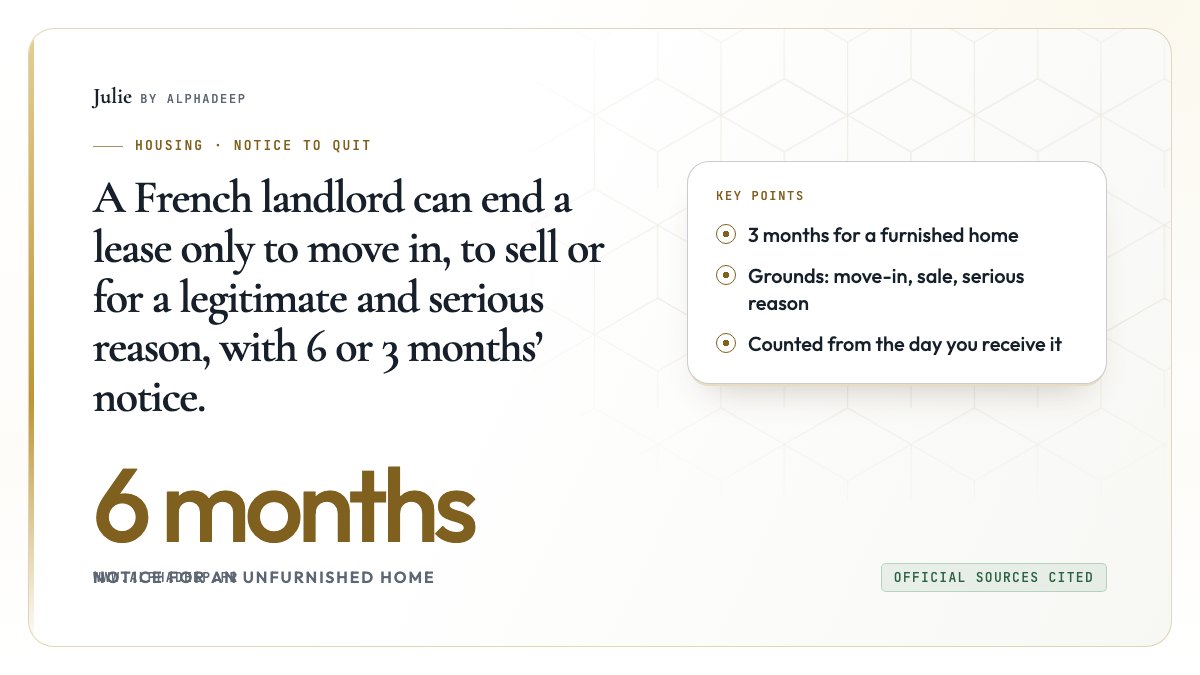
In France a landlord can end a residential lease only to move in or house a close relative, to sell, or for a legitimate and serious reason, with six months’ notice for an unfurnished home and three for a furnished one (law of 6 July 1989, art. 15 and 25-8). The notice is void if it omits the reason or, for a move-in, the beneficiary. No specific deadline applies to challenge it, only the three-year limitation.
- Official texts cited
- Sources checked on
- Drafted with AI assistance, our method
General legal information with official references and dated checks. It is not personalised advice: for a decision that commits you, have your situation checked by a qualified professional.
Julie by AlphaDeep
Your French landlord has served notice to end your lease: I can check the ground, the notice period and the required wording with you, and explain how to challenge it.
3 free questions at signup. Avoid names and sensitive information.
On what grounds can a French landlord end your lease?
A French landlord can end a residential lease at its expiry date on only three grounds: to move in or house a close relative (congé pour reprise), to sell the home (congé pour vente), or for a legitimate and serious reason (motif légitime et sérieux), such as the tenant failing to pay the rent or causing repeated disturbance (law n° 89-462 of 6 July 1989, article 15). Outside these three grounds, the notice is not valid.
The notice must reach you at least six months before the lease ends for an unfurnished home, and three months for a furnished one (article 25-8). It must be sent by registered letter with acknowledgement of receipt, served by a bailiff (commissaire de justice) or handed over against a signed receipt, and the period runs from the day you actually receive it. A notice to move in or to sell must state the ground and come with an official information leaflet (notice d’information). According to Service-public.fr, a notice that reaches the tenant late is not valid.
Loi n° 89-462 of 6 July 1989 (residential leases): article 15Loi n° 89-462 of 6 July 1989: article 25-8 (furnished lets)Service-public.fr: Préavis et formalités du congé donné par le propriétaire (bailleur) (in French)
Move-in, sale, legitimate reason: which conditions apply to each notice?
| Ground | Conditions | If one is missing | Source |
|---|---|---|---|
| Move-in (reprise) | Name and address of the person moving in and their link to the landlord: landlord, spouse, civil partner, partner of one year or more, parents, children, or those of the spouse or partner; the decision must be real and serious; information leaflet attached | Notice void if the ground, the name, the address or the link is missing; the judge can also set it aside if the move-in is not genuine | Law of 6 July 1989, art. 15 I and 25-8 |
| Sale (vente) | Price and conditions of the sale stated; for an unfurnished home, the notice is an offer to sell to the tenant for the first two months; information leaflet attached | Notice void if the price or the conditions are missing | Law of 6 July 1989, art. 15 II |
| Legitimate and serious reason | A real failure by the tenant (unpaid rent, disturbance, unauthorised subletting) or another serious reason, stated in the notice | The judge can declare the notice not valid if the reason is not shown | Law of 6 July 1989, art. 15 I |
| Every notice: form and timing | Registered letter with acknowledgement, bailiff or hand delivery against receipt; received 6 months (unfurnished) or 3 months (furnished) before the lease ends | Notice not valid; the lease renews for 3 years (unfurnished, private landlord) or 1 year (furnished) | Law of 6 July 1989, art. 10, 15, 25-7 and 25-8 |
| Landlord who bought the home with the tenant in it | Sale: no notice before the end of the first renewal if the lease ends less than 3 years after the purchase. Move-in: takes effect no earlier than 2 years after the purchase | The notice cannot end the lease on that date | Law of 6 July 1989, art. 15 I |
| Tenant over 65 on a low income | Over 65 at the lease end date and income under the official ceiling: the landlord must offer suitable housing nearby, unless the landlord is a person over 65 or on a low income | Notice not valid without a rehousing offer | Law of 6 July 1989, art. 15 III and 25-8 II |
Unfurnished lets follow article 15, furnished lets article 25-8. The right to buy first, the information leaflet and the rules for a landlord who bought the home occupied appear in article 15 only.
Loi n° 89-462 of 6 July 1989 (residential leases): article 15Loi n° 89-462 of 6 July 1989: article 25-8 (furnished lets)Loi n° 89-462 of 6 July 1989: article 10 (lease term and renewal)Loi n° 89-462 of 6 July 1989: article 25-7 (furnished lease term)
Does the notice you received hold up, point by point?
Enter the dates and tick what the notice says: the worksheet works out the latest date it had to reach you, checks each statement the law requires and points you to the right step. It does not say whether the landlord’s reason is genuine: only a judge decides that.
Fictional example · What your notice shows
A notice to move in or to sell must come with the official information leaflet set by the decree of 13 December 2017 (article 15 I). Write to the landlord that it was missing and keep the envelope: the judge decides what follows from its absence.
- Latest date the notice had to reach you (6 months)
- 2026-09-30
- Date you received it
- 2026-09-22
- Required statements present
- 1 of 2
- Compare the date you received the notice with 2026-09-30: if it reached you later, the notice is not valid and the lease renews (article 10).
- Write to the landlord by registered letter, listing each defect you found and asking for an answer within 15 days.
- Without agreement, refer the dispute to the departmental conciliation board (free), then to the local housing judge (juge des contentieux de la protection) of the court where the home is.
- Keep paying the rent while the dispute lasts, and keep the envelope, the notice and any proof of the landlord’s real plans.
This worksheet applies the form and timing rules of articles 15 and 25-8 of the law of 6 July 1989. It does not judge whether the landlord’s reason is genuine or check the over-65 income ceiling.
What must a notice to sell contain, and can you buy the home first?
A notice to sell must state the price and the conditions of the planned sale, on pain of nullity, and it counts as an offer to sell the home to you: this is the tenant’s right to buy first (droit de préemption) (article 15 II of the law of 6 July 1989). The offer stays open during the first two months of the notice period. If you accept, you have two months from sending your reply to sign the deed of sale, or four months if you say in your reply that you will take out a loan, and the lease runs on until then.
If the landlord later agrees to sell to someone else at a lower price or on better terms, the notaire must offer you those new terms first, on pain of nullity of the sale, and you then have one month to accept. These rules do not apply to a sale between relatives up to the third degree when the buyer lives in the home for at least two years. Furnished lets are different: article 25-8 allows a notice to sell but gives the tenant no right to buy first.
Loi n° 89-462 of 6 July 1989 (residential leases): article 15Loi n° 89-462 of 6 July 1989: article 25-8 (furnished lets)
Are you protected from a landlord’s notice if you are over 65?
Yes, if you are over 65 on the date the lease ends and your annual income is under the ceiling set for social housing: the landlord can then end the lease only by offering you suitable housing nearby (law of 6 July 1989, article 15 III, and article 25-8 II for furnished lets). The same protection covers a younger tenant who supports a person over 65 living in the home, when the whole household’s income is under the ceiling.
The protection does not apply if the landlord is an individual over 65, or has an income under the same ceiling. Age is assessed on the lease end date and income on the date of the notice. According to Service-public.fr, the income taken into account is that of the 12 months before the notice, and the ceilings change every year, so check the current table there. The rehousing offer must be in the same district or a neighbouring one, or failing that within 5 km.
Loi n° 89-462 of 6 July 1989 (residential leases): article 15Loi n° 89-462 of 6 July 1989: article 25-8 (furnished lets)Service-public.fr: Préavis et formalités du congé donné par le propriétaire (bailleur) (in French)
Which deadlines and penalties frame a landlord’s notice in France?
These figures are fixed by the law of 6 July 1989 itself, in the version in force since 29 July 2023.
- Landlord’s notice period, unfurnished home
- 6 months
- in force since 29 July 2023 · Law n° 89-462 of 6 July 1989, article 15
- Landlord’s notice period, furnished home
- 3 months
- in force since 29 July 2023 · Law n° 89-462 of 6 July 1989, article 25-8
- Time the tenant’s offer to buy stays open, from the start of the notice period
- 2 months
- in force since 29 July 2023 · Law n° 89-462 of 6 July 1989, article 15 II
- Maximum fine for a fraudulent notice, individual landlord
- €6,000
- in force since 29 July 2023 · Law n° 89-462 of 6 July 1989, article 15 V
- Maximum fine for a fraudulent notice, company landlord
- €30,000
- in force since 29 July 2023 · Law n° 89-462 of 6 July 1989, article 15 V
- Limitation period for claims arising from the lease
- 3 years
- in force since 27 March 2014 · Law n° 89-462 of 6 July 1989, article 7-1
What does article 15 of the French law of 6 July 1989 say?
I. - Lorsque le bailleur donne congé à son locataire, ce congé doit être justifié soit par sa décision de reprendre ou de vendre le logement, soit par un motif légitime et sérieux, notamment l'inexécution par le locataire de l'une des obligations lui incombant. A peine de nullité, le congé donné par le bailleur doit indiquer le motif allégué et, en cas de reprise, les nom et adresse du bénéficiaire de la reprise ainsi que la nature du lien existant entre le bailleur et le bénéficiaire de la reprise qui ne peut être que le bailleur, son conjoint, le partenaire auquel il est lié par un pacte civil de solidarité enregistré à la date du congé, son concubin notoire depuis au moins un an à la date du congé, ses ascendants, ses descendants ou ceux de son conjoint, de son partenaire ou de son concubin notoire. Lorsqu'il donne congé à son locataire pour reprendre le logement, le bailleur justifie du caractère réel et sérieux de sa décision de reprise. Le délai de préavis applicable au congé est de six mois lorsqu'il émane du bailleur.
[…]
Le congé doit être notifié par lettre recommandée avec demande d'avis de réception, signifié par acte d'un commissaire de justice ou remis en main propre contre récépissé ou émargement. Ce délai court à compter du jour de la réception de la lettre recommandée, de la signification de l'acte du commissaire de justice ou de la remise en main propre.
In plain English: A landlord can end the lease only to move in or house a close relative, to sell, or for a legitimate and serious reason. The notice must name the ground and, for a move-in, the person and their link to the landlord, or it is void. It must reach the tenant six months before the lease ends, by registered letter, bailiff or hand delivery against receipt.
For a furnished let, article 25-8 sets the same grounds with three months’ notice.
Do you have to leave on the date in the notice if you dispute it?
No: if you dispute the notice, you can stay in the home after the date it gives, and only a court can order you to leave (Code of civil enforcement procedures, article L411-1). Once the notice period ends, a valid notice removes your right to occupy the home (article 15 I of the law of 6 July 1989), so the landlord must ask the local housing judge (juge des contentieux de la protection) to confirm it and order your eviction.
Staying carries a risk. If the judge finds the notice valid, you owe an occupation payment for the months after the end date, and possibly damages and costs. Keep paying the same amount as the rent and write down why you consider the notice void. Even after a judgment, an eviction cannot be carried out between 1 November and 31 March, the winter truce (trêve hivernale), unless suitable rehousing is provided (article L412-6).
Code des procédures civiles d’exécution (civil enforcement): article L411-1Loi n° 89-462 of 6 July 1989 (residential leases): article 15Service-public.fr: Saisir le juge des contentieux de la protection (in French)Code des procédures civiles d’exécution (civil enforcement): article L412-6 (winter truce)
How do you challenge a notice to move in a relative?
Write to the landlord by registered letter explaining why the notice is wrong, then, if that fails, ask the departmental conciliation board (commission départementale de conciliation) and finally the local housing judge (juge des contentieux de la protection) to set it aside. The board handles disputes over notices under article 15, is free, and gives its opinion within two months (law of 6 July 1989, article 20). A lawyer is not compulsory before the judge.
The judge can check, even without being asked, whether the move-in is genuine and can declare the notice not valid (article 15 I). Useful evidence includes the relative’s address and situation, a home they already own nearby, or the flat advertised for rent or sale after you leave. No specific deadline applies: claims arising from the lease are time-barred three years after you knew or should have known the facts (article 7-1). A fraudulent notice is also a criminal offence.
Loi n° 89-462 of 6 July 1989: article 20 (departmental conciliation board)Service-public.fr: Que faire en cas de litige lié à la location d’un logement ? (in French)Service-public.fr: Saisir le juge des contentieux de la protection (in French)Loi n° 89-462 of 6 July 1989 (residential leases): article 15Loi n° 89-462 of 6 July 1989: article 7-1 (three-year limitation)
What else do tenants and landlords ask about a French notice to quit?
I bought a flat in France with a tenant in it: when can I give notice?
A landlord who buys a French home with a tenant in it cannot always give notice at the next lease end. A notice to sell is possible at that date only if the lease ends more than three years after the purchase; otherwise only at the end of the first renewal. A move-in notice for a lease ending less than two years after the purchase takes effect two years after the purchase (law of 6 July 1989, article 15 I).
Loi n° 89-462 of 6 July 1989 (residential leases): article 15
What fine does a landlord face for a fake notice to move in?
A landlord who gives a fraudulent notice to move in or to sell faces a criminal fine of up to €6,000 for an individual and €30,000 for a company, set in proportion to the facts (law of 6 July 1989, article 15 V, and article 25-8 for furnished lets). The tenant can join the criminal case as a civil party and claim damages for the loss suffered.
Loi n° 89-462 of 6 July 1989 (residential leases): article 15Loi n° 89-462 of 6 July 1989: article 25-8 (furnished lets)
Does a notice to quit have to come with an information leaflet?
Yes, for an unfurnished let. A French notice to move in or to sell must come with an information leaflet on the landlord’s obligations and the tenant’s remedies (article 15 I of the law of 6 July 1989). Its content is fixed by the decree (arrêté) of 13 December 2017, which covers the notice period, protected tenants, the right to buy first, conciliation and the fines for a fraudulent notice.
Loi n° 89-462 of 6 July 1989 (residential leases): article 15Arrêté of 13 December 2017 on the information leaflet attached to a notice to move in or to sell
Is a notice received five months before the lease ends valid?
For an unfurnished home, no: a French landlord’s notice must reach the tenant at least six months before the lease ends, and according to Service-public.fr a late notice is not valid. Without a valid notice, the lease renews automatically, for three years with a private landlord (law of 6 July 1989, article 10). For a furnished home, three months is enough, so a notice received five months ahead is on time (article 25-8).
Service-public.fr: Préavis et formalités du congé donné par le propriétaire (bailleur) (in French)Loi n° 89-462 of 6 July 1989: article 10 (lease term and renewal)Loi n° 89-462 of 6 July 1989: article 25-8 (furnished lets)
Which relatives can a French landlord move into the home?
A French landlord can take back the home for themselves, their spouse, their registered civil partner (PACS), a partner they have lived with openly for at least one year, their parents or children, or the parents or children of their spouse or partner (law of 6 July 1989, article 15 I). Brothers, sisters, nephews and friends are not on the list. The notice must name the person, give their address and state the link.
Loi n° 89-462 of 6 July 1989 (residential leases): article 15
Which French texts govern a landlord’s notice to quit?
- Loi n° 89-462 of 6 July 1989 (residential leases): article 15République française / DILA : Légifrance
- Loi n° 89-462 of 6 July 1989: article 25-8 (furnished lets)République française / DILA : Légifrance
- Service-public.fr: Préavis et formalités du congé donné par le propriétaire (bailleur) (in French)Service-public.fr (DILA, French Prime Minister’s office)
- Loi n° 89-462 of 6 July 1989: article 10 (lease term and renewal)République française / DILA : Légifrance
- Loi n° 89-462 of 6 July 1989: article 25-7 (furnished lease term)République française / DILA : Légifrance
- Code des procédures civiles d’exécution (civil enforcement): article L411-1République française / DILA : Légifrance
- Service-public.fr: Saisir le juge des contentieux de la protection (in French)Service-public.fr (DILA, French Prime Minister’s office)
- Code des procédures civiles d’exécution (civil enforcement): article L412-6 (winter truce)République française / DILA : Légifrance
- Loi n° 89-462 of 6 July 1989: article 20 (departmental conciliation board)République française / DILA : Légifrance
- Service-public.fr: Que faire en cas de litige lié à la location d’un logement ? (in French)Service-public.fr (DILA, French Prime Minister’s office)
- Loi n° 89-462 of 6 July 1989: article 7-1 (three-year limitation)République française / DILA : Légifrance
- Arrêté of 13 December 2017 on the information leaflet attached to a notice to move in or to sellRépublique française / DILA : Légifrance
Texts cited last checked: 30 October 2026