Family and couples · Divorce · separation
Leaving the marital home before a French divorce: consequences and proof
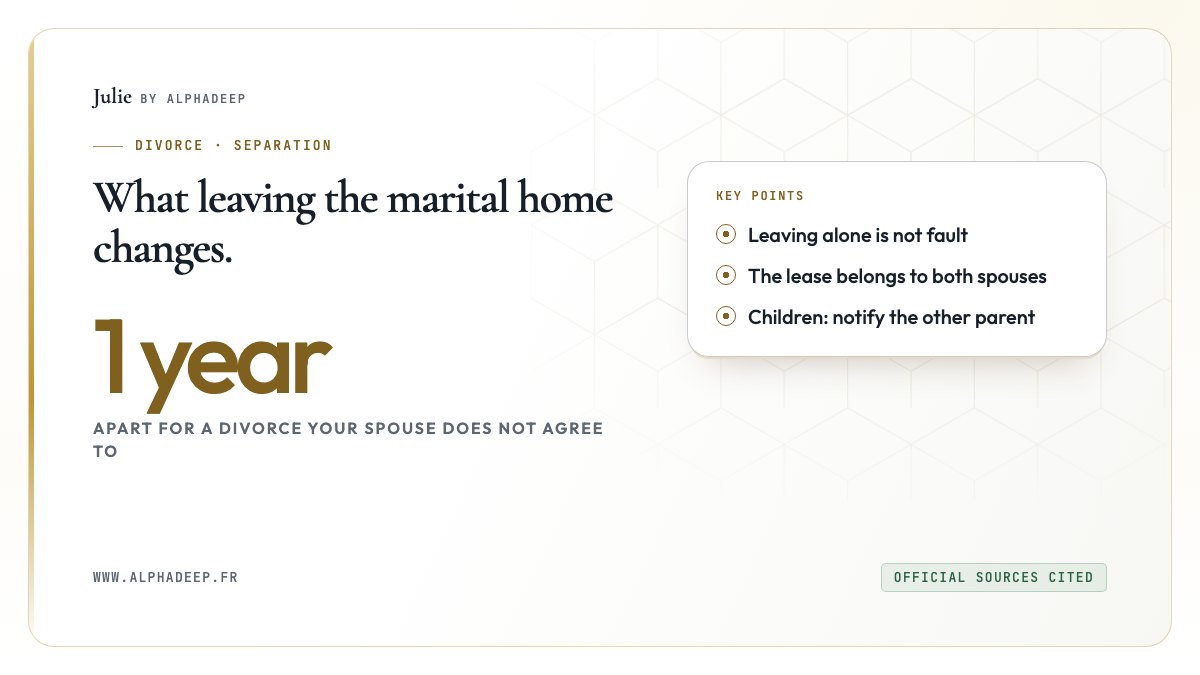
Leaving the marital home is not, by itself, fault in a French divorce: article 242 of the Civil Code requires a serious or repeated breach of marital duties that makes living together intolerable. The move matters mainly as a date. It starts the one-year separation needed for a divorce without consent and can fix when property effects begin between spouses. Date it and keep proof.
- Leaving alone is not fault
- The lease belongs to both spouses
- Children: notify the other parent
- Official texts cited
- Sources checked on
- Drafted with AI assistance, our method
General legal information with official references and dated checks. It is not personalised advice: for a decision that commits you, have your situation checked by a qualified professional.
Julie by AlphaDeep
Your spouse has moved out, or you are thinking of leaving: I can help you date the separation and list the evidence worth keeping.
3 free questions at signup. Avoid names and sensitive information.
Does leaving the marital home count as fault in France?
Not on its own. A fault divorce requires facts amounting to a serious or repeated breach of marital duties, attributable to the other spouse, that make living together intolerable. Spouses may even keep separate homes without ending their shared life.
Service-public adds that leaving because of violence, for a legitimate reason such as a job, or under a written agreement is not fault. The move matters mainly as a date: it starts the one-year period for a divorce on definitive breakdown of the marriage.
Code civil, article 242Service-public: recording that a spouse left the marital homeCode civil, article 238
Which documents should you gather, given how the move happened?
Five questions about how the move happened: the list of documents builds in the order you will need them.
Fictional example · documents to gather
Date your move and keep the reasons: on its own it is not fault.
- A dated record of the day of the move: registered letter or email to the other spouse
- The lease and rent notices: the family home’s lease belongs to both spouses until the judge decides
- Statements showing who has paid the household costs since the move
An indicative list, not a legal assessment of your case: a lawyer weighs the facts.
What does moving out change in each situation?
| Situation | Effect of moving out | Basis |
|---|---|---|
| Leaving without agreement or stated reason | Not fault on its own; it may count if part of a serious or repeated breach of marital duties | C. civ., art. 242 |
| Leaving with a written agreement | Not fault; it dates the start of the separation | C. civ., art. 238 |
| Leaving to escape violence | Not fault; a protection order from the judge is possible | C. civ., art. 515-11 |
| One year apart when the divorce is filed | Divorce for definitive breakdown of the marriage becomes possible | C. civ., art. 238 |
| Home rented by the couple | The lease stays with both spouses until the judge decides | C. civ., art. 1751 |
| Dividing property | Effects run from the divorce petition, or from the end of living together if a spouse asks | C. civ., art. 262-1 |
Code civil, article 242Code civil, article 238Code civil, article 515-11Code civil, article 1751Code civil, article 262-1
Which records date the move, from the firmest to the weakest?
Ranked by how firmly each record fixes the date of the move, from the most solid to the weakest.
A commissaire de justice’s report
A public officer visits, dates and describes the situation at the home. It is the strongest record and the most expensive: fees are free, so ask for a quote.
Service-public: recording that a spouse left the marital home
A written agreement, registered or taken up by a notary
A private agreement only has a certain date against third parties once registered or recorded in an authentic deed.
A registered letter with proof of receipt
It proves when your letter to the other spouse was sent and received, and keeps a record of your reasons.
A police complaint, or failing that a main courante
The police log dates your statement. Where there is violence, file a complaint rather than a simple logbook entry.
Service-public: recording that a spouse left the marital home
Dated emails and messages
They show when and why the move happened, but the other spouse can dispute what they prove.
Statements from family and friends
Handwritten, dated, signed, with ID and the writer’s link to the spouses. Children can never testify about the spouses’ grievances.
Can you move out with the children, and must you tell the other parent?
Yes, but any change of residence that alters how parental authority is exercised requires prior, timely notice to the other parent. If you disagree, either parent can apply to the family judge, who decides according to the child’s interest.
Under conditions, this duty does not apply to a parent authorised by a protection order to keep their address secret.
Who pays the rent, mortgage and bills after one spouse leaves?
Moving out does not end the duty to contribute to household costs in proportion to each spouse’s means. The family home’s lease belongs to both spouses, even if only one signed it, until the judge awards it.
The spouse who stays occupies the home free of charge until the divorce petition, unless the judge decides otherwise. After that, the judge rules on who uses the home and who pays the debts in the meantime.
Code civil, article 214Code civil, article 1751Code civil, article 262-1Code civil, article 255
Leaving because of violence: which protection can you ask the judge for?
File a police complaint and ask the family judge for a protection order. The judge issues it within six days at most of setting the hearing date, if there are serious grounds to consider the violence and the danger likely.
The order can rule on separate homes, give the home to the spouse who suffered violence, and allow you to keep your address secret.
Code civil, article 515-11Service-public: recording that a spouse left the marital home
What does the French Civil Code say about spouses living together?
Les époux s’obligent mutuellement à une communauté de vie. La résidence de la famille est au lieu qu’ils choisissent d’un commun accord. Les époux ne peuvent l’un sans l’autre disposer des droits par lesquels est assuré le logement de la famille, ni des meubles meublants dont il est garni. Celui des deux qui n’a pas donné son consentement à l’acte peut en demander l’annulation : l’action en nullité lui est ouverte dans l’année à partir du jour où il a eu connaissance de l’acte, sans pouvoir jamais être intentée plus d’un an après que le régime matrimonial s’est dissous.
In plain English: Spouses owe each other a shared life; the family home is chosen together, and neither spouse may dispose alone of the rights that secure it or of its furniture.
What else should you know about moving out?
Does staying with family for a few weeks count as leaving?
Not in itself. A temporary, explained absence is not a serious or repeated breach of marital duties. Keep the messages explaining the reason and the expected length.
Do the same rules apply to PACS partners or unmarried couples?
No. The duty to share a life and fault divorce apply to married spouses only. For a PACS couple, the lease of the shared home belongs to both partners if they ask for it jointly.
Is a main courante the same as a police complaint?
It is not compulsory, but a dated letter fixes the date of the move and its reasons. If the children change residence, prior notice to the other parent is compulsory.
Can a French judge order a spouse to move back home?
The Civil Code provides no measure forcing a spouse to come back. The judge rules on separate homes, who keeps the home and any support during the proceedings.
Can you change the locks after your spouse moves out?
Until the judge rules, each spouse keeps their rights over the family home: changing the locks to shut the other out invites a dispute. Ask the judge to award you the home; where there is violence, a protection order can award it to the spouse who suffered it.
Which texts is this guide based on?
- Code civil, article 215Légifrance
- Code civil, article 242Légifrance
- Code civil, article 238Légifrance
- Code civil, article 214Légifrance
- Code civil, article 262-1Légifrance
- Code civil, article 373-2Légifrance
- Code civil, article 1751Légifrance
- Code civil, article 515-11Légifrance
- Code civil, article 1377Légifrance
- Code de procédure civile, article 202Légifrance
- Code civil, article 255Légifrance
- Service-public: recording that a spouse left the marital homeService-public.fr
Texts cited last checked: 17 October 2026