The deadline registerRetirement · since 1 September 2026
French retirement age in 2026: the legal age and the quarters by generation
For the general scheme and pensions effective from September 2026, legal age is 62 years and nine months for births from January 1963 to March 1965, then rises to 64 for generations from 1969 (CSS L161-17-2). Full rate requires the applicable quarters or age 67 in the ordinary case. Parents, long careers and disability may have special rules; active public-service categories follow another calendar.
Go to the tool: the deadline register
Julie by AlphaDeep is an AI legal assistant for French law: it researches official references to help answer your questions (Légifrance, case law, service-public), analyses your documents and drafts your letters, for individuals and professionals alike.
General legal information with official references and dated checks. It is not personalised advice: for a decision that commits you, have your situation checked by a qualified professional.

Let’s look at your situation
Give your date of birth, your quarters and when your career began.
Example questions
Your question carries over after signup. Maximum 400 characters. Avoid health data and names.
Which legal age and how many quarters, by year of birth?
The schedule of the social security financing law for 2026, for pensions taking effect since 1 September 2026.
| You were born | Legal age | Quarters for the full rate |
|---|---|---|
| From 1 January 1958 to 31 December 1960 | 62 years | 167 |
| From 1 January to 31 August 1961 | 62 years | 168 |
| From 1 September to 31 December 1961 | 62 years and 3 months | 169 |
| In 1962 | 62 years and 6 months | 169 |
| From 1 January 1963 to 31 March 1965 | 62 years and 9 months | 170 |
| From 1 April to 31 December 1965 | 63 years | 171 |
| In 1966 | 63 years and 3 months | 172 |
| In 1967 | 63 years and 6 months | 172 |
| In 1968 | 63 years and 9 months | 172 |
| From 1 January 1969 | 64 years | 172 |
At 67, the full rate is granted whatever the number of quarters (article L351-8; service-public, fiche F14044).
Sources: CSS L161-17-2 · CSS L161-17-3 · CSS L351-8
From which date can you retire in France?
Enter your date of birth and, where relevant, a quarter of child-related insurance credit: the register dates the legal age, recalls your generation’s quarters and the full rate at 67. The example: a person born on 10 May 1966. The result is indicative: confirm the ordinary-case conditions; a special case or unknown decisive fact prevents calculation.
Fictional example · retirement register
You can retire from 10 August 2029, at 63 years and 3 months; full rate with 172 quarters, or automatically at 67.
- Your generation
- In 1966
- Legal age
- 63 years and 3 months
- Quarters for the full rate
- 172
Days left: to be calculated
Legal age reached, 63 years and 3 months: you can retire, with 172 quarters for the full rate
At 67: full rate whatever the number of quarters, with no reduction
Schedule of the ordinary general scheme only for pensions taking effect since 1 September 2026; a long career, a disability or an occupational incapacity can open an earlier departure.
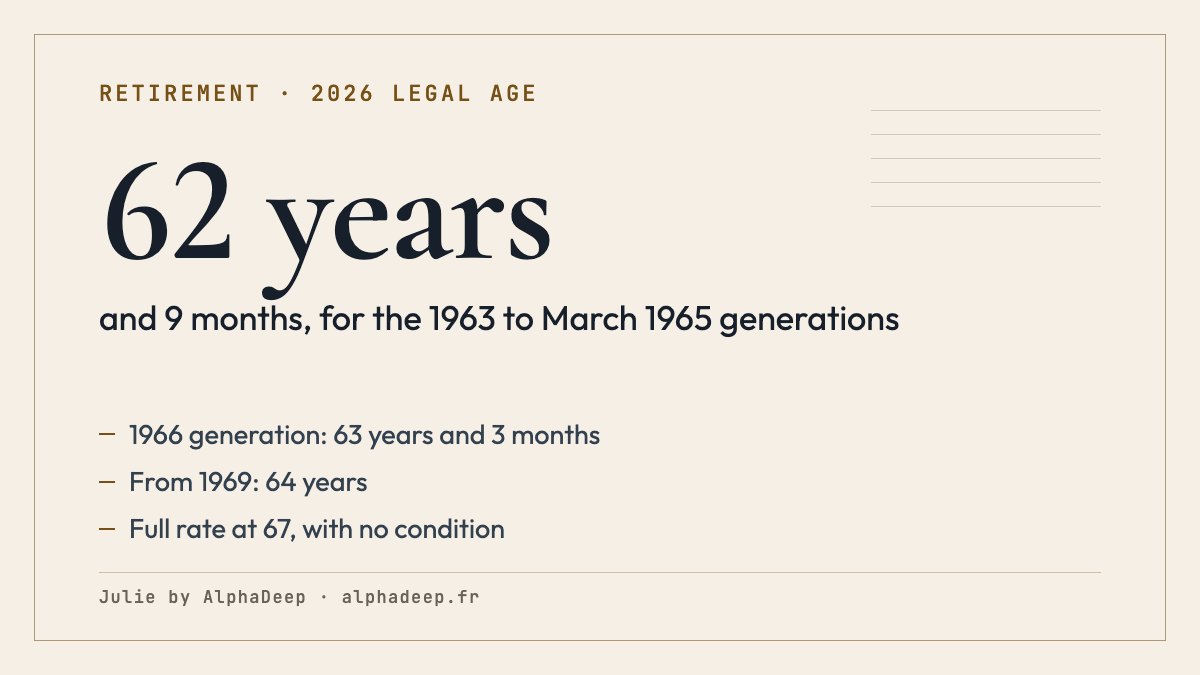
At what age can you retire in France in 2026?
The legal age depends on the year of birth: 62 years and 9 months for people born between 1 January 1963 and 31 March 1965, then 3 months more per generation up to 64 for those born from 1969 (Social Security Code, article L161-17-2, rewritten by the social security financing law for 2026 of 30 December 2025).
This schedule freezes the age at 62 years and 9 months for the generations born from 1963 to March 1965 before the rise resumes, and it applies to pensions taking effect since 1 September 2026 (article 105 of law no. 2025-1403). According to service-public, the age is also lowered by one year for people born since 1 April 1965 who have at least one quarter of insurance credit for a child.
Sources: CSS L161-17-2 · Law no. 2025-1403 · Service-public F14043
How many quarters do you need for a full-rate pension?
172 quarters, that is 43 years, for people born from 1966; 170 for those born from January 1963 to March 1965, 171 for those born from April to December 1965 (Social Security Code, article L161-17-3). Quarters from all basic schemes count together, according to service-public.
Without that period, the basic pension is reduced (décote) until 67; at 67, the full rate is granted with no quarters condition (article L351-8; service-public). Some situations open it earlier: 65 for certain carers, 62 in case of unfitness for work, 60 with a permanent occupational incapacity of at least 10%, according to service-public.
Sources: CSS L161-17-3 · CSS L351-8 · Service-public F14044
Can you retire before the legal age?
Yes, with a long career: the age is lowered to 58 for work started before 16, 60 before 18, 62 before 20 and 63 before 21, provided the required period has been contributed, with adjustments for each generation (Social Security Code, articles L351-1-1 and D351-1-1).
People with disabilities, those with a permanent incapacity recognised after a work accident or an occupational disease, and workers exposed to asbestos also have early departures, under conditions (articles L351-1-3 and L351-1-4; service-public).
Sources: CSS L351-1-1 · CSS D351-1-1 · Service-public F14043
What changed for the retirement age in 2026?
The social security financing law for 2026 rewrote the schedule of the 2023 reform.
New legal schedule: 62 years and 9 months for the generations born from 1963 to March 1965, then 63, 63 and 3 months, 63 and 6 months, 63 and 9 months, and 64 from the 1969 generation, with 170 to 172 quarters (articles L161-17-2 and L161-17-3, law no. 2025-1403 of 30 December 2025).
Sources: CSS L161-17-2 · CSS L161-17-3 · Law no. 2025-1403
The new schedule applies to pensions taking effect from this date (article 105, VI, of law no. 2025-1403), and the long-career ages are adapted to each generation (article D351-1-1).
Sources: Law no. 2025-1403 · CSS D351-1-1
For parents with a child-related insurance credit, the average annual salary is calculated on the best 24 years with one child, 23 with two or more, instead of 25; the Assurance retraite will apply this calculation in 2027, with an automatic recalculation.
Source: L’Assurance retraite
What does article L161-17-2 of the Social Security Code provide?
Article L161-17-2 is the text of the legal age, as worded by the law of 30 December 2025.
L’âge d’ouverture du droit à une pension de retraite mentionné au premier alinéa de l’article L. 351-1 du présent code, au 1° du I de l’article L. 24 et au 1° de l’article L. 25 du code des pensions civiles et militaires de retraite est fixé à soixante-quatre ans pour les assurés nés à compter du 1er janvier 1969.
Cet âge est fixé à : […] 3° Soixante-deux ans et neuf mois, pour les assurés nés entre le 1er janvier 1963 et le 31 mars 1965 ; 4° Soixante-trois ans, pour les assurés nés entre le 1er avril et le 31 décembre 1965 ; […]
In English, briefly (our summary, not an official translation): The age from which a retirement pension can be claimed, under article L351-1 of the Social Security Code and the civil and military pensions code, is set at sixty-four for people born on or after 1 January 1969. It is set, among other steps, at sixty-two years and nine months for people born between 1 January 1963 and 31 March 1965, and at sixty-three for those born between 1 April and 31 December 1965. Article 105 of law no. 2025-1403 reserves this schedule for pensions taking effect from 1 September 2026.
What do future retirees ask about their departure date?
Is the legal age the same for civil servants?
Not for all categories. Sedentary civil servants follow the applicable ordinary calendar; active and super-active categories can retire earlier and have different full-rate ages. Check the category and required service with the relevant scheme (service-public F2786 and F36465).
Can you retire at the legal age without all your quarters?
Yes, but the basic pension is reduced according to the missing quarters, until 67; the Agirc-Arrco supplementary pension can also be reduced or increased depending on the retirement age (service-public, fiche F14044).
How do you find out your number of quarters?
The career statement in your retirement account on the Info retraite website brings together the quarters from all schemes; a free retirement information interview can be requested from one of your funds (service-public, fiche F14044).
Does the new schedule apply to a pension already being paid?
No: it applies to pensions taking effect since 1 September 2026 (article 105, VI, of law no. 2025-1403 of 30 December 2025).
Is the full rate at 67 the same for everyone?
At 67, the general scheme grants the full rate without a quarter requirement, with special rules allowing it earlier. This is not a universal age for special schemes or active public-service categories (L351-8; service-public F14044 and F36465).
Which texts set the retirement age and the insurance period?
- Categories of public-sector employeesService-public.fr, in French
- Full-rate pensions for public-sector employeesService-public.fr, in French
- Social Security Code, article L161-17-2 (legal age by generation)Légifrance, in French
- Social Security Code, article L161-17-3 (quarters for the full rate)Légifrance, in French
- Law no. 2025-1403 of 30 December 2025 on social security financing for 2026, article 105Légifrance, Journal officiel, in French
- From what age can an employee retire? (fiche F14043)Service-public.fr, in French · checked by the publisher on 14 August 2026
- Social Security Code, article L351-8 (full rate with no insurance period condition)Légifrance, in French
- Full-rate retirement pension (fiche F14044)Service-public.fr, in French · checked by the publisher on 14 August 2026
- Social Security Code, articles L351-1-1, L351-1-3 and L351-1-4 (early retirement)Légifrance, in French
- Social Security Code, article D351-1-1 (long-career ages)Légifrance, in French
- Changes in the calculation of parents’ pensionsL’Assurance retraite, in French · updated on 15 September 2026
Texts cited last checked: 25 September 2026