Money, tax and inheritance · Inheritance · France and Switzerland
Inheritance between France and Switzerland: which law, which authority and which taxes
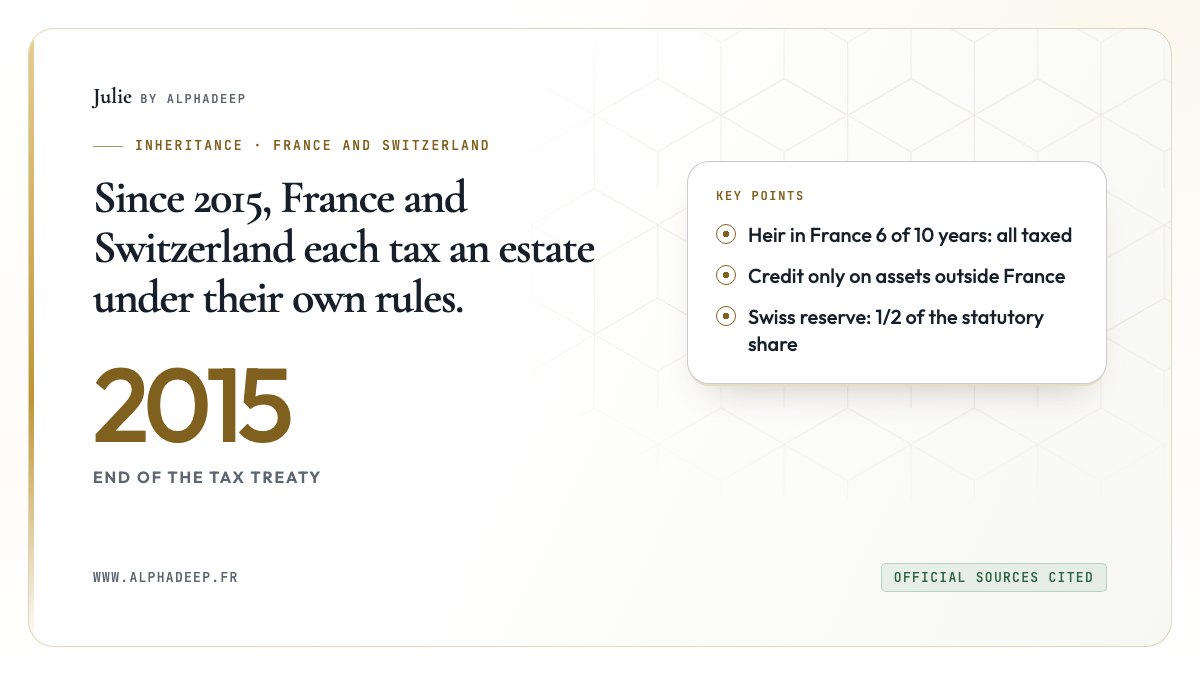
Since 1 January 2015 no tax treaty covers inheritances between France and Switzerland, so each country applies its own inheritance tax. France taxes all assets when the deceased lived in France, or when the heir lives in France and did so for at least 6 of the last 10 years, with a credit for foreign tax paid on assets outside France. The estate follows the law of the last residence unless a will chose the law of a nationality.
- Official texts cited
- Sources checked on
- Drafted with AI assistance, our method
General legal information with official references and dated checks. It is not personalised advice: for a decision that commits you, have your situation checked by a qualified professional.
Julie by AlphaDeep
An estate links France and Switzerland: tell me where the deceased lived, where the assets are and where the heirs live, and I will show you the law, the authority and the taxes involved.
3 free questions at signup. Avoid names and sensitive information.
Who decides, which law and which tax, depending on the last residence?
| Question | Last residence in France | Last residence in Switzerland | Source |
|---|---|---|---|
| Who handles the estate? | French notary and courts, for all assets | Swiss authorities of the last residence; a French notary for property in France | Regulation 650/2012, art. 4; LDIP, art. 86 |
| Governing law without a choice | French law | Swiss law | Regulation 650/2012, art. 21; LDIP, art. 90 |
| Choice in a will | Law of a country of which the deceased is a national | Law of a country of nationality; a Swiss national keeps the Swiss disposable share | Regulation 650/2012, art. 22; LDIP, art. 91 |
| Children’s reserved share | 1/2, 2/3 or 3/4 of the estate depending on the number of children | Half of their statutory share since 2023 | Civil Code, art. 913; CC, art. 471 |
| Assets taxed by France | All assets, in France and abroad | Assets in France, or everything received by an heir living in France for 6 of the last 10 years | Tax code, art. 750 ter |
| Credit for foreign tax | Yes, on assets located outside France | Only for an heir living in France for 6 of the last 10 years | Tax code, art. 784 A |
| Cantonal tax | Not applicable | Geneva: children and spouse exempt unless lump-sum taxed; Vaud: CHF 1,000,000 deducted per branch of descendants | LDS GE, art. 6A; LMSD VD, art. 31 |
The EU Regulation uses habitual residence, the LDIP uses domicile: in most cases both point to the same country.
EU Succession Regulation No 650/2012: articles 4, 10, 21, 22 and 34Swiss Federal Act on Private International Law (LDIP / PILA), article 86 (in French)Swiss Federal Act on Private International Law (LDIP / PILA), article 90 (in French)Swiss Federal Act on Private International Law (LDIP / PILA), article 91 (in French)French Civil Code (Code civil), article 913 (in French)Swiss Civil Code (CC / ZGB), articles 457, 470 and 471 (in French)French General Tax Code (Code général des impôts), article 750 ter (in French)French General Tax Code, article 784 A (in French)Geneva Inheritance Duties Act (LDS, rsGE D 3 25), articles 6A and 17 (in French)Vaud Inheritance and Gift Tax Act (LMSD), article 31 with official commentary (in French)
Which law, which authority and which tax apply in your case?
Enter the last residence, nationality, will, any property in France and where the heir lives. The worksheet shows the authority, the governing law, the reserved shares and what each country can tax; it computes no tax.
Fictional example · Law, authority and taxes involved
Last residence in Switzerland: the Swiss authorities of that residence handle the estate (LDIP, article 86) and Swiss law applies, unless a national law was chosen (LDIP, articles 90 and 91). Your heir has lived in France for at least 6 of the last 10 years: France taxes everything they receive, wherever it is (article 750 ter, 3°), with a credit for Swiss tax on assets outside France (article 784 A). The heir must file a French inheritance tax return (déclaration de succession).
- Competent authority
- Swiss authorities of the last residence (LDIP, art. 86); a French notary for the property in France
- Governing law
- Swiss law (LDIP, art. 90, para. 1)
- Children’s reserved share
- Swiss law: half of their statutory share since 2023; parents no longer reserved (CC, art. 470 and 471)
- Assets taxed in France
- Everything this heir receives (tax code, art. 750 ter, 3°)
- Credit for Swiss tax
- Yes, capped at the French tax on assets located outside France (tax code, art. 784 A)
- Cantonal tax
- Vaud: CHF 1,000,000 deducted per branch of descendants, reduced above CHF 1,001,000 (LMSD, art. 31)
- Gather the death certificate, proof of the deceased’s last residence and any will.
- List the assets by country: property, bank accounts, securities, life insurance.
- For each heir living in France, count their years of French tax residence over the last 10 years.
- Keep the cantonal tax assessment and proof of payment to claim the credit in France.
- Contact a notary in France for the property and the French inheritance tax return.
This worksheet applies the connecting rules of the texts cited. It does not compute any tax amount and does not replace a notary’s review of the file.
Which law governs the estate, and can a will choose it?
The law of the deceased’s last habitual residence (résidence habituelle) governs the whole estate, and a will can replace it with the law of a country of which the person is a national. On the French side, the EU Succession Regulation No 650/2012 sets both rules (articles 21 and 22) for deaths since 17 August 2015. On the Swiss side, article 90 of the Swiss private international law act (LDIP) applies Swiss law to anyone whose last residence (domicile) was in Switzerland, and article 91 LDIP allows a choice of the law of a country of nationality.
The choice of law in a will (professio juris) must appear in a will or an inheritance contract, and the nationality must exist when the choice is made or at death. A French national living in Lausanne can therefore choose French law. One Swiss limit: since 1 January 2025, a Swiss national who chooses a foreign law cannot depart from the Swiss rules on the freely disposable share (LDIP, article 91).
EU Succession Regulation No 650/2012: articles 4, 10, 21, 22 and 34Swiss Federal Act on Private International Law (LDIP / PILA), article 90 (in French)Swiss Federal Act on Private International Law (LDIP / PILA), article 91 (in French)
Who handles the estate: a French notary or a Swiss authority?
The last residence decides: a French notary (notaire) and the French courts if the deceased lived in France, the Swiss authorities of the last residence if they lived in Switzerland. The EU Regulation gives the country of habitual residence jurisdiction over the whole estate (article 4), and article 86 LDIP does the same for the Swiss authorities of the last residence.
Two exceptions matter in practice. A French court may also hear a case about assets in France of someone who lived in Switzerland, if they were French or had left France less than 5 years before the court is seised (article 10 of the Regulation). For a Swiss national who dies in France, the authorities of their Swiss place of origin step in if France does not deal with the estate, or if their will designated them (article 87 LDIP). Property in France always goes through a French notary.
EU Succession Regulation No 650/2012: articles 4, 10, 21, 22 and 34Swiss Federal Act on Private International Law (LDIP / PILA), article 86 (in French)Swiss Federal Act on Private International Law (LDIP / PILA), article 87 (in French)
Which French dates, rates and thresholds matter?
These figures come from the texts in force and the official notice terminating the treaty.
- End of the 1953 France-Switzerland inheritance tax treaty
- 1 January 2015
- deaths from that date · impots.gouv.fr, treaty termination notice
- Heir’s residence in France that makes all inherited assets taxable
- 6 of 10 years
- in force since 31 July 2011 · French General Tax Code, article 750 ter
- Tax-free allowance on each child’s share
- €100,000
- in force since 1 January 2013 · French General Tax Code, article 779
- Direct-line rate on the slice from €15,932 to €552,324
- 20 %
- in force since 30 December 2014 · French General Tax Code, article 777
- Direct-line rate above €1,805,677
- 45 %
- in force since 30 December 2014 · French General Tax Code, article 777
- Freely disposable share with three or more children
- 1/4 of the estate
- in force since 1 November 2021 · French Civil Code, article 913
What does article 750 ter of the French tax code say?
Sont soumis aux droits de mutation à titre gratuit :
1° Les biens meubles et immeubles situés en France ou hors de France, et notamment les fonds publics, parts d'intérêts, biens ou droits composant un trust défini à l'article 792-0 bis et produits qui y sont capitalisés, créances et généralement toutes les valeurs mobilières françaises ou étrangères de quelque nature qu'elles soient, lorsque le donateur ou le défunt a son domicile fiscal en France au sens de l'article 4 B ;
[…]
3° Les biens meubles et immeubles situés en France ou hors de France, et notamment les fonds publics, parts d'intérêts, biens ou droits composant un trust défini à l'article 792-0 bis et produits qui y sont capitalisés, créances et généralement toutes les valeurs mobilières françaises ou étrangères de quelque nature qu'elles soient, reçus par l'héritier, le donataire, le légataire ou le bénéficiaire d'un trust défini au même article 792-0 bis qui a son domicile fiscal en France au sens de l'article 4 B. Toutefois, cette disposition ne s'applique que lorsque l'héritier, le donataire ou le bénéficiaire d'un trust a eu son domicile fiscal en France pendant au moins six années au cours des dix dernières années précédant celle au cours de laquelle il reçoit les biens.
In plain English: France taxes all inherited assets, wherever they are, in two cases: the deceased was tax-resident in France, or the heir is tax-resident in France and has been for at least 6 of the last 10 years. In every other case, only assets located in France are taxed.
Point 2° of the same article covers those assets located in France, including property held directly or through a company.
What share are children guaranteed under French and Swiss law?
Under French law, children have a forced heirship share (réserve héréditaire) of half the estate with one child, two thirds with two and three quarters with three or more (Civil Code, article 913). Under Swiss law, since 1 January 2023, descendants are reserved half of their statutory share (CC, article 471), and parents are no longer forced heirs (CC, article 470).
The gap is clear for a parent with three children. Under the French Civil Code, only 1/4 of the estate is freely disposable (quotité disponible). Under Swiss law, with no spouse, the children are the only statutory heirs (CC, article 457) and their reserve is half the estate, so 1/2 is freely disposable.
These shares follow the law that governs the estate. In France, a child who has been shortchanged has 5 years from the death to bring a claim for reduction, or 2 years from learning of it, with a cap of 10 years (Civil Code, article 921).
French Civil Code (Code civil), article 913 (in French)Swiss Civil Code (CC / ZGB), articles 457, 470 and 471 (in French)French Civil Code, article 921 (in French)
Do heirs living in France pay French tax on a Swiss inheritance?
Yes, if the heir is tax-resident in France and has been for at least 6 of the last 10 years: France then taxes everything they receive, including assets in Switzerland (French General Tax Code, article 750 ter, 3°). Otherwise France taxes only assets located in France, such as a flat in Annecy or shares in French companies (article 750 ter, 2°).
No treaty prevents the overlap any more: according to impots.gouv.fr, the 1953 treaty no longer applies to deaths from 1 January 2015. French inheritance tax (droits de succession) is computed on each heir’s share, after a tax-free allowance (abattement) of €100,000 per child (article 779), with a 20 % rate between €15,932 and €552,324 (article 777).
French General Tax Code (Code général des impôts), article 750 ter (in French)France-Switzerland inheritance tax treaty of 31 December 1953: termination notice (in French)French General Tax Code, article 779 (in French)French General Tax Code, article 777 (in French)
Can Swiss inheritance tax be credited against French inheritance tax?
Yes, in part: article 784 A of the French General Tax Code lets an heir credit inheritance tax paid abroad against the French tax, but only in two cases (deceased resident in France, or heir resident in France for 6 of the last 10 years) and only up to the French tax due on assets located outside France.
In practice, tax paid to a canton on a bank account in Lausanne reduces the French tax on that account. It does not reduce the French tax on a property in France. And when France taxes only assets located in France (heir who fails the 6-year test), no credit is available.
How much this matters depends on the canton. In Geneva, children and the spouse are exempt unless the deceased was taxed on a lump-sum basis (LDS, article 6A): there is then nothing to credit, and an heir settled in France pays the full French tax.
French General Tax Code, article 784 A (in French)Geneva Inheritance Duties Act (LDS, rsGE D 3 25), articles 6A and 17 (in French)
What else do people ask about a French-Swiss estate?
Is there still an inheritance tax treaty between France and Switzerland?
No inheritance tax treaty links France and Switzerland any more: France terminated the treaty of 31 December 1953, which no longer applies to deaths from 1 January 2015. Each country taxes under its own rules, and only article 784 A of the French General Tax Code limits the overlap on the French side.
France-Switzerland inheritance tax treaty of 31 December 1953: termination notice (in French)French General Tax Code, article 784 A (in French)
Do Geneva and Vaud tax inheritances left to children?
Geneva exempts the surviving spouse and children unless the deceased was taxed on a lump-sum basis in one of the last 3 assessments (LDS, article 6A); they then pay 2 % to 6 % (article 17). Vaud taxes descendants but deducts CHF 1,000,000 per branch for estates opened from 2025 (LMSD, article 31), with a cantonal rate of at most 3.5 % plus municipal tax. Check the Vaud treatment of a spouse with the cantonal tax office.
Geneva Inheritance Duties Act (LDS, rsGE D 3 25), articles 6A and 17 (in French)Vaud Inheritance and Gift Tax Act (LMSD), article 31 with official commentary (in French)Vaud general inheritance and gift tax scale (LMSD, art. 34) (in French)
A flat in France left by a Swiss resident: what does France tax?
A flat in France left by a Swiss resident is always taxable in France, even if no heir lives there (French General Tax Code, article 750 ter, 2°). Each child gets the €100,000 allowance (article 779), and the surviving spouse is exempt (article 796-0 bis). A French notary draws up the deed that transfers the flat.
French General Tax Code (Code général des impôts), article 750 ter (in French)French General Tax Code, article 779 (in French)French General Tax Code, article 796-0 bis (in French)
Are parents still forced heirs under Swiss law since 2023?
No, parents have not been forced heirs in Switzerland since 1 January 2023: article 470 of the Swiss Civil Code now protects only descendants, the spouse and the registered partner. Without them, a person resident in Switzerland can leave the whole estate by will. In France, parents are not forced heirs either: with no descendants, the Civil Code protects the surviving spouse (article 914-1).
Swiss Civil Code (CC / ZGB), articles 457, 470 and 471 (in French)French Civil Code, article 914-1 (in French)
What is the French compensatory levy, and does it apply against Swiss law?
The French compensatory levy (prélèvement compensatoire) lets a child recover their French reserved share from assets in France when the foreign law governing the estate has no forced heirship mechanism protecting children (Civil Code, article 913, paragraph 3). Swiss law keeps a reserve for descendants (CC, article 471), so the condition is not met when Swiss law applies, even though that reserve is smaller.
French Civil Code (Code civil), article 913 (in French)Swiss Civil Code (CC / ZGB), articles 457, 470 and 471 (in French)
Which French, EU and Swiss texts does this page rely on?
- EU Succession Regulation No 650/2012: articles 4, 10, 21, 22 and 34European Union: EUR-Lex
- Swiss Federal Act on Private International Law (LDIP / PILA), article 86 (in French)Swiss Confederation: Fedlex
- Swiss Federal Act on Private International Law (LDIP / PILA), article 90 (in French)Swiss Confederation: Fedlex
- Swiss Federal Act on Private International Law (LDIP / PILA), article 91 (in French)Swiss Confederation: Fedlex
- French Civil Code (Code civil), article 913 (in French)French Republic / DILA: Légifrance
- Swiss Civil Code (CC / ZGB), articles 457, 470 and 471 (in French)Swiss Confederation: Fedlex
- French General Tax Code (Code général des impôts), article 750 ter (in French)French Republic / DILA: Légifrance
- French General Tax Code, article 784 A (in French)French Republic / DILA: Légifrance
- Geneva Inheritance Duties Act (LDS, rsGE D 3 25), articles 6A and 17 (in French)Republic and Canton of Geneva: official law database
- Vaud Inheritance and Gift Tax Act (LMSD), article 31 with official commentary (in French)State of Vaud, cantonal tax administration
- France-Switzerland inheritance tax treaty of 31 December 1953: termination notice (in French)French Republic, tax administration (DGFiP): impots.gouv.fr
- Swiss Federal Act on Private International Law (LDIP / PILA), article 87 (in French)Swiss Confederation: Fedlex
- French Civil Code, article 921 (in French)French Republic / DILA: Légifrance
- French General Tax Code, article 779 (in French)French Republic / DILA: Légifrance
- French General Tax Code, article 777 (in French)French Republic / DILA: Légifrance
- Vaud general inheritance and gift tax scale (LMSD, art. 34) (in French)State of Vaud, cantonal tax administration
- French General Tax Code, article 796-0 bis (in French)French Republic / DILA: Légifrance
- French Civil Code, article 914-1 (in French)French Republic / DILA: Légifrance
Texts cited last checked: 30 October 2026