Money, tax and inheritance · Property · Switzerland
Buying a home in France while living in Switzerland: steps, financing, Swiss pension and tax
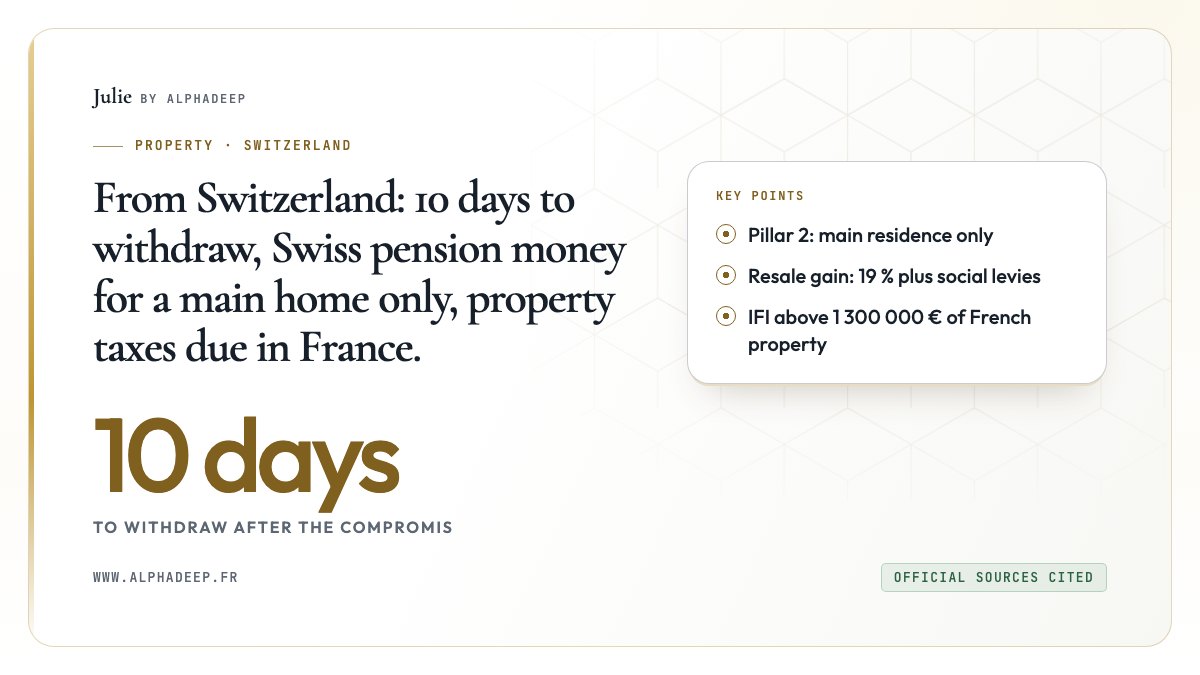
Living in Switzerland does not stop you buying in France: you sign a compromis, then the deed before a notary, and have 10 days to withdraw after the compromis is notified (Construction and Housing Code, article L271-1). Swiss pillar 2 and 3a money can fund only a home you will live in as your main residence, never a holiday home. Rent, resale gains and wealth tax on the property are taxed in France (France-Switzerland tax treaty, articles 6, 15, 24).
- Official texts cited
- Sources checked on
- Drafted with AI assistance, our method
General legal information with official references and dated checks. It is not personalised advice: for a decision that commits you, have your situation checked by a qualified professional.
Julie by AlphaDeep
You live in Switzerland and are buying in France: I can check each step with you, whether your Swiss pension can fund it, and the French taxes on the property.
3 free questions at signup. Avoid names and sensitive information.
Which figures matter before buying in France from Switzerland?
These markers are set by the texts themselves: no official statistic counts Swiss residents buying in France.
- Cooling-off period after the compromis is notified
- 10 days
- in force since 25 November 2018 · Construction and Housing Code, article L271-1
- Minimum duration of the loan condition
- 1 month
- in force since 1 July 2016 · Consumer Code, article L313-41
- Income tax on a non-resident’s property gain, before social levies
- 19 %
- checked 15 April 2026 · Service-public.fr, page F10864
- IFI wealth-tax threshold, on French property only for a non-resident
- 1 300 000 €
- in force since 1 January 2018 · French Tax Code, article 964
- Minimum Swiss pillar 2 early withdrawal, once every 5 years
- CHF 20 000
- in force since 1 October 2017 · OEPL ordinance, article 5
Which rule applies at each step of the purchase?
| Step | Rule | Source |
|---|---|---|
| Compromis | 10 days to withdraw, from the day after the notification letter is first presented | Construction and Housing Code, article L271-1 |
| Mortgage | Loan condition valid for at least one month; deposit returned if the loan is refused | Consumer Code, article L313-41 |
| Swiss pillar 2 | Main residence only, at least CHF 20 000, once every 5 years, spouse’s written consent | LPP, article 30c; OEPL, articles 4 and 5 |
| Swiss pillar 3a | Same own-use rule as pillar 2, withdrawal once every 5 years | OPP 3, article 3 |
| Letting | Rent taxed in France | France-Switzerland treaty, article 6 |
| Ownership | IFI wealth tax if French property exceeds 1 300 000 € net on 1 January | French Tax Code, articles 964 and 965 |
| Resale | 19 % plus social levies, paid when the deed is registered through an accredited representative unless exempt | French Tax Code, article 244 bis A; treaty, article 15 |
Code de la construction et de l’habitation (Construction and Housing Code): article L271-1Code de la consommation (Consumer Code): article L313-41Swiss Occupational Pensions Act (LPP/BVG): article 30c (in French)Swiss Home Ownership Promotion Ordinance (OEPL/WEFV): article 4 (in French)Swiss Home Ownership Promotion Ordinance (OEPL/WEFV): article 5 (in French)Swiss Pillar 3a Ordinance (OPP 3/BVV 3): article 3 (in French)France-Switzerland tax treaty of 9 September 1966: article 6 (in French)Code général des impôts (French Tax Code): article 964Code général des impôts (French Tax Code): article 965Code général des impôts (French Tax Code): article 244 bis AFrance-Switzerland tax treaty of 9 September 1966: article 15 (in French)
What are the steps to buy in France when you live in Switzerland?
To buy in France from Switzerland, you first sign a preliminary sale contract (compromis de vente), you then have 10 days to withdraw after it is notified to you, and you sign the final deed before a notary (notaire) once your financing is in place. The procedure is the same as for any private buyer.
The 10 days run from the day after the registered letter notifying the compromis is first presented to you, or from the day after an instructed estate agent hands it to you (Construction and Housing Code, article L271-1). A Swiss address changes nothing: count from the first presentation by Swiss Post. If you pay with a loan, the compromis is signed subject to a mortgage contingency clause (condition suspensive de prêt) valid for at least one month (Consumer Code, article L313-41). Taxes on the property are due in France under the France-Switzerland tax treaty.
- Compromis signed and notified
- 10-day cooling-off period
- Loan offer, Swiss pension withdrawal or own funds
- Final deed (acte authentique) before the notary
Code de la construction et de l’habitation (Construction and Housing Code): article L271-1Code de la consommation (Consumer Code): article L313-41France-Switzerland tax treaty of 9 September 1966: article 6 (in French)
Can a Swiss bank finance the purchase, and does the loan condition still protect you?
Yes, a Swiss bank can finance a home in France, but the protection of the loan condition is only guaranteed for the loans the French Consumer Code covers. Article L313-41 requires a condition of at least one month when the compromis states that the price is paid with a loan governed by the code’s property-credit sections; if that loan is not obtained, any money paid in advance must be returned in full, with no deduction.
With a Swiss lender, do not rely on that article applying automatically. Have the compromis state a precise condition: the lender or type of bank, amount, term, maximum rate and a realistic deadline, because a bank reviewing a file for a property abroad often needs more than a month. Under the Consumer Code, one month is a minimum and a longer period can be agreed. If part of the price comes from your Swiss pillar 2, the date your pension fund pays out must fit the same timetable.
What does article 244 bis A of the French Tax Code say?
I. – 1. Sous réserve des conventions internationales, les plus-values, telles que définies aux e bis et e ter du I de l'article 164 B, réalisées par les personnes et organismes mentionnés au 2 du I lors de la cession des biens ou droits mentionnés au 3 sont soumises à un prélèvement selon les taux fixés au III bis.
[…]
a) Les personnes physiques qui ne sont pas fiscalement domiciliées en France au sens de l'article 4 B ;
[…]
Toutefois, les personnes physiques, les associés personnes physiques de sociétés, groupements ou organismes dont les bénéfices sont imposés au nom des associés et les porteurs de parts, personnes physiques, de fonds de placement immobilier mentionnés à l'article 239 nonies sont soumis au prélèvement au taux de 19 %.
[…]
IV. – L'impôt dû en application du présent article est acquitté lors de l'enregistrement de l'acte ou, à défaut d'enregistrement, dans le mois suivant la cession, sous la responsabilité d'un représentant établi en France, accrédité par l'administration fiscale.
In plain English: If you live in Switzerland and sell property in France, the gain is subject in France to a 19 % levy, subject to the France-Switzerland treaty. The tax is paid when the deed of sale is registered, under the responsibility of a representative established in France and accredited by the tax authorities.
The exemption from a representative in section IV bis covers residents of the EU and EEA: Switzerland is not among them.
Is your purchase ready, from compromis to financing and tax?
Enter your situation: the worksheet orders the purchase steps, the cooling-off deadline, the loan condition, the Swiss pension rules and the French taxes to expect. It computes no tax and does not replace the notary or your pension fund.
Fictional example · The steps and rules for your purchase
An early withdrawal is possible for a main residence in France: at least CHF 20 000, once every five years (OEPL, article 5), no later than three years before retirement, with your spouse’s written consent (LPP, article 30c). Ask your pension fund for the form as soon as the compromis is signed.
- End of the cooling-off period
- 2026-11-26
- Loan condition valid at least until
- 2026-12-12
- IFI wealth tax
- Due if your French property exceeds 1 300 000 € net on 1 January (French Tax Code, article 964)
- If you change your mind, send your withdrawal by registered letter with acknowledgement of receipt no later than 2026-11-26.
- Ask your pension fund for the early withdrawal with your spouse’s written consent, and check the payout date.
- Declare the French property in your Swiss tax return: it is exempt but may count towards the rate.
The worksheet applies the cited texts to your answers. It computes no tax and does not replace the notary or your pension fund’s decision.
Can you use Swiss pillar 2 or pillar 3a money to buy in France?
Yes, but only for a home you will live in as your main residence: the Swiss Federal Social Insurance Office (OFAS) accepts a home abroad, for example for a cross-border worker, and expressly excludes holiday homes. The law’s “own use” means a home at your place of domicile or usual residence (OEPL ordinance, article 4).
For pillar 2, the early withdrawal (versement anticipé EPL) is at least CHF 20 000, once every five years (OEPL, article 5), and must be requested no later than three years before retirement. Up to age 50 you can take your whole vested benefit; after 50 the amount is capped. If you are married or in a registered partnership, your spouse’s written consent is required (Occupational Pensions Act, LPP, article 30c). Pillar 3a uses the same definition of own use and the same five-year rhythm (OPP 3, article 3).
The withdrawal is taxed in Switzerland as a pension capital benefit (LPP, article 83a) and must be repaid if you sell the home.
Federal Social Insurance Office (FSIO/OFAS): home ownership with occupational pension money (in French)Swiss Home Ownership Promotion Ordinance (OEPL/WEFV): article 4 (in French)Swiss Home Ownership Promotion Ordinance (OEPL/WEFV): article 5 (in French)Swiss Occupational Pensions Act (LPP/BVG): article 30c (in French)Swiss Pillar 3a Ordinance (OPP 3/BVV 3): article 3 (in French)Swiss Occupational Pensions Act (LPP/BVG): article 83a (in French)
Which French taxes does a Swiss resident owner pay?
A Swiss resident who owns property in France pays French income tax on any rent, the French real-estate wealth tax (IFI, impôt sur la fortune immobilière) if their French property exceeds 1 300 000 €, and French tax on any resale gain. The France-Switzerland tax treaty gives France the right to tax income from property located in France (article 6), gains on its sale (article 15) and the wealth it represents (article 24).
For the IFI, a non-resident is taxed only on property and property rights located in France (French Tax Code, article 964), at their net value on 1 January (article 965). On the Swiss side, this income and wealth are exempt, but Switzerland may take them into account when setting the rate on the rest of your income and wealth (treaty, article 25, B). So declare the French property in your Swiss tax return even though it is not taxed there.
France-Switzerland tax treaty of 9 September 1966: article 6 (in French)France-Switzerland tax treaty of 9 September 1966: article 15 (in French)France-Switzerland tax treaty of 9 September 1966: article 24 (in French)Code général des impôts (French Tax Code): article 964Code général des impôts (French Tax Code): article 965France-Switzerland tax treaty of 9 September 1966: article 25 (in French)
How is a resale gain taxed when you live in Switzerland?
When you live in Switzerland, a gain on selling French property is taxed in France at 19 %, plus social levies (French Tax Code, article 244 bis A). The capital gain (plus-value immobilière) is worked out as for a resident, with the holding-period allowances of articles 150 V to 150 VE, and according to Service-public.fr an extra tax of 2 % to 6 % applies above 50 000 € of taxable gain.
According to Service-public.fr (2026), social levies are 17.2 %. A person covered by another country’s health insurance under EU Regulation 883/2004 does not owe the CSG levy (Social Security Code, article L136-6) but pays the 7.5 % solidarity levy (prélèvement de solidarité, French Tax Code, article 235 ter). Ask the notary to confirm which rate applies to your Swiss cover.
The tax is paid when the deed is registered, under the responsibility of an accredited tax representative (représentant fiscal accrédité) unless an exemption applies. The notary withholds it from the sale price.
Code général des impôts (French Tax Code): article 244 bis AService-public.fr: income tax on a property capital gain (in French, checked 15 April 2026)Code de la sécurité sociale (Social Security Code): article L136-6Code général des impôts (French Tax Code): article 235 ter
What else do Swiss residents ask before buying in France?
Does the 150,000 euro exemption for former French residents cover Swiss nationals?
No, the 150,000 euro capital-gain exemption does not cover Swiss nationals: French Tax Code article 150 U, II, 2° reserves it for non-resident nationals of the EU or EEA. A French national living in Switzerland can use it if they were tax resident in France for at least two years, for one home only.
Code général des impôts (French Tax Code): article 150 UService-public.fr: income tax on a property capital gain (in French, checked 15 April 2026)
Which social levies come on top of the 19 % for a Swiss resident?
For a Swiss resident, Service-public.fr gives 17.2 % social levies on the gain, on top of the 19 %. A person covered by another country’s health insurance under EU Regulation 883/2004 does not owe the CSG levy (Social Security Code, article L136-6) but pays a 7.5 % solidarity levy. Ask the notary to confirm the rate.
Service-public.fr: income tax on a property capital gain (in French, checked 15 April 2026)Code de la sécurité sociale (Social Security Code): article L136-6Code général des impôts (French Tax Code): article 235 ter
Do you need a tax representative to sell a French property from Switzerland?
Yes, as a rule: a non-resident’s tax on a French property gain is paid under the responsibility of an accredited tax representative (French Tax Code, article 244 bis A, IV). The legal exemption covers EU and EEA residents, not Switzerland. According to Service-public.fr, no representative is needed if the sale price is 150 000 € or less.
Code général des impôts (French Tax Code): article 244 bis AService-public.fr: income tax on a property capital gain (in French, checked 15 April 2026)
Where is rent from a French flat let by a Swiss resident taxed?
Rent from a flat in France let by a Swiss resident is taxed in France, where the property is located (France-Switzerland tax treaty, article 6). Switzerland exempts it but may take it into account when setting the rate on your other income (article 25, B). Declare it in both countries.
France-Switzerland tax treaty of 9 September 1966: article 6 (in French)France-Switzerland tax treaty of 9 September 1966: article 25 (in French)
Is your French home counted for the IFI wealth tax if you live in Geneva?
Yes, a home in France counts for the IFI wealth tax even if you live in Geneva: a non-resident is taxed on property located in France (French Tax Code, article 964), at its net value on 1 January (article 965). The tax is due only if that value exceeds 1 300 000 €.
Code général des impôts (French Tax Code): article 964Code général des impôts (French Tax Code): article 965France-Switzerland tax treaty of 9 September 1966: article 24 (in French)
Which French and Swiss texts govern this purchase?
- Code de la construction et de l’habitation (Construction and Housing Code): article L271-1République française / DILA : Légifrance
- Code de la consommation (Consumer Code): article L313-41République française / DILA : Légifrance
- Code général des impôts (French Tax Code): article 244 bis ARépublique française / DILA : Légifrance
- Service-public.fr: income tax on a property capital gain (in French, checked 15 April 2026)Service-public.fr (DILA, Premier ministre)
- Code général des impôts (French Tax Code): article 964République française / DILA : Légifrance
- Federal Social Insurance Office (FSIO/OFAS): home ownership with occupational pension money (in French)Swiss Federal Social Insurance Office (FSIO)
- Swiss Occupational Pensions Act (LPP/BVG): article 30c (in French)Confédération suisse : Fedlex
- Swiss Home Ownership Promotion Ordinance (OEPL/WEFV): article 4 (in French)Confédération suisse : Fedlex
- Swiss Home Ownership Promotion Ordinance (OEPL/WEFV): article 5 (in French)Confédération suisse : Fedlex
- Swiss Pillar 3a Ordinance (OPP 3/BVV 3): article 3 (in French)Confédération suisse : Fedlex
- Swiss Occupational Pensions Act (LPP/BVG): article 83a (in French)Confédération suisse : Fedlex
- France-Switzerland tax treaty of 9 September 1966: article 6 (in French)Confédération suisse : Fedlex
- France-Switzerland tax treaty of 9 September 1966: article 15 (in French)Confédération suisse : Fedlex
- France-Switzerland tax treaty of 9 September 1966: article 24 (in French)Confédération suisse : Fedlex
- France-Switzerland tax treaty of 9 September 1966: article 25 (in French)Confédération suisse : Fedlex
- Code général des impôts (French Tax Code): article 965République française / DILA : Légifrance
- Code général des impôts (French Tax Code): article 150 URépublique française / DILA : Légifrance
- Code de la sécurité sociale (Social Security Code): article L136-6République française / DILA : Légifrance
- Code général des impôts (French Tax Code): article 235 terRépublique française / DILA : Légifrance
Texts cited last checked: 30 October 2026