Family and couples · Health · end of life
Advance directives and the personne de confiance in France: the rules as rewritten in 2026
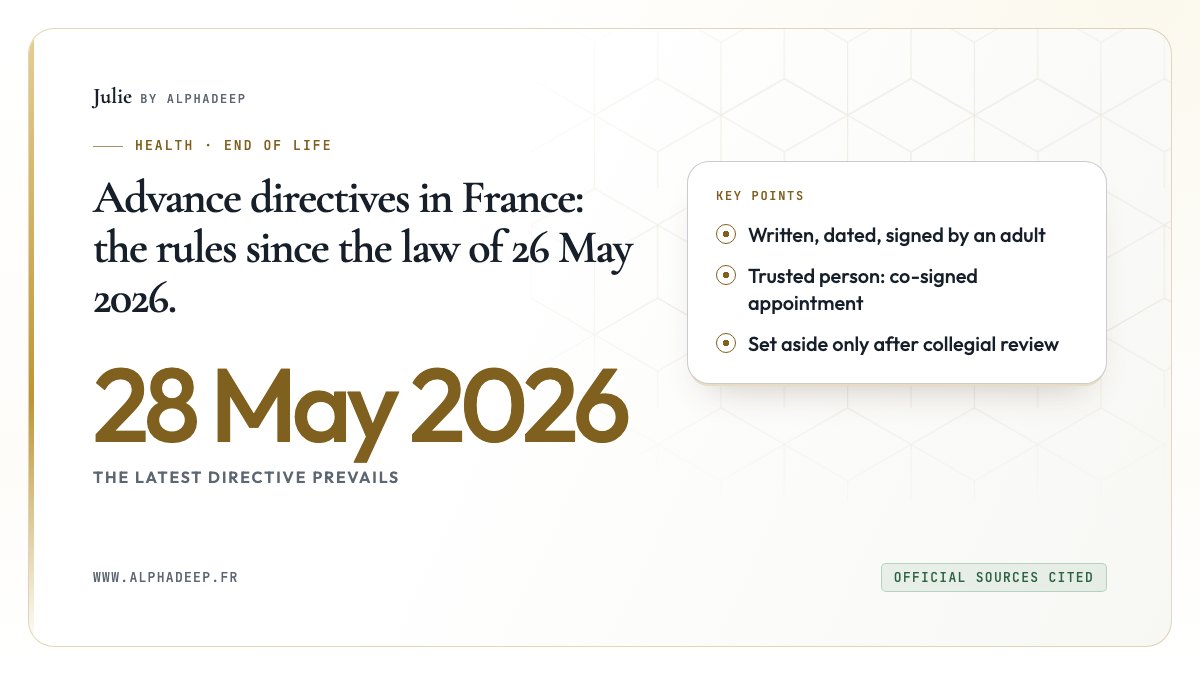
In France any adult can write advance directives on end-of-life care, on the official form or not, and change them at any time. Since 28 May 2026 the most recent directives prevail whatever the medium, and they are kept in the shared medical record. They bind the doctor, except in a life-threatening emergency or when manifestly inappropriate, set aside only after a collegial procedure (Public Health Code, art. L1111-11). Older guides describe the previous rules.
- Official texts cited
- Sources checked on
- Drafted with AI assistance, our method
General legal information with official references and dated checks. It is not personalised advice: for a decision that commits you, have your situation checked by a qualified professional.
Julie by AlphaDeep
You want to put your end-of-life care wishes in writing in France or name a trusted person: I can explain the rules in force since May 2026 and help you structure your text.
3 free questions at signup. Avoid names and sensitive information.
What changed for advance directives in France on 28 May 2026?
Since 28 May 2026, if you have written several sets of advance directives (directives anticipées), the most recent ones prevail in France, whatever the medium: paper, file or online record. Law no. 2026-404 of 26 May 2026 rewrote article L1111-11 of the Public Health Code (Code de la santé publique) on this point and on storage: directives are kept in the shared medical record (dossier médical partagé), and you are regularly reminded in Mon espace santé, the French online health space, that they exist and can be revised.
The new wording also says that from the age of 18 your health insurance fund (caisse d’assurance maladie) periodically tells you that you can write, revise or confirm directives and appoint a trusted person. The official form must be easy to understand, including for people with disabilities. The core rule is unchanged: directives bind the doctor, except in a life-threatening emergency or when manifestly inappropriate.
- Several versions: the latest wins, whatever the medium.
- Storage: the shared medical record, with reminders in Mon espace santé.
- Information: periodic reminders from the health insurance fund from age 18.
Code de la santé publique: article L1111-11 (as worded by law no. 2026-404 of 26 May 2026)
What does article L1111-11 of the French Public Health Code say since 2026?
Toute personne majeure peut rédiger des directives anticipées pour le cas où elle serait un jour hors d'état d'exprimer sa volonté. Ces directives anticipées expriment la volonté de la personne relative à sa fin de vie en ce qui concerne les conditions de la poursuite, de la limitation, de l'arrêt ou du refus de traitement ou d'acte médicaux.
[…]
Les directives anticipées s'imposent au médecin pour toute décision d'investigation, d'intervention ou de traitement, sauf en cas d'urgence vitale pendant le temps nécessaire à une évaluation complète de la situation et lorsque les directives anticipées apparaissent manifestement inappropriées ou non conformes à la situation médicale. Si plusieurs directives anticipées existent, les plus récentes prévalent, quel que soit leur support.
In plain English: Any adult in France can set out in advance what they want for end-of-life treatment. These directives bind the doctor, except in a life-threatening emergency or when manifestly inappropriate, and since 28 May 2026 the most recent ones prevail whatever the medium.
Refusing to apply directives requires a collegial procedure and is notified to the trusted person (same article).
Directives, trusted person, family: who counts when you can no longer speak for yourself?
| Situation | What applies | Source |
|---|---|---|
| You wrote directives | They bind the doctor for any investigation, procedure or treatment | Public Health Code, art. L1111-11 |
| Several versions exist | The most recent prevail, whatever the medium | Public Health Code, art. L1111-11 |
| Life-threatening emergency | The doctor may not apply them while assessing the situation fully | Public Health Code, art. L1111-11 |
| Directives deemed manifestly inappropriate | Refusal only after a collegial procedure, recorded and notified to the trusted person | Public Health Code, art. L1111-11 |
| No directive, trusted person appointed | Their account of your wishes prevails over any other | Public Health Code, art. L1111-6 and L1111-12 |
| No directive and no trusted person | The doctor gathers the testimony of family or close friends | Public Health Code, art. L1111-12 |
| Limiting or stopping treatment considered | Check of the shared medical record, then a collegial procedure | Public Health Code, art. R1111-20 and L1111-4 |
The collegial procedure is mandatory if the trusted person, the family or a close friend asks for it (art. R4127-37-2).
Code de la santé publique: article L1111-11 (as worded by law no. 2026-404 of 26 May 2026)Code de la santé publique: article L1111-6Code de la santé publique: article L1111-12Code de la santé publique: article R1111-20Code de la santé publique: article L1111-4Code de la santé publique: article R4127-37-2
How do you write a valid advance directive in France?
A valid French advance directive is a written document, dated and signed by an adult who is identified by surname, first name, date and place of birth (Public Health Code, art. R1111-17). The official form is optional: a handwritten letter or a typed text meeting these conditions is enough, and nothing in the article requires French. A translation helps the medical team read it quickly.
The official form comes in two versions: form A if you know you have a serious illness, form B if you consider yourself in good health (Service Public). It covers your identity, your trusted person, any authorisation linked to a legal protection measure, witnesses if you cannot write, and your wishes on continuing, limiting, stopping or refusing treatment (art. R1111-18). According to the Ipsos BVA survey for the CNSPFV (May 2025), only 22 % of French adults know what directives are for.
If you cannot write and sign yourself, two witnesses, including your trusted person if you have one, certify that the document expresses your free and informed will.
Code de la santé publique: article R1111-17Directives anticipées: dernières volontés sur les soins en fin de vie (fact sheet F32010, in French)Code de la santé publique: article R1111-18Parlons fin de vie: chiffres et enquêtes (Ipsos BVA survey, May 2025, in French)
Who can be your personne de confiance, and how do you appoint one?
Your trusted person (personne de confiance) can be a relative, someone close to you or your regular doctor (médecin traitant), provided you are an adult and the appointment is made in writing and co-signed by the person chosen (Public Health Code, art. L1111-6). It has no time limit unless you decide otherwise, and you can change it at any time.
If you can no longer express your wishes, this person is consulted first and reports what you wanted: their testimony prevails over anyone else’s, family included. If you wish, they can also go with you to medical appointments. They receive a guide on their role when appointed.
Every French hospital must offer you the chance to appoint one on admission. Nationality does not matter. An adult under a protection measure with representation for personal matters needs the authorisation of the judge or the family council.
How do you draft your advance directives step by step?
Answer the questions: the worksheet lists the formal conditions to meet, the form that fits you and the headings to fill in. It gives no medical advice and does not choose your wishes for you.
Fictional example · Your advance directive draft
Your directives can be valid without a trusted person. If you appoint one, the appointment must be in writing and co-signed by them (article L1111-6); otherwise, where no directive applies, the doctor turns to your family or close friends.
- Heading 1
- Identity: surname, first name, date and place of birth
- Heading 2
- Trusted person: identity and co-signature
- Heading 3
- Wishes: continuing, limiting, stopping or refusing treatment
- Heading 4
- Revision or revocation, dated and signed
- Formal conditions met
- 1 of 2
- Write your wishes on plain paper or on the official form, then date and sign on 2026-11-16.
- Have your trusted person co-sign the appointment and give them a copy.
- Upload the document to Mon espace santé, or record there where it is kept and who holds it.
- Reread your directives whenever your health changes: a new dated version replaces the old one.
This worksheet checks the form and structure of the document against the French Public Health Code. It does not replace a conversation with your doctor about treatment.
Which figures frame advance directives in France?
According to the Ipsos BVA survey for France’s national centre for palliative and end-of-life care (CNSPFV, May 2025), fewer than one French adult in two even knows the term advance directives.
- Official French advance directive forms (A: known serious illness; B: good health)
- 2
- 2026 · Service Public, fact sheet F32010 Directives anticipées
- French adults who know the term « directives anticipées »
- 41 %
- May 2025 · Ipsos BVA for the CNSPFV, Parlons fin de vie: figures and surveys
- French adults who know what advance directives are for
- 22 %
- May 2025 · Ipsos BVA for the CNSPFV, Parlons fin de vie: figures and surveys
- French adults who have thought about their end-of-life preferences
- 40 %
- May 2025 · Ipsos BVA for the CNSPFV, Parlons fin de vie: figures and surveys
When can a French doctor set your advance directives aside?
A French doctor can set your advance directives aside in only two cases: in a life-threatening emergency, for the time needed to assess the situation fully, or when they appear manifestly inappropriate or inconsistent with your medical condition (Public Health Code, art. L1111-11). In the second case the doctor does not decide alone.
The refusal follows a collegial procedure (procédure collégiale), is recorded in your medical file and is notified to your trusted person or, failing that, your family or close friends. The collegial procedure is a consultation between the available members of the care team and the doctor in charge, involving your regular doctor where possible (art. L1110-5-1).
The doctor in charge may start the procedure on their own initiative and must start it when the trusted person or, failing that, the family or a close friend asks (art. R4127-37-2).
Code de la santé publique: article L1111-11 (as worded by law no. 2026-404 of 26 May 2026)Code de la santé publique: article L1110-5-1Code de la santé publique: article R4127-37-2
Who speaks for you in a French hospital if you left no directive?
If you left no directive, the French doctor must seek your wishes from your trusted person, whose testimony prevails, and failing that from your family or close friends (Public Health Code, art. L1111-12, for a patient in an advanced or terminal stage of a serious and incurable illness).
Before limiting or stopping treatment, the doctor first checks the shared medical record, then asks the trusted person, family, friends or your regular doctor whether directives exist and where they are kept (art. R1111-20). If you cannot express your will, no treatment may be limited or stopped without a collegial procedure and without consulting these people (art. L1111-4).
The doctor must also avoid unreasonable obstinacy (obstination déraisonnable): treatment that is useless, disproportionate or only keeps you alive artificially is not continued (art. L1110-5-1). A directive written abroad is not mentioned in these articles: if you have one, write a French-law version too.
Code de la santé publique: article L1111-12Code de la santé publique: article L1111-4Code de la santé publique: article R1111-20Code de la santé publique: article L1110-5-1
What do people dealing with France ask about advance directives?
Is a living will legally binding in France?
Yes. In France, advance directives bind the doctor for any decision on investigation, procedure or treatment (Public Health Code, art. L1111-11). The only exceptions are a life-threatening emergency, while the situation is assessed, and directives that are manifestly inappropriate, which can be set aside only after a collegial procedure.
Code de la santé publique: article L1111-11 (as worded by law no. 2026-404 of 26 May 2026)
Do you have to use the official French form?
No. The official French advance directive form, in versions A and B, is optional. Any document written, dated and signed by an identified adult (surname, first name, date and place of birth) is valid (Public Health Code, art. R1111-17). The form helps you cover every heading the law expects.
Code de la santé publique: article R1111-17Directives anticipées: dernières volontés sur les soins en fin de vie (fact sheet F32010, in French)
Where should you store your directives so French doctors find them?
Store French advance directives in your shared medical record through Mon espace santé: the upload counts as registration, and it is the first place a doctor checks. You can also leave them with your doctor, a hospital or a relative and record where they are kept (Public Health Code, art. R1111-19).
Code de la santé publique: article R1111-19Code de la santé publique: article R1111-20
Can you change or cancel your advance directives?
Yes. Advance directives in France can be revised or revoked at any time and by any means (Public Health Code, art. L1111-11). Write a new dated and signed version: since 28 May 2026 the most recent prevail, whatever the medium. Update the copy in Mon espace santé too.
Code de la santé publique: article L1111-11 (as worded by law no. 2026-404 of 26 May 2026)
Can your relatives ask for a collegial review of a treatment decision?
Yes. The doctor in charge must start a collegial procedure when the trusted person or, failing that, the family or a close friend asks, before deciding to limit or stop treatment (Public Health Code, art. R4127-37-2). They are told of the decision as soon as it is made.
Which French texts govern advance directives and the trusted person?
- Code de la santé publique: article L1111-11 (as worded by law no. 2026-404 of 26 May 2026)République française / DILA: Légifrance
- Directives anticipées: dernières volontés sur les soins en fin de vie (fact sheet F32010, in French)République française / DILA: Service Public
- Code de la santé publique: article R1111-17République française / DILA: Légifrance
- Code de la santé publique: article R1111-18République française / DILA: Légifrance
- Code de la santé publique: article L1111-6République française / DILA: Légifrance
- Code de la santé publique: article L1110-5-1République française / DILA: Légifrance
- Code de la santé publique: article R4127-37-2République française / DILA: Légifrance
- Code de la santé publique: article L1111-12République française / DILA: Légifrance
- Code de la santé publique: article L1111-4République française / DILA: Légifrance
- Code de la santé publique: article R1111-20République française / DILA: Légifrance
- Code de la santé publique: article R1111-19République française / DILA: Légifrance
- Parlons fin de vie: chiffres et enquêtes (Ipsos BVA survey, May 2025, in French)Centre national des soins palliatifs et de la fin de vie (CNSPFV)
Texts cited last checked: 30 October 2026