Family and couples · Divorce · cross-border
International divorce in France: which court to use and which law applies
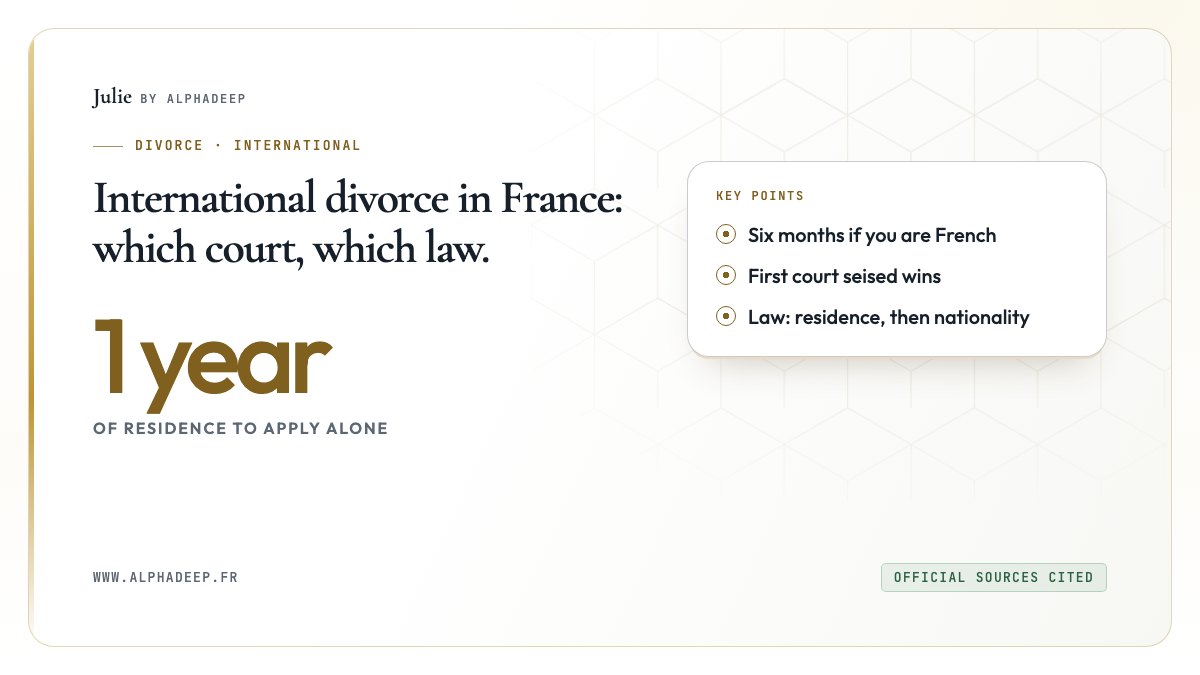
An international divorce raises two separate questions. Inside the EU, the competent court follows Regulation 2019/1111: the couple’s common habitual residence, the respondent’s residence, or the applicant’s residence for one year (six months for a national of that State). The applicable law follows the Rome III Regulation: without a written choice by the spouses, it is usually the law of their common habitual residence when the court is seised.
- Six months if you are French
- First court seised wins
- Law: residence, then nationality
- Official texts cited
- Sources checked on
- Drafted with AI assistance, our method
General legal information with official references and dated checks. It is not personalised advice: for a decision that commits you, have your situation checked by a qualified professional.
Julie by AlphaDeep
You live abroad, or you are a binational couple: I can tell you which courts can grant the divorce and which law would apply.
3 free questions at signup. Avoid names and sensitive information.
Can you divorce in France if neither spouse is French?
Yes. The EU regulation’s grounds rest mainly on habitual residence, not nationality: a foreign couple living in France can divorce there, as can a spouse who stayed in France after the other left, or one who has lived there for at least a year.
Nationality only matters at the edges: six months’ residence is enough for an applicant who holds that country’s nationality, and two spouses of the same nationality can go to that country’s courts wherever they live.
Regulation (EU) 2019/1111 (Brussels II ter), articles 3, 6, 20, 65 and 100Service-public: can a European divorce in France?
How long must you live in France before filing there on your own?
A year of habitual residence immediately before applying, or six months if you are French. These periods only matter when no other ground applies: if your spouse lives in France, if you lived there together and one of you stayed, or if you apply jointly, no minimum period is needed.
Within France, the competent judge is then the one for the family home; failing that, the one where the children live; failing that, the one where the spouse who did not start the case lives.
Regulation (EU) 2019/1111 (Brussels II ter), articles 3, 6, 20, 65 and 100Code de procédure civile, article 1070
Which court and which law fit your couple?
Answer on residence, nationality and any choice of law: the tool shows whether a French court can hear the divorce and which law it will apply, with the article behind each answer.
Fictional example · court and law
French courts can hear your divorce.
- French courts
- Have jurisdiction
- Applicable law
- French law
- Brussels II ter, art. 3(a)(ii): last shared residence, one spouse still there
- Rome III, art. 8(b): last shared residence left under a year ago
A pointer to the regulation’s grounds, not legal advice: habitual residence is assessed on the facts.
Which jurisdiction grounds does Regulation 2019/1111 set out?
| Ground | Condition | Example |
|---|---|---|
| Common habitual residence | Both spouses live in the country | An Italian-German couple settled in Lyon |
| Last shared residence | One spouse still lives there | One moved back to Madrid, the other stayed in Paris |
| Respondent’s residence | The spouse not applying lives in the country | You live in London, your spouse in Bordeaux |
| Joint application | Either spouse’s residence is enough | A joint petition, one in Nice, the other in Rome |
| Applicant’s residence | A year’s residence just before applying | Moved to Lille fourteen months ago |
| National applicant’s residence | Six months if they hold that nationality | A French national back in France for seven months |
| Shared nationality | Both spouses hold that country’s nationality | Two French nationals living in Montreal |
These grounds are alternatives with no ranking: several countries can have jurisdiction at once. The examples are fictional.
Regulation (EU) 2019/1111 (Brussels II ter), articles 3, 6, 20, 65 and 100Service-public: can a European divorce in France?
Can spouses choose which law governs their divorce?
Yes, by a written agreement dated and signed by both spouses, at the latest when the court is seised. The choice is limited: the law of your habitual residence, of your last shared residence if one of you still lives there, of either spouse’s nationality, or the law of the court seised.
Without a choice, it is the law of your common habitual residence when the court is seised; failing that, of your last shared residence left under a year ago if one of you still lives there; failing that, of your shared nationality; failing that, the court’s own law. Article 309 of the Civil Code, still in print, only covers cases brought before 21 June 2012.
Regulation (EU) No 1259/2010 (Rome III), articles 4, 5, 7, 8 and 18European e-Justice Portal: which law applies in France?Code civil, article 309
What happens if your spouse files first in another country?
Between EU countries, the first court seised wins: the court seised second stays its case of its own motion, then declines once the first court’s jurisdiction is established. When several countries have jurisdiction, the filing date therefore matters.
Outside the EU this mechanism does not apply: each country follows its own rules, and a lawyer should check the position before starting proceedings.
Regulation (EU) 2019/1111 (Brussels II ter), articles 3, 6, 20, 65 and 100
What does article 3 of the Brussels II ter Regulation say?
Sont compétentes pour statuer sur les questions relatives au divorce, à la séparation de corps et à l’annulation du mariage des époux, les juridictions de l’État membre: a) sur le territoire duquel se trouve: i) la résidence habituelle des époux, ii) la dernière résidence habituelle des époux dans la mesure où l’un d’eux y réside encore, iii) la résidence habituelle du défendeur, iv) en cas de demande conjointe, la résidence habituelle de l’un ou l’autre époux, v) la résidence habituelle du demandeur s’il y a résidé depuis au moins une année immédiatement avant l’introduction de la demande, ou vi) la résidence habituelle du demandeur s’il y a résidé depuis au moins six mois immédiatement avant l’introduction de la demande et s’il est ressortissant de l’État membre en question; ou b) de la nationalité des deux époux.
In plain English: The courts of a Member State have jurisdiction over divorce, legal separation and annulment where the spouses habitually reside, where they last resided if one still lives there, where the respondent resides, where either resides for a joint application, where the applicant has resided for a year (six months for a national), or where both spouses are nationals.
These grounds cover the divorce itself. Children, maintenance and the property regime follow their own rules on jurisdiction and applicable law.
What else do international couples ask?
Must you divorce in the country where you married?
No. The grounds rest on the spouses’ habitual residence and nationality, not on where they married. A couple married abroad who live in France can divorce there.
Regulation (EU) 2019/1111 (Brussels II ter), articles 3, 6, 20, 65 and 100
Does the property regime follow the same law as the divorce?
No. For spouses married since 29 January 2019 with no choice of law, the property regime follows the law of their first common habitual residence after the marriage, failing that their shared nationality, failing that the country they are most closely connected with. For marriages from 1 September 1992 to 29 January 2019, the 1978 Hague Convention applies.
Regulation (EU) 2016/1103 (matrimonial property), articles 26 and 69European e-Justice Portal: which law applies in France?
Does the UK still apply the EU divorce rules?
Not for recent cases. The Withdrawal Agreement keeps the EU jurisdiction and recognition rules only for cases brought before the transition period ended on 31 December 2020. Since then, a divorce involving the UK falls under each country’s national rules.
Is a French divorce without a judge recognised elsewhere in the EU?
Yes, for agreements registered since 1 August 2022: divorce agreements with binding legal effect in their country of origin are recognised in other Member States without any procedure. The certificate is requested from the president of the court where the agreement was filed with the notary. Outside the EU, it depends on each country’s law.
Regulation (EU) 2019/1111 (Brussels II ter), articles 3, 6, 20, 65 and 100Code de procédure civile, article 509-1
Which texts is this grid based on?
- Regulation (EU) 2019/1111 (Brussels II ter), articles 3, 6, 20, 65 and 100EUR-Lex
- Regulation (EU) No 1259/2010 (Rome III), articles 4, 5, 7, 8 and 18EUR-Lex
- Regulation (EU) 2016/1103 (matrimonial property), articles 26 and 69EUR-Lex
- UK Withdrawal Agreement, articles 67 and 126EUR-Lex
- Code civil, article 309Légifrance
- Code de procédure civile, article 1070Légifrance
- Code de procédure civile, article 509-1Légifrance
- Service-public: can a European divorce in France?Service-public.fr
- European e-Justice Portal: which law applies in France?Commission européenne
Texts cited last checked: 17 October 2026