Fines, complaints and courts · Civil procedure · document disclosure
Court-ordered document disclosure in France
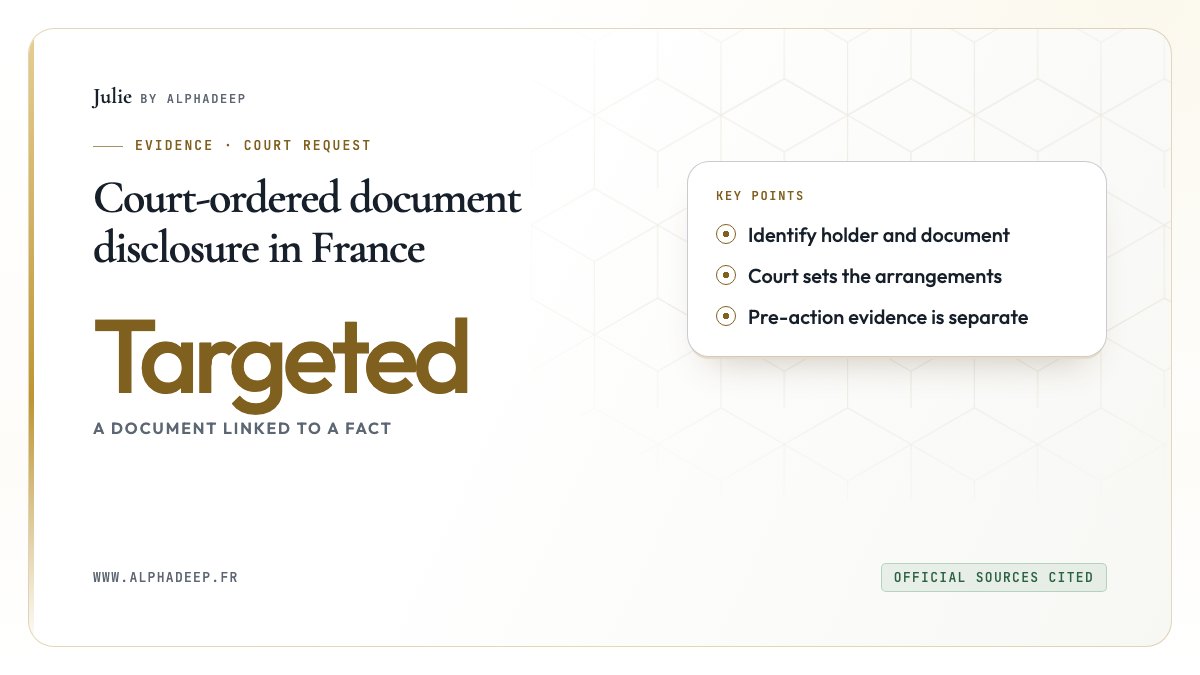
During French civil proceedings, a party can ask the court handling the case to order production of a document held by a third party or the opponent. Identify the document and explain its relevance to the dispute. The court assesses the request, sets arrangements and may require safeguards or a penalty. Before proceedings begin, an article 145 evidence measure follows a separate route.
- Identify holder and document
- Court sets the arrangements
- Pre-action evidence is separate
- Official texts cited
- Sources checked on
- Drafted with AI assistance, our method
General legal information with official references and dated checks. It is not personalised advice: for a decision that commits you, have your situation checked by a qualified professional.
Julie by AlphaDeep
You need a document a third party or opponent has not disclosed: I can help clarify the request and its legal sources.
3 free questions at signup. Avoid names and sensitive information.
Which court can order a third party to produce a document?
Apply to the court already handling the case. Article 138 covers, in particular, a deed to which the applicant was not a party or a document held by a third party. A general search for unspecified documents does not explain the evidential need.
The case-management judge also has powers to obtain and communicate documents. Where a lawyer handles the proceedings, prepare the request with the lawyer who knows the file and its timetable.
What if the opponent holds the document?
Article 142 applies articles 138 and 139 to evidence held by a party. The holder changes, but the request must still identify the document and the fact it would help address.
Separate a document relied on in proceedings and expected to be communicated from one whose production you are specifically asking the court to order. Keep the requests and replies so the disclosure problem is clear.
How can you prepare a targeted document request?
Choose the holder and stage, then name a document and the fact it could establish. The worksheet separates disclosure during proceedings from pre-action evidence.
Fictional example · Your preparation worksheet
During proceedings, identify the third party and document, then explain the request to the court already handling the case. The court decides whether it is justified.
- Identified document
- Contract signed on 12 June 2026
- Stated relevance
- Delivery date and agreed obligations
- Describe the document and why the named holder is likely to have it.
- Specify the useful copy, extract or original and any necessary confidentiality safeguards.
- Keep the request and disclosure correspondence in the pending court file.
Fictional example. This worksheet organises a request; it does not compel disclosure or guarantee a penalty.
Which route applies to the holder and stage of the dispute?
| Situation | Basis to examine | Preparation task |
|---|---|---|
| Third-party document, pending proceedings | CPC articles 138 and 139 | Identify the document and relevance |
| Document held by a party | Article 142 referring to 138 and 139 | Explain the production difficulty |
| No proceedings started | CPC article 145 | Examine the legitimate reason and useful measure |
What should a document-production request contain?
Article 139 provides for a request without a prescribed form and leaves its merits to the court. Identify the document, holder and connection with a specific disputed issue. Explain the basis for believing the document exists.
The order may require an original, copy or extract and impose safeguards. An extract limited to the relevant period may be more appropriate than an entire file containing unrelated information.
Can the court impose a penalty or protect confidential material?
The court may attach a penalty to production, but there is no automatic entitlement or uniform amount. The order sets the conditions and safeguards. A worksheet cannot decide that protected information must be disclosed.
If a difficulty or legitimate impediment arises, article 141 allows the court to vary or withdraw its decision. Examine the actual impediment and possible safeguards rather than assuming unrestricted access.
What does the governing text say about document disclosure?
elle peut demander au juge saisi de l'affaire d'ordonner la délivrance d'une expédition
In plain English: Article 138 concerns production of a deed or third-party document during proceedings. Article 142 extends the mechanism to evidence held by a party, under court control.
How does this differ from evidence measures before proceedings?
Before proceedings, article 145 provides an evidence-measure route where a legitimate reason justifies preserving or establishing evidence. It is not the ordinary basis for document production during an existing case.
First establish the stage: pending proceedings, preparation before a case starts, or enforcement of an existing decision. This avoids copying a model for a different procedure.
What else should you know about document disclosure?
Does a written request to a company already compel disclosure?
No. A voluntary request and a court order are different. Keep the reply or lack of reply, then explain the document, relevance and proposed arrangements to the court handling the case.
Must production wait until an appeal is decided?
Article 140 makes the decision provisionally enforceable, on the original court minute if necessary. This does not remove difficulties or impediments that should be raised with the court.
Does a third party always have fifteen days to challenge?
The fifteen-day period in article 141 concerns a third party’s appeal against the further decision on a difficulty or impediment. It is not a general appeal deadline for every disclosure order.
Should the original contract always be requested?
No. The court determines whether an original, copy or extract is required. Explain why that version is needed and which safeguards can protect information unrelated to the dispute.
Which sources explain document disclosure?
- CPC article 138DILA / Légifrance, texte normatif officiel
- CPC article 139DILA / Légifrance, texte normatif officiel
- CPC article 140DILA / Légifrance, texte normatif officiel
- CPC article 141DILA / Légifrance, texte normatif officiel
- CPC article 142DILA / Légifrance, texte normatif officiel
- CPC article 145DILA / Légifrance, texte normatif officiel
- CPC article 788DILA / Légifrance, texte normatif officiel
- CPC article 11DILA / Légifrance, texte normatif officiel
Texts cited last checked: 19 October 2026